


Japanese Yen remains depressed amid BoJ policy doubts; seems vulnerable
- The Japanese Yen retains its bearish bias as Takaichi’s pro-stimulus stance fuels BoJ uncertainty.
- A positive development to end the US government shutdown also undermines the safe-haven JPY.
- Economic concerns and Fed rate cut bets keep the USD on the back foot, capping the USD/JPY pair.
The Japanese Yen (JPY) remains on the defensive during the Asian session on Thursday and reacts little to Bank of Japan (BoJ) Governor Kazuo Ueda's comments, saying that the underlying inflation is gradually accelerating toward the 2% goal. Traders, however, remain uncertain about the BoJ's policy tightening plan amid Japan's Prime Minister Sanae Takaichi's pro-stimulus stance. This, along with the optimism led by a positive development to reopen the US federal government, seems to undermine the safe-haven JPY.
Meanwhile, the recent decline in the JPY prompted Japan's Finance Minister Satsuki Katayama to issue a warning on currency movements. This fuels speculations that Japanese authorities could step into the markets to stem further JPY weakness and hold back bears from placing aggressive bets. The US Dollar (USD), on the other hand, struggles to lure buyers amid Federal Reserve (Fed) rate cut bets and concerns that the longest US government shutdown could affect the economy. This contributes to capping the USD/JPY pair.
Japanese Yen bears retain control on uncertainty over BoJ’s policy tightening path
- Bank of Japan (BoJ) Governor Kazuo Ueda said on Thursday that the central bank strives to achieve moderate inflation backed by wage growth by helping improve the economy. Ueda pointed to resilient consumption driven by stronger household incomes and improving labour-market conditions, and also noted that underlying inflation is gradually accelerating toward the BoJ’s 2% goal.
- Japan's Prime Minister Sanae Takaichi said on Wednesday that the government and the BoJ will continue to work together to develop the national economy. Takaichi had pledged to continue former Premier Shinzo Abe's policy mix – Abenomics – and called on the BoJ to fully cooperate with the government. This signals her administration's preference for interest rates to stay low.
- Japan's Finance Minister Satsuki Katayama noted that the BoJ will guide policy to sustainably and stably achieve 2% inflation target. The government will pursue responsible fiscal policy to avoid a free fall in the JPY, which will push up import costs and cause inflation unseen in the past, Katayama added. On Wednesday, Katayama said that she will be watching FX moves with a high sense of urgency.
- The US Senate has passed the funding bill to end the longest-running government shutdown, boosting investors' confidence and triggering a fresh wave of the global risk-on trade. The US Dollar bulls, however, remain on the back foot amid concerns about weakening economic momentum on the back of the US government closure and bets for more rate cuts by the Federal Reserve.
- According to the CME Group's FedWatch Tool, traders are pricing in a 60% probability that the US central bank will lower borrowing costs by a 25-basis-point in December. The expectations were reaffirmed by the recent US data, which indicated notable job losses in October. Moreover, consumer sentiment fell to a 3½-year low in early November, reaffirming dovish Fed expectations.
- This marks a significant divergence in comparison to the BoJ's signal that the next interest rate increase could come as soon as December. This, along with intervention fears, is holding back traders from placing fresh bearish bets around the Japanese Yen and acting as a headwind for the USD/JPY pair. Investors will continue to take cues from speeches from FOMC members later this Thursday.
USD/JPY seems poised to rise further; break above 154.45-154.50 remains in play
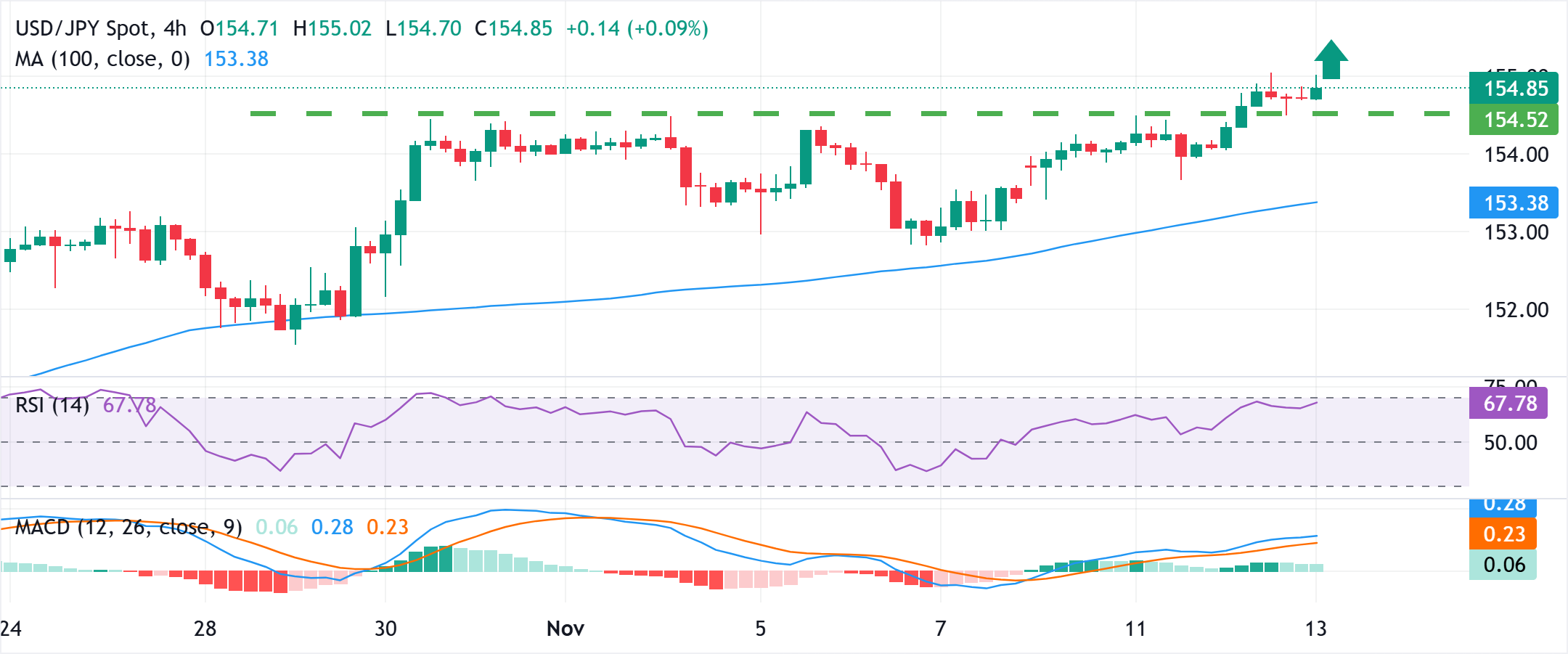
From a technical perspective, Wednesday's breakout through the 154.45-154.50 supply zone was seen as a fresh trigger for the USD/JPY bulls. Moreover, oscillators on the daily chart are holding in positive territory and back the case for additional gains. A sustained strength beyond the 155.00 psychological mark will reaffirm the constructive outlook and lift spot prices towards the 155.60-155.65 intermediate hurdle en route to the 156.00 round figure.
On the flip side, any corrective pullback below the 154.50-154.45 resistance breakpoint could be seen as a buying opportunity near the 154.00 mark. A convincing break below the said handle, however, might prompt some technical selling and drag the USD/JPY pair to the 153.60-153.50 intermediate support. Spot prices could decline further towards the 153.00 round figure, which, if broken, should pave the way for a further weakness towards the 152.15-152.10 region.
Japanese Yen FAQs
The Japanese Yen (JPY) is one of the world’s most traded currencies. Its value is broadly determined by the performance of the Japanese economy, but more specifically by the Bank of Japan’s policy, the differential between Japanese and US bond yields, or risk sentiment among traders, among other factors.
One of the Bank of Japan’s mandates is currency control, so its moves are key for the Yen. The BoJ has directly intervened in currency markets sometimes, generally to lower the value of the Yen, although it refrains from doing it often due to political concerns of its main trading partners. The BoJ ultra-loose monetary policy between 2013 and 2024 caused the Yen to depreciate against its main currency peers due to an increasing policy divergence between the Bank of Japan and other main central banks. More recently, the gradually unwinding of this ultra-loose policy has given some support to the Yen.
Over the last decade, the BoJ’s stance of sticking to ultra-loose monetary policy has led to a widening policy divergence with other central banks, particularly with the US Federal Reserve. This supported a widening of the differential between the 10-year US and Japanese bonds, which favored the US Dollar against the Japanese Yen. The BoJ decision in 2024 to gradually abandon the ultra-loose policy, coupled with interest-rate cuts in other major central banks, is narrowing this differential.
The Japanese Yen is often seen as a safe-haven investment. This means that in times of market stress, investors are more likely to put their money in the Japanese currency due to its supposed reliability and stability. Turbulent times are likely to strengthen the Yen’s value against other currencies seen as more risky to invest in.
Recommended Articles


