

NZD/USD (NZDUSD) Drops on Sep 29: What Are the Key Reasons?

Source Tradingkey

NZD/USD (NZDUSD) is down 0.50% at Sep 29 11:00(ET), now at $0.56368, with a 7-day down of 1.55%.
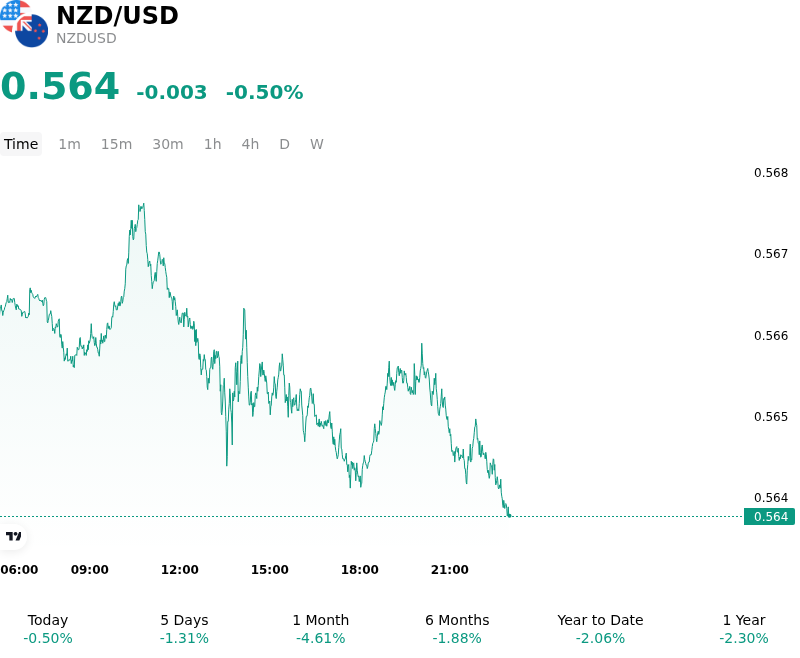
SummaryOverview

What is driving NZD/USD (NZDUSD)’s stock price down today?

The decline in the New Zealand dollar against the US dollar was primarily driven by safe-haven capital flows into the greenback alongside a widening US yield advantage, which outweighed domestic monetary policy expectations in New Zealand. Geopolitical friction in the Middle East and ongoing concerns regarding potential trade disruptions around the Strait of Hormuz dampened global risk appetite. This environment boosted international demand for liquid, safe-haven assets, prompting institutional investors to rotate away from growth-sensitive, pro-cyclical currencies like the Kiwi and into the US dollar.

Relative interest-rate dynamics and short-end bond yield differentials continued to provide structural support to the US dollar. US Treasury yields remained firm at the front end of the curve as market participants adjusted to persistent inflation risks and a relatively restrictive Federal Reserve stance. The resulting yield differential between short-term US and New Zealand debt maintained a significant spread in favor of the US dollar. Although market expectations for Reserve Bank of New Zealand policy have remained firm due to domestic inflation risks tied to elevated energy prices, the prevailing interest-rate advantage offered by US fixed-income assets continued to attract yield-seeking capital flows at the expense of New Zealand assets.

Broader macro risk sentiment and technical trading flows further reinforced the downward pressure on the exchange rate. As a high-beta commodity currency, the New Zealand dollar remains particularly vulnerable to shifts in global growth expectations and broader market risk aversion. The failure to sustain corrective bounces led to systematic selling and technical trend-following flows, accelerating the pair's lower trajectory. Looking ahead, institutional investors will closely monitor developments in energy markets, geopolitical risk headlines, and upcoming macroeconomic releases in both economies to assess whether interest-rate differentials and risk appetite will offer a catalyst for stabilization.

Technical Analysis of NZD/USD (NZDUSD)

Technically, NZD/USD (NZDUSD) shows a MACD (12,26,9) value of -0.002, indicating a sell signal. The RSI at 25.727 suggests sell condition and the Williams %R at 99.680 suggests oversold condition. Please monitor closely.
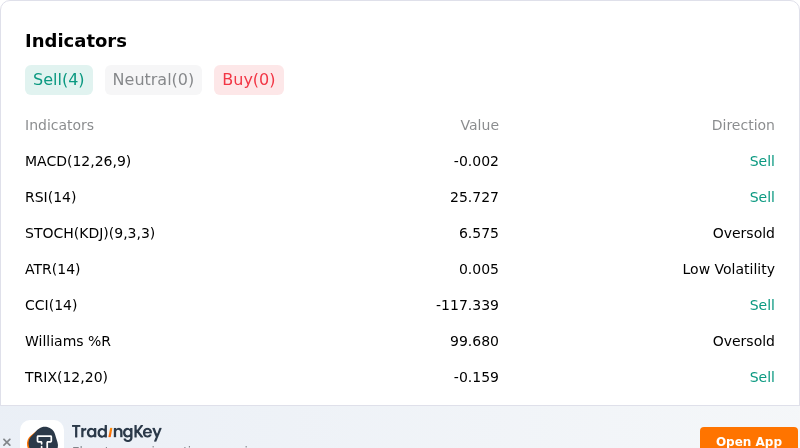
IndicatorAnalysis

More details about NZD/USD (NZDUSD)

Recent Events and Risks:

  • Dovish Central Bank Rate Path Differential: Although the Reserve Bank of New Zealand recently adjusted the Official Cash Rate to 2.75%, its dovish forward guidance signaling a cautious tightening path contrasts with a hawkish Federal Reserve stance and elevated US Treasury yields, eroding yield support for the Kiwi dollar.
  • Geopolitical Safe-Haven Demand for USD: Escalating Middle East geopolitical conflicts and US-Iran hostilities continue to depress global risk sentiment, encouraging capital rotation out of high-beta commodity currencies like the New Zealand dollar and into safe-haven US dollar assets.
  • Energy Price Shock and Domestic Economic Pressure: Spiking global crude oil prices driven by Middle East trade disruptions are imposing severe imported inflation on New Zealand as a net oil importer, suppressing domestic consumer spending and compounding downside risks for the currency.
  • Technical Breakdown and Downside Trend Acceleration: Persistent trading below key technical moving averages (including the 50-period and 100-hour SMAs) has reinforced intraday downside momentum in NZDUSD, exposing the pair to deeper sell-offs toward support levels near 0.5610.
Disclaimer: For information purposes only. Past performance is not indicative of future results.
placeholder
October hike odds climb toward 60% as Goldman and BofA both flip — what Warsh's "dose of accommodation" really changedRate futures now price roughly 55% to 62% for a 25bp hike at the October 27-28 FOMC, up from about 30% before Chair Warsh's post-meeting framing that the Fed is merely "removing some accommodation." Goldman Sachs has added an October hike to its forecast and Bank of America now sees moves in both October and December. Here is the repricing, the language behind it, and the two data points that decide it.
Author  Irene Q.
Sep 23, Wed
Rate futures now price roughly 55% to 62% for a 25bp hike at the October 27-28 FOMC, up from about 30% before Chair Warsh's post-meeting framing that the Fed is merely "removing some accommodation." Goldman Sachs has added an October hike to its forecast and Bank of America now sees moves in both October and December. Here is the repricing, the language behind it, and the two data points that decide it.
placeholder
Four jobs reports in five days: what JOLTS, ADP, claims and the September payrolls mean for the October Fed decisionThe US labour market faces its densest data week of the month. JOLTS job openings land Tuesday (7.2 million expected), ADP on Wednesday (70,000 expected), initial claims on Thursday and the September non-farm payrolls on Friday (100,000 expected, down from 162,000). Markets price a 64%-70% chance of another quarter-point Fed hike on October 28. The dollar index sits at 100.77 and the S&P 500 at 7,729.8.
Author  Mitrade
Sep 28, Mon
The US labour market faces its densest data week of the month. JOLTS job openings land Tuesday (7.2 million expected), ADP on Wednesday (70,000 expected), initial claims on Thursday and the September non-farm payrolls on Friday (100,000 expected, down from 162,000). Markets price a 64%-70% chance of another quarter-point Fed hike on October 28. The dollar index sits at 100.77 and the S&P 500 at 7,729.8.
placeholder
Nvidia's $150 billion buyback landed — and the AI sector fell anyway. That's the signal worth tradingNvidia closed up 1.68% at $228.86 on 28 September after announcing a $150 billion share repurchase authorisation, the largest single corporate buyback on record, while the rest of the AI complex sold off: AMD -3.6%, Micron -2.6%, Meta -4.8% and the Philadelphia Semiconductor Index -1.61%. The divergence is not noise. Capital is rotating toward cash-flow certainty, not abandoning the AI theme. With Micron reporting after the close on 30 September, here is what the split means.
Author  Irene Q.
Sep 29, Tue
Nvidia closed up 1.68% at $228.86 on 28 September after announcing a $150 billion share repurchase authorisation, the largest single corporate buyback on record, while the rest of the AI complex sold off: AMD -3.6%, Micron -2.6%, Meta -4.8% and the Philadelphia Semiconductor Index -1.61%. The divergence is not noise. Capital is rotating toward cash-flow certainty, not abandoning the AI theme. With Micron reporting after the close on 30 September, here is what the split means.
placeholder
【Daily Brief】The dollar ground higher for six days — and the AUD fell 2% in the very week the RBA hiked to a 15-year highThe dollar index held above 101 while the Australian dollar slid to a two-month low of 0.6976, a 2.02% six-session loss, even though the RBA raised rates to 4.60% and Australian CPI printed 4.0%. The yen is the only major currency gaining, ahead of Japan's monthly intervention tally at 7pm JST.
Author  Irene Q.
19 hours ago
The dollar index held above 101 while the Australian dollar slid to a two-month low of 0.6976, a 2.02% six-session loss, even though the RBA raised rates to 4.60% and Australian CPI printed 4.0%. The yen is the only major currency gaining, ahead of Japan's monthly intervention tally at 7pm JST.
placeholder
【Daily Brief】30-year Treasury tops 5.59%, S&P 500 slips to 7,670 and gold holds $4,180 — PCE lands tonightThe 30-year Treasury yield closed at 5.59%, its highest since June 2002, and the Dow fell 131.59 points to 51,349.92. US consumer confidence dropped to 81.9, a 12-year low, and JOLTS job openings fell to 7.1 million. August PCE and Q3 GDP both land at 8:30am ET tonight.
Author  Suzie
18 hours ago
The 30-year Treasury yield closed at 5.59%, its highest since June 2002, and the Dow fell 131.59 points to 51,349.92. US consumer confidence dropped to 81.9, a 12-year low, and JOLTS job openings fell to 7.1 million. August PCE and Q3 GDP both land at 8:30am ET tonight.
goTop
quote