

US Cocoa Futures (COCOA-F) Is up 2.18% on Sep 21: Why It Happened

Source Tradingkey

US Cocoa Futures (COCOA-F) is up 2.18% at Sep 21 05:50(ET), now at $5440.5, with a 7-day down of 9.62%.
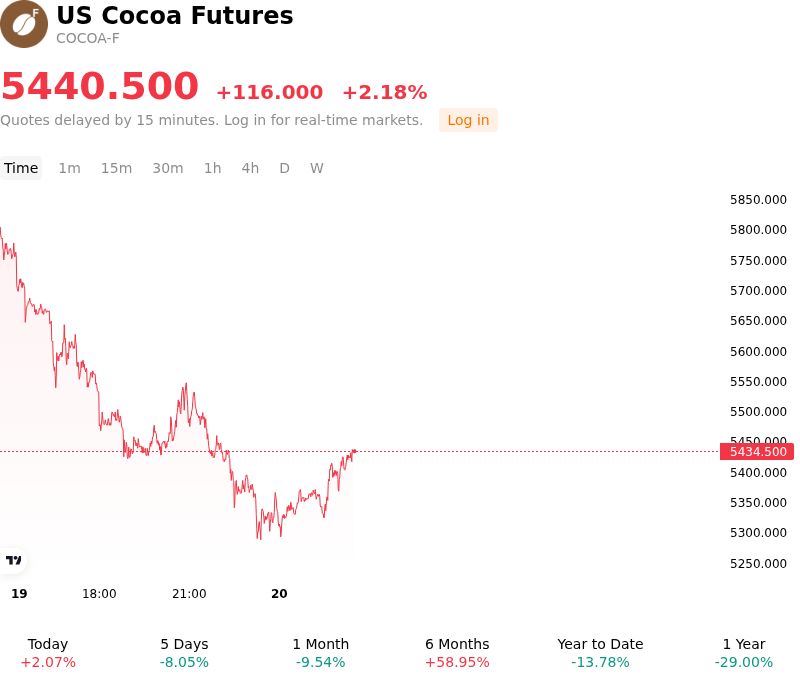
SummaryOverview

What is driving US Cocoa Futures (COCOA-F)’s stock price up today?

Renewed gains in cocoa futures were primarily propelled by escalating supply-side risks across West Africa and heightened concern over upcoming main-crop deliveries. Tensions in Côte d'Ivoire, the world's leading producer, intensified as producer unions issued strike threats and warned of collection disruptions targeting key export ports in Abidjan and San Pedro. At the same time, persistent weather irregularities across Côte d'Ivoire and Ghana, characterized by excessive rainfall and prolonged lack of sunshine, have heightened the incidence of black pod disease and damaged early pod development. These logistical and crop-health challenges triggered immediate buying interest as market participants reassessed physical supply availability ahead of the main harvest starting in October.

The advance also reflects a broader repricing of the 2026/27 global cocoa balance sheet. Analytical firms and trade houses have progressively trimmed their global supply surplus projections for the upcoming crop year, citing lingering yield degradation from aging cocoa trees, high fertilizer costs, and disease pressure. Although exchange-monitored warehouse inventories have provided a short-term buffer, the narrowing surplus outlook leaves global supply chains vulnerable to further harvest downgrades. Consequently, buyers and institutional hedgers have begun rebuilding long-dated risk premiums to guard against potential supply shortfalls in West Africa.

Technical mechanics and capital flows further amplified the upward momentum. Following the recent expiration of nearby September futures and the subsequent roll of open interest into December contracts, speculative accounts engaged in aggressive short covering as prices broke above key technical resistance levels. A softer US dollar provided additional support across soft commodities, while steadying grinding margins in key processing hubs bolstered baseline demand expectations, sustaining firm buying pressure throughout the trading session.

Technical Analysis of US Cocoa Futures (COCOA-F)

Technically, US Cocoa Futures (COCOA-F) shows a MACD (12,26,9) value of -215.794, indicating a neutral signal. The RSI at 39.310 suggests neutral condition and the Williams %R at 90.930 suggests oversold condition. Please monitor closely.
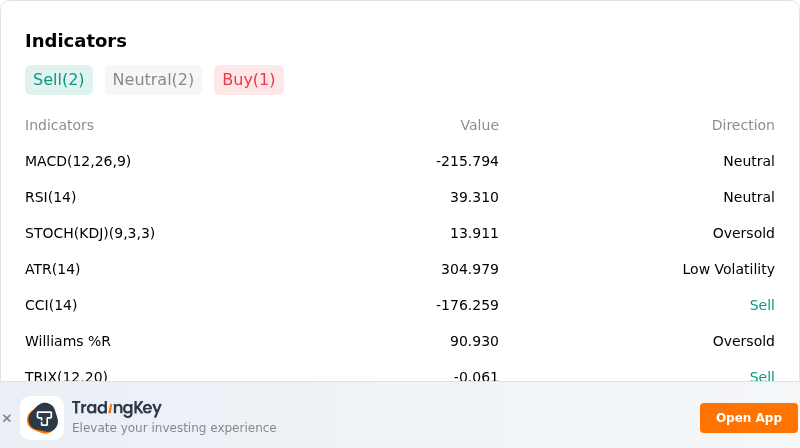
IndicatorAnalysis

More details about US Cocoa Futures (COCOA-F)

Recent Events and Risks:

  • Surging Port Deliveries and West African Supply Glut: Recent port arrival data from Ivory Coast showed cumulative shipments expanding 18% year-over-year to 2.14 million metric tons, while full-year harvest output rose 30% to 2.06 million metric tons, creating heavy downside pressure on futures as physical beans flood export channels.
  • Multi-Year High ICE Certified Inventory Overhang: Exchange-monitored ICE cocoa inventories climbed to a two-year high of over 3.42 million bags, signaling that physical bean delivery is outstripping downstream processor demand and leaving futures vulnerable to prompt-month liquidation.
  • Persistent Downstream Demand Destruction and Product Reformulation: Global grindings data underscores ongoing structural demand weakness, with European Q2 processing down 4.6% and major confectionery manufacturers actively pivoting toward product reformulation and alternative technologies to permanently lower cocoa bean intensity.
  • Elevated Margin Costs and Liquidity-Driven Volatility Risk: High realized volatility, elevated exchange margin requirements, and wide bid-ask spreads have eroded market liquidity, exposing cocoa futures to sharp algorithmic unwind cascades and violent intraday downside moves.
Disclaimer: For information purposes only. Past performance is not indicative of future results.
placeholder
Bitcoin falls below $75,000 as the CLARITY Act fails in the Senate — what the vote means for cryptoThe US Senate blocked the Digital Asset Market CLARITY Act in a 49-50 procedural vote, sending Bitcoin briefly below $75,000 — its biggest one-day drop since June. Ethereum fell more than 8%, Coinbase slid 10% and $75 billion of crypto market value evaporated. Here is what the vote was, why it failed, and the levels that matter now.
Author  Suzie
Sep 16, Wed
The US Senate blocked the Digital Asset Market CLARITY Act in a 49-50 procedural vote, sending Bitcoin briefly below $75,000 — its biggest one-day drop since June. Ethereum fell more than 8%, Coinbase slid 10% and $75 billion of crypto market value evaporated. Here is what the vote was, why it failed, and the levels that matter now.
placeholder
Dollar index tops 100 for the first time since July as the Fed's hawkish dot plot sinks inThe U.S. dollar index broke back above 100 for the first time since 31 July after the Fed delivered its first rate hike since 2023, with the dot plot showing 16 of 18 officials expect at least one more increase this year. Here are the levels that matter for DXY, the currencies feeling it most, and what to watch next.
Author  Irene Q.
Sep 17, Thu
The U.S. dollar index broke back above 100 for the first time since 31 July after the Fed delivered its first rate hike since 2023, with the dot plot showing 16 of 18 officials expect at least one more increase this year. Here are the levels that matter for DXY, the currencies feeling it most, and what to watch next.
placeholder
Gold ends three-week slide at the $4,400 line — eight straight days of ETF inflows vs a 5% 10-year and a 100 dollarSpot gold closed Friday at $4,378.39, up 0.84% on the day and about 0.8% for the week — its first weekly gain in four weeks — with the intraday high of $4,399.67 leaving it 33 cents shy of the $4,400 line. Gold ETFs have now logged eight straight sessions of inflows, but with the 10-year back above 5% and the dollar index near 100, here is what decides whether this is a reversal or a bounce.
Author  Suzie
Yesterday 05: 53
Spot gold closed Friday at $4,378.39, up 0.84% on the day and about 0.8% for the week — its first weekly gain in four weeks — with the intraday high of $4,399.67 leaving it 33 cents shy of the $4,400 line. Gold ETFs have now logged eight straight sessions of inflows, but with the 10-year back above 5% and the dollar index near 100, here is what decides whether this is a reversal or a bounce.
placeholder
Bitcoin squeezes back above $80,000 — 110,000 traders liquidated as the hawkish Fed and CLARITY setback fail to hold it down; is $83,000 next?Bitcoin closed above $80,000 on Friday for the first time since September 7, and pushed to $81,299 over the weekend, triggering about $603 million of liquidations — $523 million of them shorts — across more than 110,000 traders. With the Fed's hike already priced and the SEC and CFTC advancing crypto rules after the CLARITY Act failed, here is what stands between BTC and the $83,000 gate.
Author  Suzie
Yesterday 06: 19
Bitcoin closed above $80,000 on Friday for the first time since September 7, and pushed to $81,299 over the weekend, triggering about $603 million of liquidations — $523 million of them shorts — across more than 110,000 traders. With the Fed's hike already priced and the SEC and CFTC advancing crypto rules after the CLARITY Act failed, here is what stands between BTC and the $83,000 gate.
placeholder
Brent slides below $102 after Houthis' first strike on Riyadh — why oil can't hold $100Houthi forces struck Riyadh for the first time on September 19 and hit Yanbu facilities — yet Brent opened at $104.71, peaked at $104.90 and settled at $101.68 (-1.63% on the day). Here is the four-way data tug-of-war between strike escalation and supply recovery, and the two switches that decide where oil goes next.
Author  Irene Q.
11 hours ago
Houthi forces struck Riyadh for the first time on September 19 and hit Yanbu facilities — yet Brent opened at $104.71, peaked at $104.90 and settled at $101.68 (-1.63% on the day). Here is the four-way data tug-of-war between strike escalation and supply recovery, and the two switches that decide where oil goes next.
goTop
quote