


Brent slides below $102 after Houthis' first strike on Riyadh — why oil can't hold $100


The weekend brought the sharpest geopolitical escalation in weeks: on Saturday, September 19, Houthi forces struck Saudi Arabia's capital Riyadh for the first time, firing a ballistic missile that Saudi air defences say they intercepted, and separately targeted Aramco facilities at Yanbu on the Red Sea. Oil's reaction was the opposite of what the headlines suggested. Brent CFD (TVC:UKOIL) opened at $104.71, peaked at $104.90 — and then slid all the way to a $101.21 low, settling at $101.68, down 1.63% on the day. WTI traded back below the $100 handle. The question every oil trader is asking: if a strike on a capital can't lift crude, what is this market actually trading?
The move: a gap higher that never held
Monday's session told the story in a single daily candle:
| Brent CFD (TVC:UKOIL) — Sept 21 session | Level |
|---|---|
| Open | $104.71 |
| Session high | $104.90 |
| Session low | $101.21 |
| Latest (snapshot) | $101.68 (-1.63%) |
The failed rally extends a pattern: the strike followed three straight down sessions for crude, and Monday's early pop was sold into almost immediately. Meanwhile the broader tape stayed constructive — S&P 500 futures traded around +1% — which tells you equity markets read the strike as a headline risk rather than a supply event.
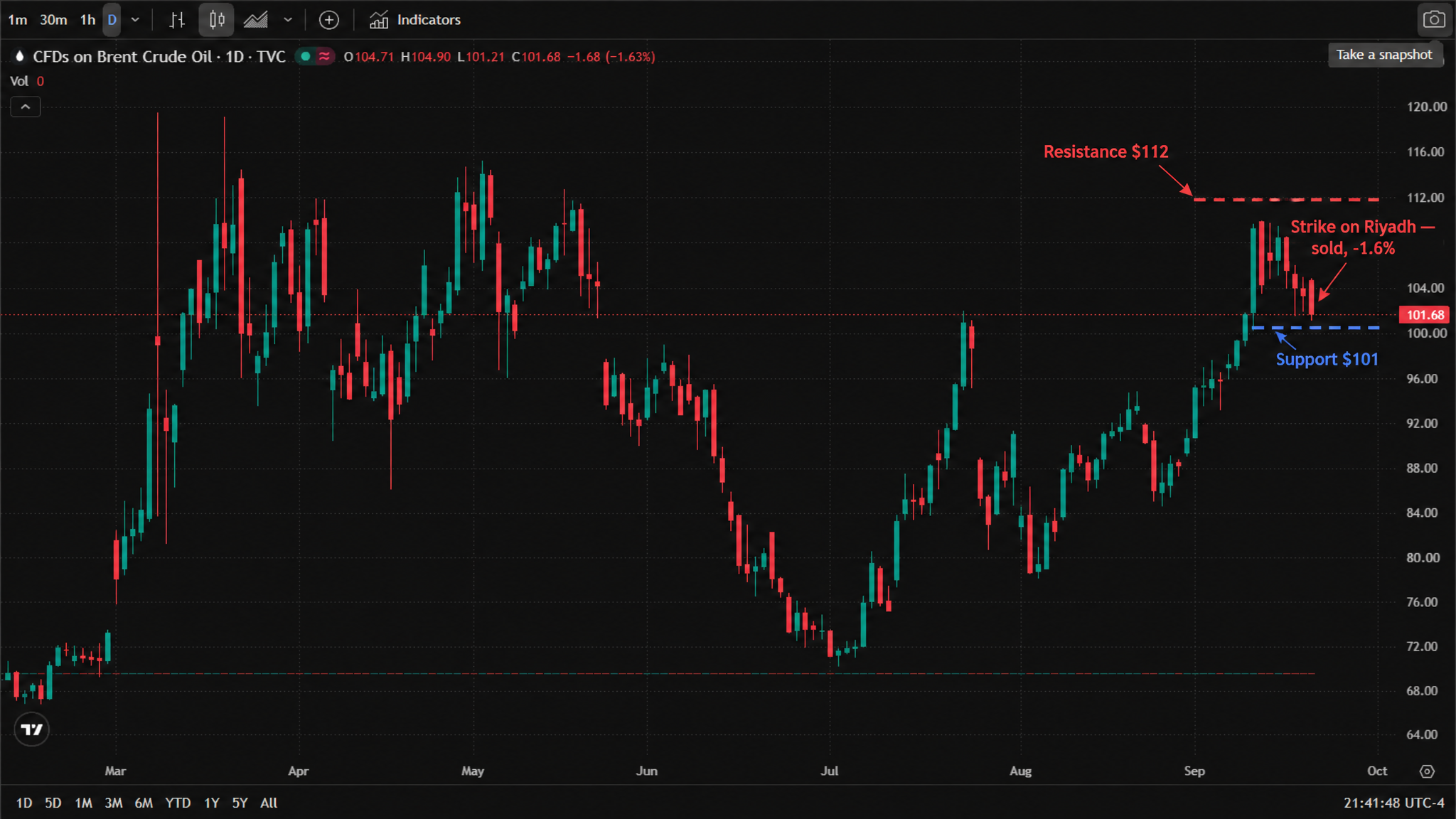
* Chart source: official TradingView chart screenshot (TVC:UKOIL).
Why: a four-way data tug-of-war
The bull case (supply risk):
The escalation is real: the first strike on the Saudi capital since the Iran war began, alongside attacks on Yanbu — the kingdom's key Red Sea export hub;
Aramco has told European refiners their October term allocations are zero, the pipeline-hit follow-through that leaves refiners scrambling for alternatives;
North Sea physical premiums have hit record levels, a signal of genuine near-term tightness in European crude.
The bear case (supply recovery):
Saudi exports have recovered to above 4 million barrels per day in September, up sharply from 2.4 million bpd in August — the lowest in more than a decade;
Oil and LNG flows through the Strait of Hormuz are at a six-month high;
Both Washington and Tehran have signalled readiness to talk, draining the war-risk premium that spiked earlier in the month.
What the market is watching
The tape is effectively voting that logistics beat headlines — but two switches can flip that vote:
Repair and export pace — how quickly the damaged East-West pipeline complex returns, and whether European refiners find replacement barrels;
Escalation ceiling — whether attacks move from "intercepted" strikes toward production facilities or shipping lanes in a way that produces actual lost barrels.
The physical data explains why the market is relaxed for now. Middle East oil flows have averaged 17.1 million barrels per day over the past ten days, only about 6.1 million bpd below the 2025 average, and Saudi flows through Hormuz have climbed back to roughly 2.9 million bpd from around 700,000 bpd in August, according to JPMorgan. Satellite tracking shows Aramco loading at least seven supertankers — some 14 million barrels — simultaneously. Those barrels are the reason a strike on Riyadh is being traded as noise rather than supply.
Until the picture changes, expect a wide, headline-driven range rather than a clean trend. The rollover of NYMEX October crude futures on Wednesday may add mechanical volatility around the middle of the week.
Levels and scenarios
Scenario A — supply keeps recovering. Brent holds below the failed $104.90 high and retests the $101.21 session low; a break opens a move toward the low-$100s zone.
Scenario B — escalation returns. A strike that produces real outages puts the $104.90–$108 band back in play, with the mid-September ~$112 spike high as the upside reference.
Related reads: for the pipeline-attack chapter that set up this price action, see Brent tests $108 as a key export pipeline stays shut; for how cooling oil prices feed into the inflation and gold trade, see Gold ends its three-week slide at the $4,400 line.
Read more
Before making any trading decisions, it is important to equip yourself with sufficient fundamental knowledge, have a comprehensive understanding of market trends, be aware of risks and hidden costs, carefully consider investment targets, level of experience, risk appetite, and seek professional advice if necessary.
Furthermore, the content of this article is solely the author's personal opinion and does not necessarily constitute investment advice. The content of this article is for reference purposes only, and readers should not use this article as a basis for any investment decisions.
Investors should not rely on this information as a substitute for independent judgment or make decisions solely based on this information. It does not constitute any trading activity and does not guarantee any profits in trading.
If you have any inquiries regarding the data, information, or content related to Mitrade in this article, please contact us via email: insights@mitrade.com. The Mitrade team will carefully review the content to continue improving the quality of the article.


