


Meet the Quantum Computing Stock Growing Faster Than Nvidia
Key Points
Nvidia's chips remain in high demand as hyperscalers accelerate their artificial intelligence infrastructure build-outs.
While IonQ is growing faster now, it is highly unprofitable and trades at an unsustainable valuation.
- 10 stocks we like better than IonQ ›
Artificial intelligence (AI) and quantum computing are two complementary waves. Classical AI is in need of more compute, better models, and cheaper tokens. The companies developing quantum computing systems are betting that their ability to handle specific types of extremely complex problems will eventually allow them to provide answers to questions in chemistry, drug development, materials science, logistics, financial services, and more that are beyond the reach of even the biggest GPU clusters.
This is why growth investors may be tempted to view Nvidia (NASDAQ: NVDA), the world's dominant graphics processing unit (GPU) designer, and IonQ (NYSE: IONQ), a quantum computing pure play, through the same tech sector investing lens.
Missed AI’s "Act 1"? Act 2 Could Be 15x Bigger. Most investors think they missed the AI boat because they didn't buy Nvidia in 2005. But according to our analysts, we’re only at the end of "Act 1"—the R&D phase. "Act 2" is the global rollout. Continue »
Below, I'll break down why Nvidia is the business you actually want to own for the long term despite IonQ's eye-watering growth.

Image source: Getty Images.
IonQ's full quantum stack vs. Nvidia's AI factories
IonQ sells access to its trapped-ion quantum computers, as well as a broader range of networking, security, and sensing applications. Customers can reach IonQ's machines through Amazon Braket, Microsoft Azure Quantum, and Google Cloud. The company has spent the last year building a vertically integrated stack, most recently layering on manufacturing and packaging expertise through its acquisition of foundry specialist, SkyWater Technology.
IonQ's top line looks explosive upon first glance. During the second quarter, revenue reached $80 million -- up 287% year over year. Organic guidance implies a doubling of the core business this year, but when you layer in the combined outlook after the SkyWater deal, IonQ's revenue is expected to jump to between $450 million and $460 million. The high end of this range would amount to 254% growth year over year. That's the kind of number that lights up finance homepages.
Nvidia is growing from a completely different dimension compared to IonQ. During Q2, the company generated $96.2 billion in revenue, up 106% year over year. The data center segment did most of the heavy lifting, growing 117% to $89 billion.
The fact that the data center segment is still growing faster than the rest of the business quietly signals how Nvidia is transitioning from a GPU shop to a more comprehensive business. During the earnings call, CEO Jensen Huang spent quite a bit of time explaining how Nvidia is complementing its core GPU business with Grace and Vera CPUs, Spectrum-X Ethernet, BlueField DPUs, NVLink fabrics, and a software layer (CUDA) that stitches all of these products together in one unified rack.
While most of Nvidia's business still stems from the data center build-out, the company is deliberately widening its product map. This makes the contrast simple: IonQ is building an expensive stack while its market is still tiny; by contrast, Nvidia is quietly becoming the go-to architect for hyperscale AI factories.
IonQ is a mess below the top line
If you look further down the income statement, comparing IonQ to Nvidia stops being cute. In Q2, IonQ booked an operating loss of $337 million while bringing in just $80 million in sales. Meanwhile, its adjusted earnings before interest, taxes, depreciation, and amortization (EBITDA) were $120 million in the red. The company has covered its liquidity needs and financed acquisitions by issuing more stock. Growth that is paid for with dilution is a far cry from growth that funds itself.
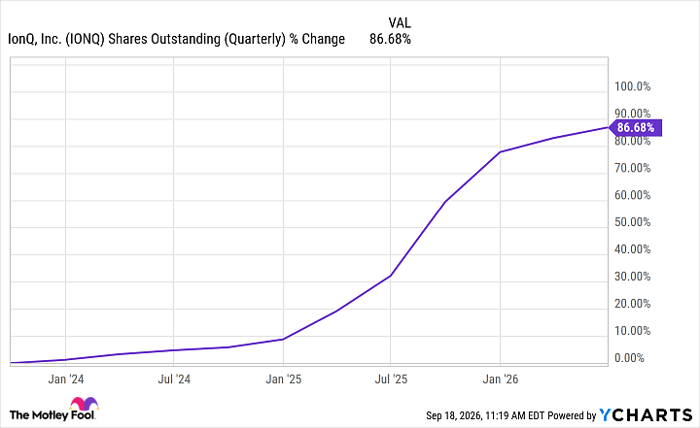
IONQ Shares Outstanding (Quarterly) data by YCharts.
Nvidia lives on the other side of this ledger. In Q2, its gross margin sat at 75%, and its operating income was $64 billion. Free cash flow still grew by 61% to $21 billion, even in a quarter when its working capital swelled alongside infrastructure build-outs. This is as clear an example of pricing power as it gets: Nvidia's juicy gross margins are dropping to the bottom line, and then leaving the building via shareholder-friendly stock buybacks and dividends, and investments in more capacity.
Valuation does the talking
With a market cap of around $15 billion, IonQ trades at a price-to-sales (P/S) ratio of 53. A multiple like that only works if you believe the company can scale up into a large, durable profit engine without going through another decade of shareholder dilution. The market can be tough on businesses that stay unprofitable and narrative-driven for too long.
By contrast, Nvidia is the largest company in the world, with a market cap of $5.3 trillion. Its trailing price-to-earnings (P/E) multiple is roughly 27, while its forward P/E hovers around 24. This compression is well below the levels Nvidia saw during earlier cycles of the AI revolution.
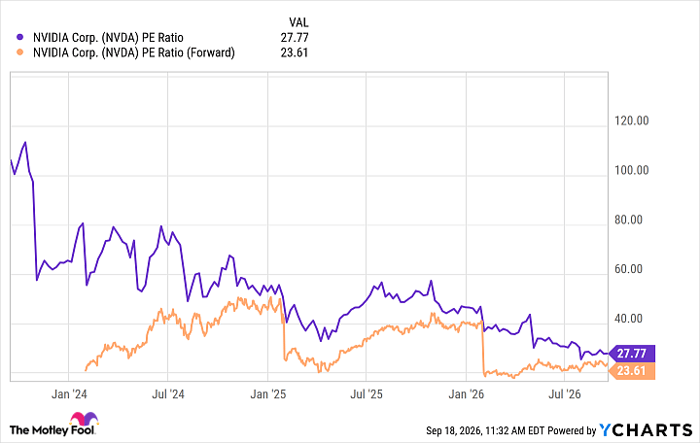
NVDA PE Ratio data by YCharts.
Nvidia's relative cheapness is a tell. Investors are still treating the company as a data center GPU play. However, it's swiftly becoming a full-spectrum vendor for AI factories: silicon, networking, CPUs, software, and the rack-level design that makes tokens per watt a monetizable product.
Remember, growth is relative. IonQ is sprinting higher off a tiny base of sales, so its growth looks more heroic than it really is. Nvidia is a $5.3 trillion empire with real cash flow that's still compounding its revenues at a triple-digit percentage this year and guiding for 70% growth next year. That is the machine at work, which ultimately makes Nvidia the no-brainer opportunity for investors right now.
Should you buy stock in IonQ right now?
Before you buy stock in IonQ, consider this:
The Motley Fool Stock Advisor analyst team just identified what they believe are the 10 best stocks for investors to buy now… and IonQ wasn’t one of them. The 10 stocks that made the cut could produce monster returns in the coming years.
Consider when Netflix made this list on December 17, 2004... if you invested $1,000 at the time of our recommendation, you’d have $387,158!* Or when Nvidia made this list on April 15, 2005... if you invested $1,000 at the time of our recommendation, you’d have $1,365,749!*
Now, it’s worth noting Stock Advisor’s total average return is 932% — a market-crushing outperformance compared to 211% for the S&P 500. Don't miss the latest top 10 list, available with Stock Advisor, and join an investing community built by individual investors for individual investors.
See the 10 stocks »
*Stock Advisor returns as of September 21, 2026.
Adam Spatacco has positions in Nvidia. The Motley Fool has positions in and recommends IonQ and Nvidia. The Motley Fool has a disclosure policy.
Recommended Articles


