


USD/JPY (USDJPY) Is up 0.56% on Sep 18: Why It Happened
USD/JPY (USDJPY) is up 0.56% at Sep 18 23:10(ET), now at $156.811, with a 7-day up of 2.13%.
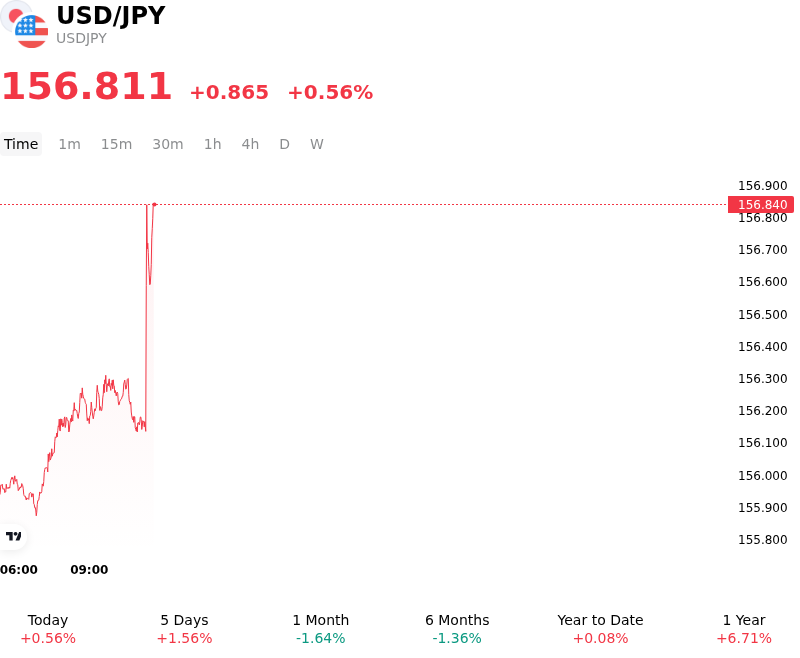
What is driving USD/JPY (USDJPY)’s stock price up today?
The upward momentum in USD/JPY was primarily fueled by cooler-than-expected Japanese inflation data alongside lingering policy rate divergence between the Federal Reserve and the Bank of Japan. Japan’s latest consumer price figures revealed an unexpected easing in underlying core inflation, falling below the central bank's two percent target. The softer reading dampened market expectations for an aggressive series of follow-through rate hikes from the Bank of Japan following its policy deliberations, prompting traders to pare back hawkish bets on the yen and unwind recent long positioning.
Compounding the yen's weakness was the lingering support for the greenback generated by the Federal Reserve's hawkish policy stance. The Fed's reinforced commitment to combating inflation, backed by upwardly revised interest rate projections, pushed U.S. Treasury yields higher and re-anchored the U.S. dollar's yield advantage. Because the front-end yield differential between the U.S. and Japan remains wide in favor of the dollar, capital flows favored the U.S. currency as market participants re-entered carry-oriented positions.
From a strategic perspective, the advance in USD/JPY appears supported by fundamental macroeconomic divergence rather than a purely speculative intraday move. Unless Japanese domestic price pressures reaccelerate sufficiently to force a steeper rate-hike path from the Bank of Japan, the pair’s broader trajectory will remain heavily dictated by U.S. rate expectations and global yield spreads. Market participants will continue to monitor post-meeting central bank communications, global risk appetite, and Japanese policy rhetoric around key resistance levels to determine the sustainability of the current rally.
Technical Analysis of USD/JPY (USDJPY)
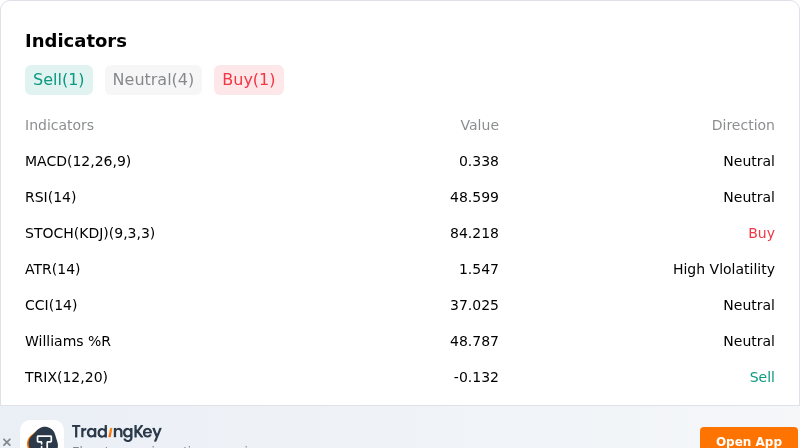
Technically, USD/JPY (USDJPY) shows a MACD (12,26,9) value of 0.326, indicating a neutral signal. The RSI at 48.125 suggests neutral condition and the Williams %R at 50.040 suggests neutral condition. Please monitor closely.
More details about USD/JPY (USDJPY)
Recent Events and Risks:
- Bank of Japan Hawkish Policy Guidance: With the Bank of Japan entering its monetary policy decision, any unexpected hawkish forward guidance or signals of accelerated rate hikes from Governor Kazuo Ueda could trigger a rapid unwind of short-yen carry trades, driving sharp downside volatility in USD/JPY.
- Japanese FX Intervention Threat near Resistance: As USD/JPY trades near the critical 156.00–156.50 resistance zone, heightened scrutiny and potential verbal warnings or direct market interventions by Japanese authorities present severe downside tail risk and liquidity shocks for long positions.
- US Yield Retrenchment and Post-FOMC Profit-Taking: Following the Federal Reserve's policy update, any sudden pullbacks in elevated US Treasury yields or profit-taking on recent dollar gains leave USD/JPY vulnerable to swift downside pullbacks toward key support levels near 154.50–155.00.
- Safe-Haven Inflows on Global Risk-Off Sentiment: Ongoing volatility across energy markets and global fixed-income yields creates downside risk for USD/JPY, as sudden risk-off moves can quickly drive safe-haven demand back into the Japanese yen.
Recommended Articles


