


AMD's data center nearly doubled — the $554 million free-cash-flow line is the catch

Mitrade Insights — AMD's third quarter was the cleanest proof yet that the AI buildout has a second supplier. Revenue rose 45% to $13.38 billion, data-center revenue jumped 97% to a record $8.5 billion, and non-GAAP EPS climbed 74% to $2.09. Management guided the fourth quarter to about $17 billion, well above the $16.2 billion consensus. The stock rose 3.65% to $483.90 in regular trading, traded as high as $519 after hours, and settled near $505 overnight. Then the cash-flow line landed: free cash flow was $554 million, versus roughly $1.97 billion expected. The market is buying the growth. It has not yet priced the bill.
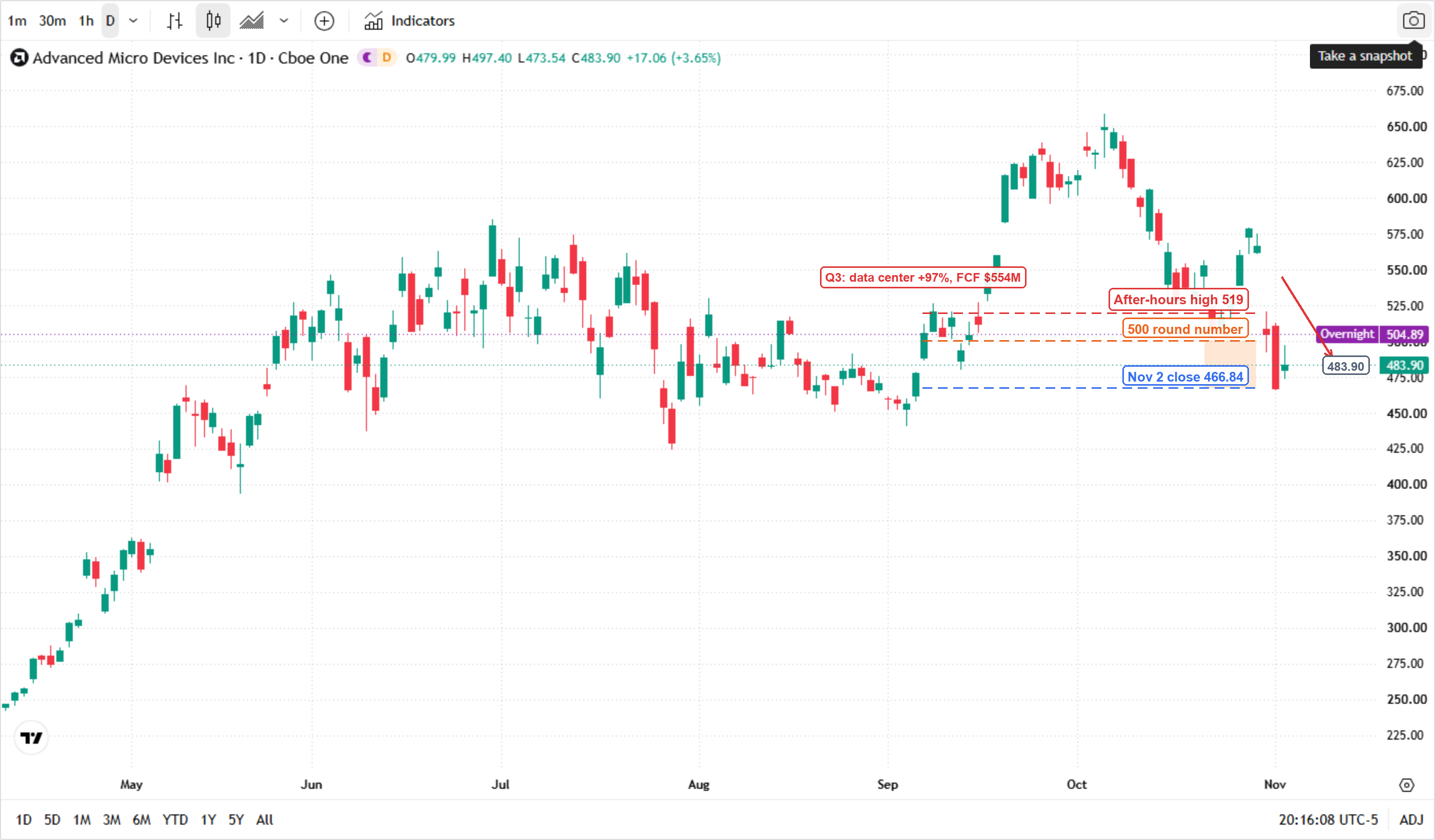
* Chart source: TradingView (NASDAQ:AMD daily), 2026-11-04.
The chart frames the trade: AMD closed at 483.90, just below the 500 round number, after touching 519 after hours and settling near 505 overnight. The first support is 466.84, the November 2 close; the November 3 low was 473.54. A close back above 500 keeps the earnings gap alive; a break of 466.84 fills it.
$8.5 billion: the 97% number that changes AMD's mix
Data center is now 64% of AMD's revenue, up from 47% a year ago. The growth came from two products: sixth-generation EPYC server CPUs and the Instinct MI450 GPU series, with the Helios rack-scale system ramping and the "Venice" server CPU moving into production. This is no longer a cyclical PC story with an AI option attached. It is a data-center company with a PC business attached.
MI450 and Helios are the next leg
The mix shift explains the guidance. AMD expects fourth-quarter revenue of about $17 billion, plus or minus 3%, and management said data-center growth should accelerate, with the segment more than doubling for the full year and exceeding 80% of total revenue in 2027. Client revenue rose 7% to $2.9 billion; gaming fell 40% to $773 million; embedded rose 29% to $1.1 billion. Gross margin was 56%, and the fourth-quarter guide of about 55% was slightly below consensus.
| Q3 metric | Actual | Consensus | Read-through |
|---|---|---|---|
| Revenue | $13.38B | ~$13.09B | Beat |
| Data center | $8.5B | ~$8.2B | +97% YoY, 64% of revenue |
| EPS (non-GAAP) | $2.09 | ~$1.95 | +74% YoY |
| Gross margin | 56% | ~56% | In line |
| Q4 revenue guide | ~$17.0B | ~$16.2B | Beat |
| Free cash flow | $554M | ~$1.97B | The miss |
The table is the quarter in one glance: every demand line beat, and the cash line did not.
$554 million: the line the after-hours rally ignored
Free cash flow of $554 million is the number that separates this report from a clean victory lap. AMD's GAAP results included a $1.1 billion non-cash warrant-related charge, which explains the gap between GAAP and non-GAAP earnings but not the cash-flow miss. The more likely driver is working capital: inventory and receivables build when a company ramps a new GPU platform and a rack-scale system at the same time.
The $1.1 billion warrant charge is not the problem
The warrant charge is accounting. The cash-flow miss is operational. Apple's warning last week was about margin; AMD's is about cash conversion. It is the same AI bill, arriving on a different line of the income statement. That distinction matters because the bull case is not "AMD earned more than expected this quarter"; it is "AMD is becoming the second source for AI compute." If that is true, cash consumption ahead of revenue is a timing issue, not a demand issue. The bear case is that the AI buildout is becoming a working-capital business, and the market is paying a growth multiple for a cash-flow profile it has not seen yet.
The strongest evidence against the bear case is the guidance, not the quarter. A company that expected demand to fade would not guide the next quarter to $17 billion and tell investors data center will exceed 80% of revenue in 2027. The strongest evidence for the bear case is the gaming line: down 40% to $773 million, a reminder that AMD's non-AI businesses are shrinking while the AI business absorbs capital.
500 and 466.84: the two levels that decide the next leg
The market's reaction was a rotation trade, not a single-stock event. The Philadelphia Semiconductor Index rose 2.64% to 10,600.40; Nvidia added 2.29% to 206.69 and reclaimed the world's most valuable company title at about $4.98 trillion; Broadcom rose 3.1% and Micron 2.6%. The Nasdaq rose 0.8% to 25,372.01, while the Dow fell 0.4% as Apple dropped 1.9%. Money moved from consumer hardware into AI infrastructure.
SOX 10,600 is the rotation tell
That rotation is the context for AMD's next move. If the SOX holds 10,300 and AMD holds 500, the earnings gap remains in force and the next tests are 519 and 540. If AMD loses 466.84, the gap fills and 450 and 430 come into play. If the SOX fails 10,300 while the VIX pushes above 22, the rotation was a one-day squeeze, not a new leg.
What would prove this read wrong. The call here is "the beat is real, but the cash-flow miss caps the multiple near 500 until the next quarter." Three falsifiers: AMD closes above 519 for two sessions while free cash flow guidance improves; the SOX breaks 10,900 with breadth; or Nvidia's November 17 report shows data-center demand accelerating enough to lift the entire supply chain. Any one of those would make the 500 cap a pause, not a ceiling.
Read more
* The content presented above, whether from a third party or not, is considered as general advice only. This article should not be construed as containing investment advice, investment recommendations, an offer of or solicitation for any transactions in financial instruments.


