


Australian Dollar appreciates due to risk-on mood ahead of US Fed interest rate decision
- The Australian Dollar extends its upside due to improved risk sentiment ahead of the Fed decision.
- The Reserve Bank of Australia’s hawkish stance supports the Aussie Dollar.
- The US Dollar struggles due to rising odds of a 50 basis points Fed interest rate cut on Wednesday.
The Australian Dollar (AUD) extends its upside for the third successive day against the US Dollar (USD) on Wednesday. Investors await the Federal Reserve (Fed) interest rate decision later in the day, although rising expectations of a 50 basis points cut should support risk-sensitive currencies like AUD.
The AUD/USD pair may advance further as the Australian Dollar remains supported by the Reserve Bank of Australia's (RBA) hawkish stance. RBA Governor Michele Bullock stated that it is premature to consider rate cuts due to persistently high inflation. Additionally, RBA Assistant Governor Sarah Hunter noted that while the labor market remains tight, wage growth appears to have peaked and is expected to slow further.
The Federal Reserve is expected to lower interest rates at its September meeting, following a steady rate range of 5.25% to 5.5% since July 2023. The CME FedWatch Tool indicates that markets are assigning a 33.0% probability to a 25-basis-point rate cut, while the likelihood of a 50-basis-point cut has risen to 67.0%, up from 62.0% just the previous day.
Daily Digest Market Movers: Australian Dollar gains ground due to dovish Fed policy outlook
- JP Morgan CEO Jamie Dimon stated on Tuesday that whether the Federal Reserve cuts interest rates by 25 or 50 basis points, the impact will be “not earth-shattering.” Dimon emphasized, “They need to do it,” but noted that such moves are relatively minor in the grand scheme of things, as "there's a real economy" operating beneath the Fed’s rate changes, according to Bloomberg.
- US Retail Sales rose by 0.1% month-over-month in August, following a revised 1.1% increase in July, surpassing expectations of a 0.2% decline and indicating resilient consumer spending. Meanwhile, the Retail Sales Control Group increased by 0.3%, slightly below the previous month's 0.4% rise.
- ANZ-Roy Morgan Consumer Confidence climbed 1.8 points, reaching an eight-week high of 84.1. While ANZ notes that the rise was broad-based, confidence remains firmly in pessimistic territory.
- Economists at Goldman Sachs and Citi have reduced their 2024 GDP growth forecasts for China to 4.7%, falling short of Beijing's target of around 5.0%. SocGen describes the situation as a "downward spiral," while Barclays calls it "from bad to worse" and a "vicious cycle." Morgan Stanley also cautions that "things could get worse before they get better," according to a Reuters report.
- The University of Michigan’s Consumer Sentiment Index rose to 69.0 in September, exceeding the market expectations of 68.0 reading and marking a four-month high. This increase reflects a gradual improvement in consumers' outlook on the US economy after months of declining economic expectations.
- China's economy weakened in August, with a continued slowdown in industrial activity and declining real estate prices, as Beijing faces growing pressure to increase spending to boost demand. According to Business Standard, this was reported by the National Bureau of Statistics on Saturday.
- Australia’s Consumer Inflation Expectations eased to 4.4% in September, down slightly from August's four-month high of 4.5%. This decline highlights the central bank's efforts to balance bringing inflation down within a reasonable timeframe and maintaining gains in the labor market.
Technical Analysis: Australian Dollar remains above 0.6750; next barrier appears at seven-month highs
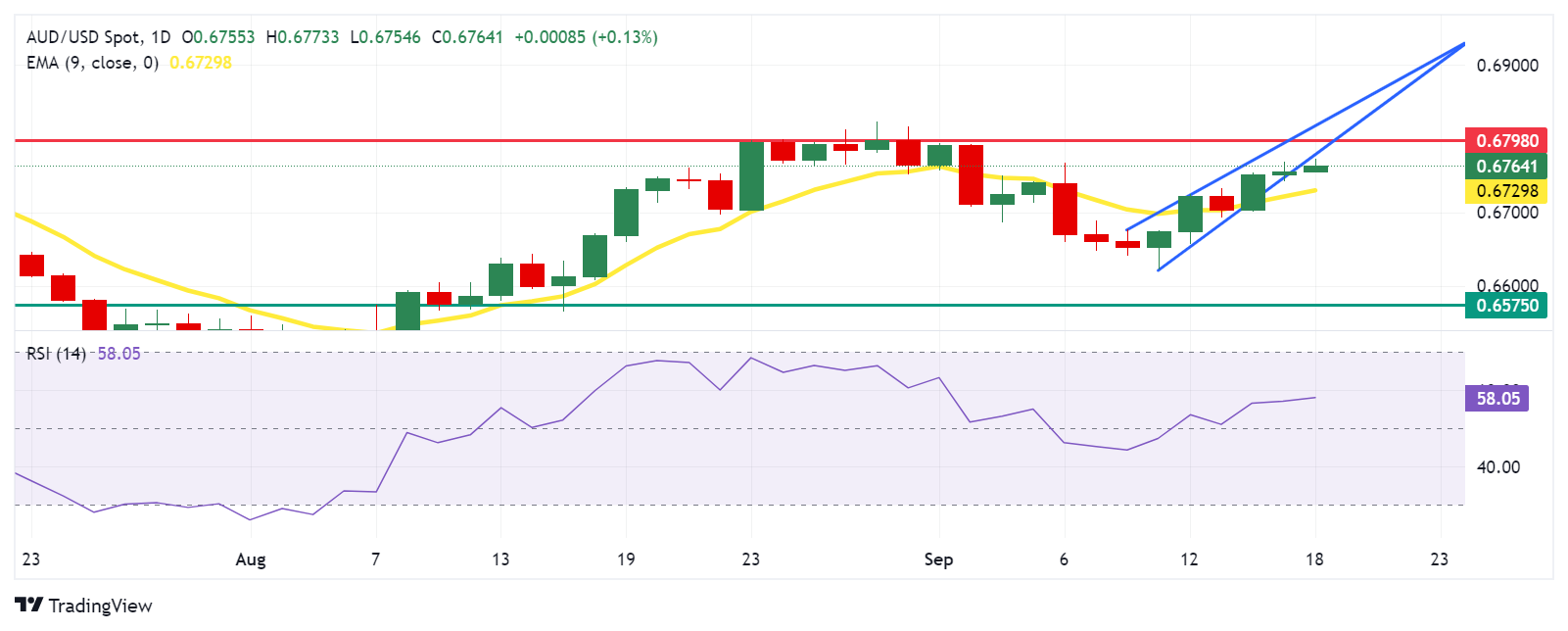
The AUD/USD pair trades near 0.6760 on Wednesday. Technical analysis of the daily chart indicates that the pair is positioned below the lower boundary of the rising wedge pattern, indicating a potential bearish reversal. However, the 14-day Relative Strength Index (RSI) remains above the 50 level, suggesting an ongoing bullish trend.
Regarding the upside, a return to the rising wedge would reinforce the bullish bias and push the AUD/USD pair to test a seven-month high of 0.6798, followed by the 0.6800 level. Further resistance appears at the upper boundary of the rising wedge at the 0.6820 level.
On the downside, the AUD/USD pair could find immediate support around the nine-day Exponential Moving Average (EMA) at the 0.6730 level, followed by the psychological level of 0.6700. A break below the latte could lead the pair to navigate the region around the throwback support zone near 0.6575.
AUD/USD: Daily Chart
Australian Dollar PRICE Today
The table below shows the percentage change of Australian Dollar (AUD) against listed major currencies today. Australian Dollar was the strongest against the US Dollar.
| USD | EUR | GBP | JPY | CAD | AUD | NZD | CHF | |
|---|---|---|---|---|---|---|---|---|
| USD | -0.12% | -0.05% | -0.58% | -0.06% | -0.16% | -0.32% | -0.23% | |
| EUR | 0.12% | 0.06% | -0.46% | 0.05% | -0.03% | -0.22% | -0.10% | |
| GBP | 0.05% | -0.06% | -0.50% | -0.02% | -0.09% | -0.28% | -0.15% | |
| JPY | 0.58% | 0.46% | 0.50% | 0.51% | 0.42% | 0.26% | 0.38% | |
| CAD | 0.06% | -0.05% | 0.02% | -0.51% | -0.10% | -0.26% | -0.13% | |
| AUD | 0.16% | 0.03% | 0.09% | -0.42% | 0.10% | -0.16% | -0.05% | |
| NZD | 0.32% | 0.22% | 0.28% | -0.26% | 0.26% | 0.16% | 0.11% | |
| CHF | 0.23% | 0.10% | 0.15% | -0.38% | 0.13% | 0.05% | -0.11% |
The heat map shows percentage changes of major currencies against each other. The base currency is picked from the left column, while the quote currency is picked from the top row. For example, if you pick the Australian Dollar from the left column and move along the horizontal line to the US Dollar, the percentage change displayed in the box will represent AUD (base)/USD (quote).
Australian Dollar FAQs
One of the most significant factors for the Australian Dollar (AUD) is the level of interest rates set by the Reserve Bank of Australia (RBA). Because Australia is a resource-rich country another key driver is the price of its biggest export, Iron Ore. The health of the Chinese economy, its largest trading partner, is a factor, as well as inflation in Australia, its growth rate and Trade Balance. Market sentiment – whether investors are taking on more risky assets (risk-on) or seeking safe-havens (risk-off) – is also a factor, with risk-on positive for AUD.
The Reserve Bank of Australia (RBA) influences the Australian Dollar (AUD) by setting the level of interest rates that Australian banks can lend to each other. This influences the level of interest rates in the economy as a whole. The main goal of the RBA is to maintain a stable inflation rate of 2-3% by adjusting interest rates up or down. Relatively high interest rates compared to other major central banks support the AUD, and the opposite for relatively low. The RBA can also use quantitative easing and tightening to influence credit conditions, with the former AUD-negative and the latter AUD-positive.
China is Australia’s largest trading partner so the health of the Chinese economy is a major influence on the value of the Australian Dollar (AUD). When the Chinese economy is doing well it purchases more raw materials, goods and services from Australia, lifting demand for the AUD, and pushing up its value. The opposite is the case when the Chinese economy is not growing as fast as expected. Positive or negative surprises in Chinese growth data, therefore, often have a direct impact on the Australian Dollar and its pairs.
Iron Ore is Australia’s largest export, accounting for $118 billion a year according to data from 2021, with China as its primary destination. The price of Iron Ore, therefore, can be a driver of the Australian Dollar. Generally, if the price of Iron Ore rises, AUD also goes up, as aggregate demand for the currency increases. The opposite is the case if the price of Iron Ore falls. Higher Iron Ore prices also tend to result in a greater likelihood of a positive Trade Balance for Australia, which is also positive of the AUD.
The Trade Balance, which is the difference between what a country earns from its exports versus what it pays for its imports, is another factor that can influence the value of the Australian Dollar. If Australia produces highly sought after exports, then its currency will gain in value purely from the surplus demand created from foreign buyers seeking to purchase its exports versus what it spends to purchase imports. Therefore, a positive net Trade Balance strengthens the AUD, with the opposite effect if the Trade Balance is negative.
Empfohlene Artikel


