


How to Open a Trading Account in the UAE: What to Avoid When Opening a Trading Account?
Have you ever thought about accessing financial markets in the UAE, but were not sure where to start?
Today, opening a trading account is much easier than it used to be. Many platforms now let you register online, verify your identity, and access financial markets from your phone or laptop.
The confusing part is choosing the right type of account and a platform you can trust. The right choice depends on what you want to trade, your location, the documents you can provide, and the financial regulator that covers the platform in your region.
In this guide, you’ll learn how trading accounts work in the UAE, which account type may fit your needs, and what to check before opening one.
* Unlock the markets with Mitrade. Start your trading journey from just $50.
Key Takeaways
Trading accounts in the UAE can support different goals, from investing in local shares to trading global markets such as forex, commodities, indices, ETFs, crypto, or CFDs, depending on the account type.
Traders and investors should choose a trusted broker by checking its fees, reviews, user feedback, legal entity, and regulation by the UAE CMA or global regulators such as ASIC, CySEC, CIMA, FSC, or FSCA.
What Is a Trading Account and Why Do You Need One in the UAE?
A trading account is an online account that allows you to buy and sell financial instruments through a bank, broker, or trading platform.
In simple terms, it acts as a digital gateway connecting UAE investors and traders to local and global financial markets.
For example, if you want to buy shares listed on the Dubai Financial Market, you usually need an account connected to the local market. If you want to trade global CFD markets, you may open an online trading account with a broker or trading platform.
In the UAE, a trading account can be used to:
Invest in local UAE shares listed on exchanges such as DFM or ADX.
Trade global markets such as forex, commodities, indices, ETFs, crypto, or CFDs, depending on the provider.
Access markets online through a mobile app or web platform.
Manage open positions, portfolio performance, and market exposure.
Use trading tools such as charts, indicators, stop-loss orders, take-profit orders, and leverage, which can give your capital more buying power.
Practise with virtual funds through a demo account to backtest trading strategies and test them in a simulated environment.
This is why a trading account is important for anyone who wants to access financial markets, execute trades, and manage investments or trading positions in one structured place.
The 2 Major Paths: Types of Trading Accounts in the UAE
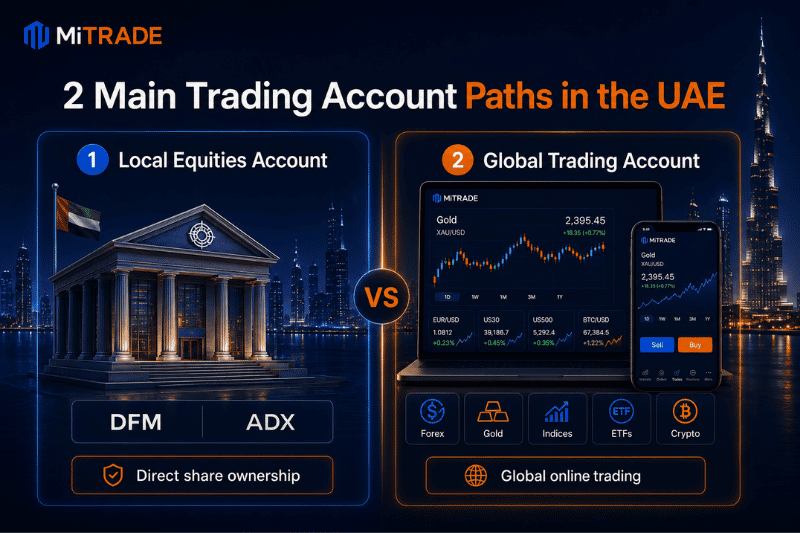
Before opening a trading account in the UAE, it helps to understand the two main routes.
One route is for investors who want to buy and sell local UAE shares. The other is for traders and investors who want access to global markets, including international stocks, forex, commodities, indices, ETFs, cryptocurrencies, futures, options, or CFDs, depending on the provider.
1. Local Equities Account
A local equities account is used to buy and sell UAE-listed shares on exchanges such as the Dubai Financial Market and Abu Dhabi Securities Exchange.
This type of account may be a good choice for traders and investors who want to own shares in UAE-listed companies across sectors such as banking, real estate, energy, telecommunications, and financial services.
To trade local UAE shares, you usually need a National Investor Number, or NIN, and a broker connected to the local exchange.
2. Global Trading Accounts: Stocks, Futures, Options, and CFDs
A global trading account is used to access international markets through an online broker or trading platform. Depending on the provider, this may include different account types:
Among these options, a CFD account can be flexible because it supports trading many asset classes from one account. Depending on the provider, this may include international stocks, forex, commodities, indices, ETFs, cryptocurrencies CFDs.
A CFD, or Contract for Difference, allows traders to speculate on whether an asset’s price may rise or fall without owning the asset itself. For example, trading a US stock CFD does not mean you own the actual US stock. You are trading its price movement through a CFD contract.
Some key features of CFD accounts include:
✅Multi-asset access from one account, instead of opening separate accounts for each market
✅Leverage, which can increase market exposure with a smaller amount of capital
✅The ability to trade both rising and falling markets by opening buy or sell positions
✅Flexible position sizing, depending on the broker, product, and account conditions
✅The ability to hold trades overnight or over several days or weeks, depending on the strategy, product, and overnight costs
✅Access to analysis and risk-management tools, such as charts, indicators, calculators, dashboards, stop-loss orders, and take-profit orders
If you want to know more about CFDs, you might be interested in the following article >>> What are CFDs? CFDs basics you need to know before trading
What About Islamic or Swap-Free Trading Accounts?
An Islamic or swap-free account is not a separate market route. It is usually an account feature that some brokers may offer for traders who want to avoid overnight swap charges.
However, a swap-free option alone does not make a broker the right choice. Before opening an account or depositing funds, traders should also check important factors such as regulation, legal entity, fees, spreads, platform tools, available markets, withdrawal conditions, execution quality, frequency of slippage or technical errors, pricing transparency, and customer feedback.
Do You Need a NIN to Open a Trading Account in the UAE?
A National Investor Number, or NIN, is an investor identification number used for trading local UAE securities.
It is mainly relevant if you want to buy and sell shares listed on local exchanges such as the Dubai Financial Market, or DFM, and the Abu Dhabi Securities Exchange, or ADX.
However, not every trading account in the UAE requires a NIN. You do not need a NIN to open a global CFD trading account with an online broker or trading platform. In that case, the platform usually asks you to complete its own account registration and Know Your Customer, or KYC, verification.
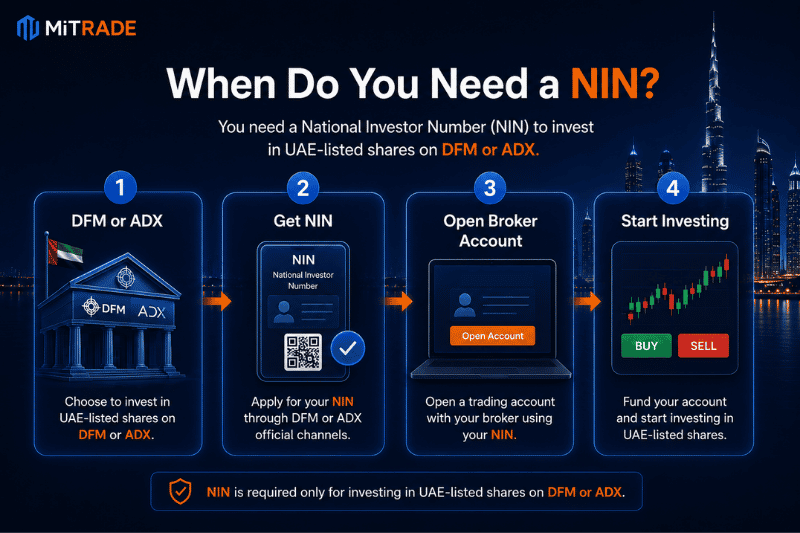
You need a NIN if you want to:
Buy and sell DFM-listed shares
Buy and sell ADX-listed shares
Open a local brokerage account for UAE securities
Manage local exchange transactions under your investor profile
How to Get a NIN in the UAE?
There are two common ways to get a NIN in the UAE.
Method A: Apply through official digital channels
For the Dubai Financial Market, investors can apply for a DFM Investor Number through the DFM app and link it to UAE Pass.
For the Abu Dhabi Securities Exchange, investors can apply through channels such as the ADX Mobile App with UAE Pass, the ADX website, investor service offices, or TAMM, depending on eligibility and document requirements.
Method B: Apply through a registered local bank or broker
Some investors may also apply through a registered local broker or bank-backed securities provider. Examples include local brokerage providers such as Emirates NBD Securities or ADCB Securities, part of Abu Dhabi Commercial Bank, depending on the market and account type.
This option is useful if you want support with opening both the investor number and the trading account.
Requirements and Key Documents to Prepare
Trading account requirements in the UAE can vary depending on the broker, exchange, account type, residency status, and age. In most cases, traders need to be at least 18 years old to open a live trading account. For local UAE securities, minors may need a guardian or legal representative to apply on their behalf, depending on the exchange rules.
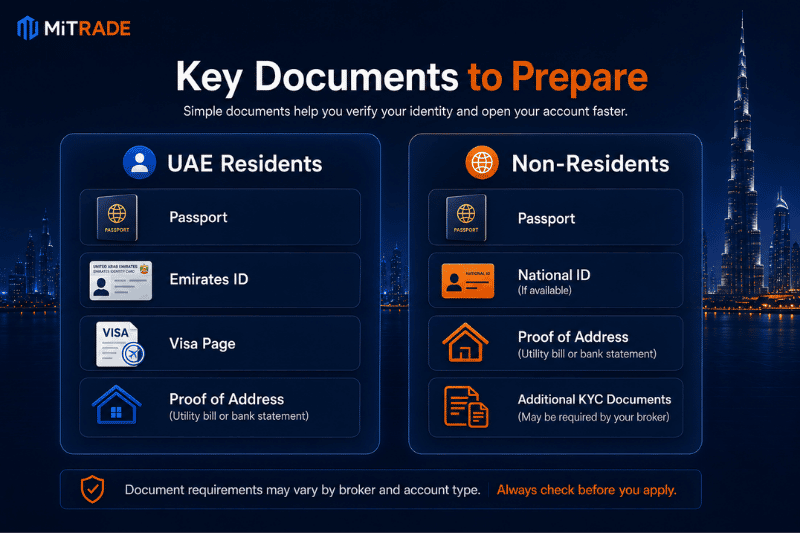
In most cases, you may need to prepare:
Payment and Withdrawal Methods
For deposits and withdrawals, brokers and trading platforms support different payment methods. This can include bank transfers using an International Bank Account Number (IBAN), debit or credit cards, e-wallets such as Skrill, and crypto.
Always use payment methods and accounts registered under your own name to avoid verification or withdrawal issues later.
How to Choose a Safe and Regulated Trading Platform in the UAE?
Choosing a trading platform is not only about the minimum deposit, available markets, or app design. A safer platform should clearly show its legal entity, licence information, fees, risk warnings, and withdrawal conditions.
In the UAE, key financial regulators include:
For UAE residents, it is especially useful to check whether the broker is authorised by the UAE CMA or another relevant UAE regulator. Some brokers may also operate through international entities, so always check which legal entity you are registering with and which regulator applies to your account.
Outside the UAE, traders may also see brokers regulated by global authorities such as ASIC, CySEC, CIMA, FSC, or FSCA, depending on the broker’s entity and client location.
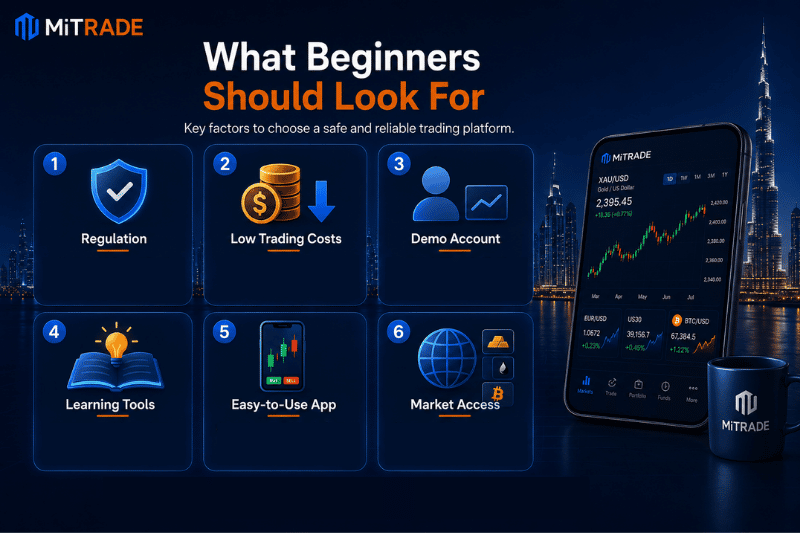
Before opening an account, check ↓↓↓
Regulation status and legal entity.
Fees, spreads, commissions, and overnight costs.
Deposit and withdrawal methods, speed, and conditions.
Platform tools, available markets, and demo account access.
Execution quality, slippage frequency, technical errors, and pricing transparency.
Customer support quality, including Arabic and English support if needed.
Reviews, customer feedback, and complaint history.
| 💡Note: Avoid platforms that hide their legal entity, make unrealistic profit claims, pressure you to deposit quickly, or do not explain trading risks clearly. |
Why Is Mitrade a Top Choice for UAE Beginners?
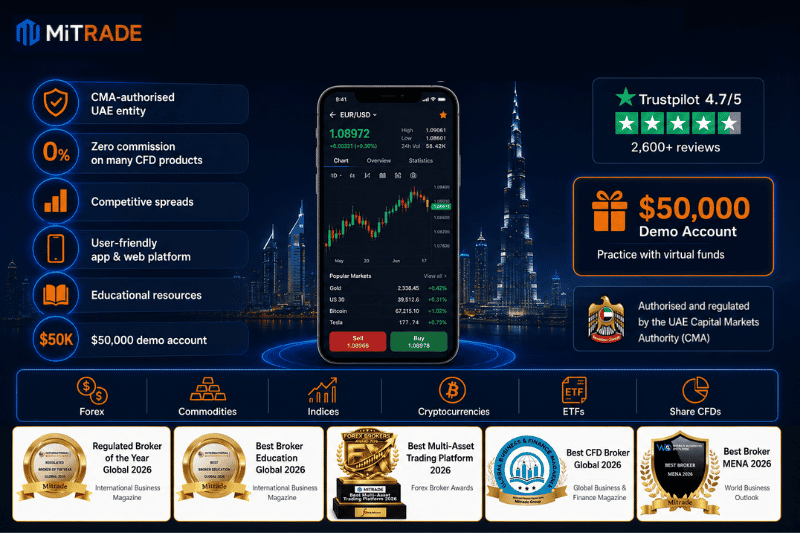
Mitrade can be a suitable choice for UAE beginners who want access to global markets through a simple online trading platform.
With Mitrade, traders can access different assets, such as gold, oil, cryptocurrencies, forex, indices, ETFs, and share CFDs, in one account.
Mitrade also holds a 4.7/5 rating on Trustpilot from more than 2,600 reviews, reflecting positive user feedback and supporting its reputation among online trading platforms.
Mitrade operates through several regulated entities, including:
Mitrade Financial Services LLC — CMA 20200000397 (Click here to verify)
Mitrade Global Pty Ltd — AFSL 398528 (Click here to verify)
Mitrade EU Ltd — CIF 438/23 (Click here to verify)
Mitrade Holding Ltd — SIB 1612446 (Click here to verify)
Mitrade International Ltd — GB20025792 (Click here to verify)
Mitrade Markets Pty Ltd — FSP 54842 (Click here to verify)
For beginners, Mitrade combines several useful features in one place:
Ready to Trade the Global Markets with Real Funds?
Open a live account with Mitrade today and start your trading journey in a secure environment backed by a CMA-authorised UAE entity. With just one account, you can easily trade forex, gold, oil, cryptocurrencies, and share CFDs. Designed with beginners in mind, our user-friendly platform helps you lower your trading costs with zero commission on many CFD products and highly competitive spreads, while keeping you in control with limit and stop-loss features for every trade.
If you are interested in Mitrade CFDs trading, you can read >>> What is Mitrade? Is It a Legal Trading Platform?
Open Live Account
CMA-regulated | 24х5 | low spreads | 0 commision Enjoy limit and stop loss for every trade!
Step-by-Step Guide: How to Open a Trading Account on Mitrade
Opening a trading account on Mitrade is designed to be simple, but you still need to complete verification and understand the risks before trading live.
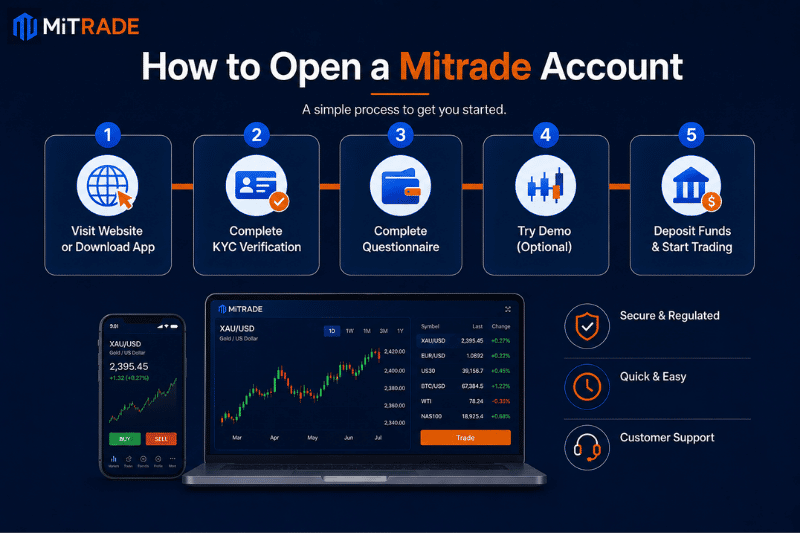
Step 1: Visit the website or download the app
Go to the Mitrade website or app, choose the option to create an account, and enter your basic details.
Step 2: Complete KYC verification
Know Your Customer, or KYC, verification is used to confirm your identity. You may need to upload documents such as an Emirates ID, passport, proof of address, or other accepted documents depending on your status.
Step 3: Answer the trading experience questionnaire
For CFD products, Mitrade may ask questions about your trading experience, financial knowledge, and risk understanding. Answer honestly so the platform can assess whether CFD trading is appropriate for you.
Step 4: Practise with a demo account
Beginners can use Mitrade’s $50,000 demo account to explore the platform, test order placement, and practise with virtual funds before using real money.
Step 5: Deposit funds and start trading
If you decide to trade live, choose from the available payment methods shown in your account. Mitrade’s minimum deposit in the UAE starts from $50. Start small and use risk management tools such as stop-loss and take-profit orders.
* Unlock the markets with Mitrade. Start your trading journey from just $50.
5 Important Things to Note Before You Start Trading
Before trading live, keep these points in mind:
1. Understand leverage risks: Leverage can increase your potential profits, but it can also increase your losses quickly. You should start with lower leverage, use smaller position sizes, and place stop-loss orders on your trades to protect your capital.
2. Know the difference between shares and CFDs: Buying shares usually means owning part of a company. With share CFDs, you trade price movements without owning the underlying shares.
3. Check the full trading cost: Costs may include spreads, commissions, overnight fees, withdrawal fees, currency conversion costs, or inactivity fees, depending on the broker and product.
4. Avoid unsafe platforms: A reliable broker should clearly show its legal entity, licence information, fees, risk warnings, and contact details. Be careful with platforms that promise guaranteed profits or pressure you to deposit quickly.
5. Understand UAE tax considerations: The UAE currently has no personal income tax, and capital gains tax is generally not imposed on UAE national or resident individuals. However, tax treatment can depend on personal circumstances, business activity, residency status, and future rule changes.
Conclusion
Opening a trading account in the UAE starts with choosing the right account type for your goals. A local equities account is mainly for UAE-listed shares, while a global trading account can give access to international markets.
For traders who want flexibility, CFD accounts can be useful because they allow access to multiple assets from one account.
Before opening an account, compare regulation, fees, available markets, platform tools, and payment methods.
Ready to start trading?
Open a Mitrade account to access global markets from one platform. Start with a $50,000 demo account to test the platform and practise your strategy, then move to live trading when you are ready.


What is the minimum amount required to open a trading account in the UAE?
The minimum amount depends on the broker, market, and account type. Some online trading platforms allow traders to start with a minimum deposit from around $50 like Mitrade, while local brokers and bank-backed platforms may have different funding rules.
How long does it take to verify a UAE trading account?
Verification time depends on the provider, account type, and documents submitted. Online trading accounts are often verified within the same day or 1 to 2 business days when documents are clear, while manual checks or traditional bank and brokerage applications may take longer.
Can a foreigner or non-resident open a trading account in the UAE?
Yes, depending on the broker, exchange, and account type. Non-residents may need a passport, proof of address, and other Know Your Customer, or KYC, documents.
Is online trading legal and tax-free in the UAE?
Online trading is legal when done through properly regulated platforms. The UAE currently has no personal income tax, and capital gains tax is generally not imposed on UAE national or resident individuals. However, tax treatment can depend on personal circumstances, business activity, residency status, and future rule changes.
* The content presented above, whether from a third party or not, is considered as general advice only. This article should not be construed as containing investment advice, investment recommendations, an offer of or solicitation for any transactions in financial instruments.


