


Not Nvidia. Not Broadcom. This Little-Known Chip Supplier Could Be the AI Boom's Best-Kept Secret.
Key Points
Cerebras' Wafer-Scale Engine combines computing, memory, and communication on one chip, aiming to speed up AI inference workloads significantly.
OpenAI is deploying up to 750 megawatts of Cerebras compute through 2028, already powering GPT-5.6 Sol's faster Ultrafast mode.
The upcoming CS-4 system and modular platform could double performance, positioning Cerebras as a scalable alternative to Nvidia and Broadcom.
- 10 stocks we like better than Cerebras Systems ›
When investors think about the artificial intelligence boom, two names tend to dominate conversations. They are Nvidia (NASDAQ: NVDA), which supplies the graphics processing units (GPUs) powering much of the AI industry, and Broadcom (NASDAQ: AVGO), which helps tech companies develop custom silicon. But there's a lesser-known player that could be the industry's best-kept secret: Cerebras Systems (NASDAQ: CBRS).
Why speed is central to Cerebras' strategy
With Cerebras, it all starts with speed. Instead of the usual approach to chip design, Cerebras built its business around a large processor designed specifically for artificial intelligence: its Wafer-Scale Engine.
Missed Nvidia in 2009? This Rare Signal Is Flashing Again. In 2009, a "Double Down" signal flashed for a little-known chipmaker called Nvidia. For the first time in years, that same "Total Conviction" signal is flashing for a company 1/100th the size of Nvidia. Continue »
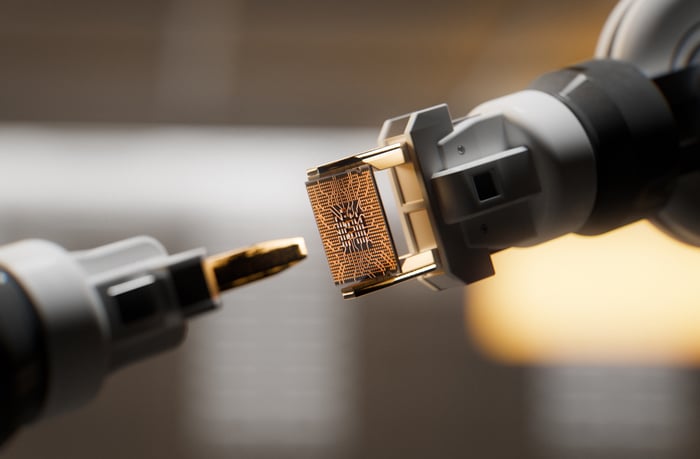
Image source: Getty Images.
The chip combines computing cores, memory, and communication capabilities into a single piece of silicon, reducing the need to move data between separate components. Through this approach, Cerebras aims to alleviate bottlenecks that can slow AI workloads.
That matters because training an AI model is only one part of the equation. Once a model is deployed, it's used for AI inference, answering questions, writing code, and even executing tasks for millions of users in real time. In fact, inference is becoming one of the fastest-growing trends in the AI market today.
Cerebras is investing in that shift by working to make AI responses faster.
As AI applications become more interactive, speed could become a huge competitive advantage. It could make conversations with AI chatbots faster and more fluid, while enabling AI agents to complete multi-step tasks more quickly, across domains ranging from software development and business workflows to scientific research.
The company's approach is already attracting attention from major AI players, including OpenAI.
OpenAI's partnership puts Cerebras on the map
Getting a major AI company to adopt its technology is a huge vote of confidence for any chipmaker. That's why Cerebras' relationship with OpenAI stands out.
The companies recently announced a multi-year agreement to deploy 750 megawatts of Cerebras compute capacity for OpenAI customers, with deployment planned in stages through 2028. The goal is to make AI responses faster, particularly for workloads that generate long answers, assist with coding, and power AI agents.
The partnership took an even bigger turn in August, when Cerebras announced that it's powering the Ultrafast mode for OpenAI's GPT-5.6 Sol. The company says the service can deliver up to 750 output tokens per second and run up to 14 times faster than with standard processing. This demonstrates how Cerebras' specialized hardware can greatly improve the user experience with advanced AI models.
For investors, the important point is that Cerebras' technology is already powering real commercial AI services, backed by one of the leading AI model providers. But proving its technology works is only part of the equation.
The company is also racing to build out its next-generation hardware.
An expanded technology portfolio
Cerebras recently announced its CS-4 system, which it says can deliver up to twice the speed of its predecessor, along with improved efficiency and faster token generation. CS-4 is part of a broader platform that Cerebras says will allow it to upgrade computing, cooling, and power delivery more independently. That matters because performance doesn't depend on chips alone.
Data centers must also deliver enough power, move data efficiently, and cool dense hardware. As a result, by adopting this design, the company is trying to improve the economics of running AI at scale. That makes Cerebras' technology better suited for large deployments, especially as AI data centers become bigger and more complex.
For investors looking beyond the biggest chipmakers, this continued product development is another reason to watch the company.
Is Cerebras stock a buy right now?
Nvidia and Broadcom may be providing much of the infrastructure behind AI, but the AI boom is also creating opportunities for lesser-known chipmakers. That could mean room for more than one winning chip design.
Looking ahead, Cerebras' focus on speed and inference could give it a major role in the next phase of the AI boom, especially as it launches broader platforms that can scale with AI data centers.
If demand for faster AI keeps growing, Cerebras could turn out to be one of the market's strongest under-the-radar chip suppliers.
Should you buy stock in Cerebras Systems right now?
Before you buy stock in Cerebras Systems, consider this:
The Motley Fool Stock Advisor analyst team just identified what they believe are the 10 best stocks for investors to buy now… and Cerebras Systems wasn’t one of them. The 10 stocks that made the cut could produce monster returns in the coming years.
Consider when Netflix made this list on December 17, 2004... if you invested $1,000 at the time of our recommendation, you’d have $379,123!* Or when Nvidia made this list on April 15, 2005... if you invested $1,000 at the time of our recommendation, you’d have $1,408,822!*
Now, it’s worth noting Stock Advisor’s total average return is 950% — a market-crushing outperformance compared to 215% for the S&P 500. Don't miss the latest top 10 list, available with Stock Advisor, and join an investing community built by individual investors for individual investors.
See the 10 stocks »
*Stock Advisor returns as of October 11, 2026.
Rick Orford has no position in any of the stocks mentioned. The Motley Fool has positions in and recommends Broadcom and Nvidia. The Motley Fool has a disclosure policy.
Recommended Articles


