


As GLP-1 Drugs Change How People Eat, Drugmakers Collect and Snack Makers Feel the Squeeze
Key Points
The two main GLP-1 manufacturers are poised to gain the most.
Some snack makers are prepared to weather the storm, while others are suffering.
- 10 stocks we like better than Eli Lilly ›
Occasionally, an innovation comes along that causes consumers to significantly alter their habits or behavior. When that happens, some companies will benefit, while others will suffer. And when such an innovation is a major one, the impact on various companies and sectors can be pronounced.
We're seeing that right now with the growth of GLP-1 drugs like Wegovy and Zepbound, which are dramatically altering the way people eat because of their powerful ability to reduce appetite.
Missed AI’s "Act 1"? Act 2 Could Be 15x Bigger. Most investors think they missed the AI boat because they didn't buy Nvidia in 2005. But according to our analysts, we’re only at the end of "Act 1"—the R&D phase. "Act 2" is the global rollout. Continue »
And the use of these drugs is growing rapidly. According to polling firm Gallup, Americans' use of GLP-1 injectables for weight loss has nearly quadrupled since 2024. The percentage of U.S. adults taking these weight loss drugs has risen to 11% this year, from 3% just two years ago. And 15% of U.S. adults report having used the medicine at some point.
The drugs are effective at treating obesity. The adult obesity rate in the U.S. has fallen from 39.9% in 2022 to 36.8% in 2026.
That effectiveness means more people will turn to the drugs for weight loss. And that's exactly what market watchers are forecasting. J.P. Morgan Global Research forecasts that some 25 million Americans will be on GLP-1 treatment by 2030, up from about 10 million last year. That includes people taking the drugs for type 2 diabetes, but the effects on appetite are the same.
That's just the U.S. market. Penetration of GLP-1 drugs globally is lower, but it too is expected to balloon in the coming years, especially as the introduction of generic drugs and oral pills grows.
Snack food sales are suffering due to growing GLP-1 use
At the same time, users of the drugs are spending less on groceries and snacks. A December 2025 study in the Journal of Marketing Research looked at purchases by GLP-1-using households and found that, within six months of starting a GLP-1 medication, grocery spending by these households fell by 5.3% on average, and 8% among higher-income households.
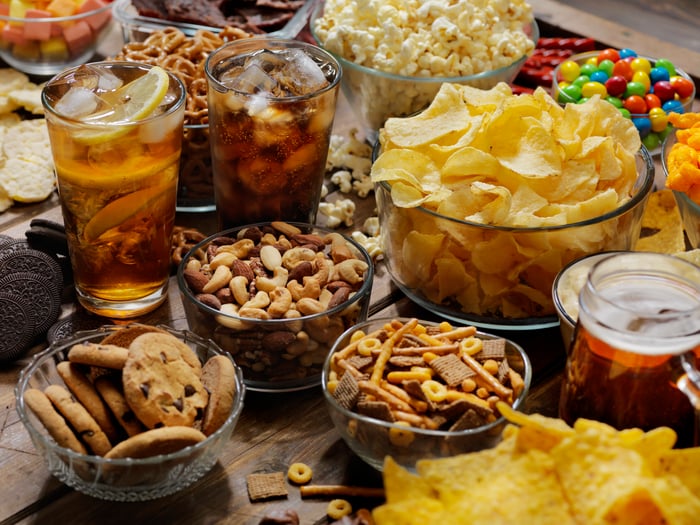
Image source: Getty Images.
Purchases of ultra-processed and calorie-dense foods saw the largest declines, with spending on savory snacks dropping by about 10%, along with similarly large decreases in spending on sweets, baked goods, and cookies.
That decrease in spending is expected to accelerate. "GLP-1 treatments are projected to lead to an annual revenue reduction of $30 billion–$55 billion by 2030–2034 for the food and beverage industry, with consumers taking in 21% fewer calories and spending 31% less on groceries," according to J.P. Morgan.
So, which companies collect and which ones pay as the use of GLP-1 drugs continues to spread around the globe?
Well, the biggest beneficiaries will likely be the makers of these drugs. Eli Lilly (NYSE: LLY) makes Mounjaro and Zepbound, with combined sales of $36.5 billion in 2025. In fact, the GLP-1 drug in each of those brand names, tirzepatide, is now the world's best-selling drug.
Competitor Novo Nordisk (NYSE: NVO) makes Wegovy and Ozempic, which together generated $31 billion in revenue last year. The surge in demand for GLP-1 drugs has made Novo Nordisk Denmark's largest company, with a market cap of about one-third of the country's economic output.
Lilly's share price has climbed more than 400% during the past five years, primarily because, at least for now, it seems to be winning the race to become the world's largest GLP-1 provider. Novo's shares are down during that time, but only because investors are choosing Lilly over the Danish firm. In fact, Novo's revenue more than doubled between 2021 and 2025.
Some snack companies will suffer, but others are adapting
And how about snack companies? Well, so far, Coca-Cola (NYSE: KO) is holding up well. While studies show that people using GLP-1 drugs consume less full-sugar soda, some 68% of the company's portfolio consists of low- or no-calorie options.
The situation is similar for Monster Beverage (NASDAQ: MNST), as energy drinks seem to be less impacted by GLP-1 use. Coca-Cola shares are up 34% over the past year, and Monster's share price has climbed 27%.
But some snack makers are already feeling the squeeze from GLP-1s. Shares of PepsiCo (NASDAQ: PEP) are down 12% during the past year. The company's major snack brands are highly exposed to consumers cutting back on processed snacks. Lay's is considered one of the products most exposed to the shift in calorie intake due to GLP-1s.
Shares of snack maker Mondelez International (NASDAQ: MDLZ) are little changed during the past year. So far, the maker of Oreo and Chips Ahoy! cookies hasn't felt a significant hit from GLP-1 drugs, but that may be because 75% of its sales are outside the U.S., with a big chunk in emerging markets. GLP-1 drugs have much lower penetration in those countries, but they, too, will likely adopt these weight-loss products eventually. It seems that investors already sense that.
Hershey (NYSE: HSY) is down about 17% over the past year. So far, GLP-1 use has had a modest negative impact on the iconic candy manufacturer. Sales of its popular snacks have declined.
But there's a silver lining there, too: There's been a surge in demand for breath mints to combat GLP-1 side effects that include dry mouth and bad breath. So, the company is seeing growth in sales of Ice Breakers and Breath Savers.
One thing is certain: Sales of GLP-1 drugs look set to accelerate. So investors will need to watch the consequences for other industries and companies.
Should you buy stock in Eli Lilly right now?
Before you buy stock in Eli Lilly, consider this:
The Motley Fool Stock Advisor analyst team just identified what they believe are the 10 best stocks for investors to buy now… and Eli Lilly wasn’t one of them. The 10 stocks that made the cut could produce monster returns in the coming years.
Consider when Netflix made this list on December 17, 2004... if you invested $1,000 at the time of our recommendation, you’d have $379,123!* Or when Nvidia made this list on April 15, 2005... if you invested $1,000 at the time of our recommendation, you’d have $1,408,822!*
Now, it’s worth noting Stock Advisor’s total average return is 950% — a market-crushing outperformance compared to 215% for the S&P 500. Don't miss the latest top 10 list, available with Stock Advisor, and join an investing community built by individual investors for individual investors.
See the 10 stocks »
*Stock Advisor returns as of October 11, 2026.
Matthew Benjamin has positions in Novo Nordisk. The Motley Fool has positions in and recommends Eli Lilly, Hershey, Monster Beverage, and Novo Nordisk. The Motley Fool has a disclosure policy.
Recommended Articles


