


Jamie Dimon Revealed 1 of the Biggest Risks to JPMorgan Chase, and This Stock Could Benefit
Key Points
Jamie Dimon has steered the world's largest investment bank, JPMorgan Chase, through several major economic shocks over the last 20 years.
However, he believes cyber threats powered by artificial intelligence (AI) are one of the biggest risks to his bank today.
Cybersecurity stocks like SentinelOne could be big winners over the long term if other chief executives have the same concerns as Dimon.
- 10 stocks we like better than SentinelOne ›
With a market capitalization of almost $900 billion, JPMorgan Chase (NYSE: JPM) is the world's largest investment bank by a wide margin. Chief executive officer Jamie Dimon has been at the helm for over 20 years, successfully steering the bank through the global financial crisis, the European debt crisis, the COVID-19 pandemic, and many other economic shocks.
In a letter to shareholders released in April, Dimon named cyber risk as one of the biggest threats to JPMorgan, primarily because artificial intelligence (AI) is laying the foundation for increasingly sophisticated attacks. He reiterated his stance in an interview with Bloomberg last Tuesday but said cyber risk has increased tenfold since his letter, following the release of Anthropic's Mythos AI models, which can autonomously uncover vulnerabilities in any corporate network.
Missed Nvidia in 2009? This Rare Signal Is Flashing Again. In 2009, a "Double Down" signal flashed for a little-known chipmaker called Nvidia. For the first time in years, that same "Total Conviction" signal is flashing for a company 1/100th the size of Nvidia. Continue »
Cybersecurity stocks are soaring this year as investors price in much higher demand. SentinelOne (NYSE: S) developed a holistic AI-powered platform called Singularity, which protects enterprises from top to bottom. Its stock is still one of the cheapest in the industry.
Here's why it could be a great buy as the cybersecurity industry tackles the AI threat.

Image source: Getty Images.
AI is creating multidimensional risks
AI can be a powerful tool for enterprises, helping improve productivity, but it also creates new attack surfaces. Every time businesses deploy chatbots, agents, or other applications, they leave their sensitive internal data and valuable digital assets exposed to cyber threats, underscoring the importance of modern cybersecurity.
SentinelOne's Singularity platform protects cloud networks, employee identities, endpoints (computers and devices), and everything in between. Its priority is to prevent breaches, but it also includes several remediation tools to help enterprises restore their digital infrastructure in the event of a successful attack, thereby minimizing downtime. Singularity also features a built-in AI assistant called Purple AI, which uses advanced reasoning to autonomously investigate threats and take action when necessary.
SentinelOne has developed a portfolio of new tools specifically designed to protect enterprises during AI deployments. Prompt Security, for example, defends against a new technique called prompt injection, where hackers try to trick chatbots and agents into handing over sensitive data by disguising their malicious requests as legitimate commands. Prompt Security also logs every AI application used internally, so it immediately knows if an unauthorized app is circulating on the corporate network.
Revenue from AI-related products is soaring
SentinelOne saw $1.2 billion in annual recurring revenue (ARR) at the end of its fiscal 2027 second quarter (which concluded on July 31), a 22% increase from the year-ago period. However, the ARR attributed to its AI products, such as Prompt Security and Purple AI, almost tripled, indicating that customers are clearly investing heavily in next-generation protection.
A notable portion of that growth appears to have been organic, because SentinelOne actually decreased its sales and marketing spending during the second quarter. In other words, it seems customers were actively seeking AI-related protection, which bodes well for demand going forward.
Although SentinelOne trimmed its marketing costs in the second quarter, it ramped up its research and development spending by 27% to fund its innovation pipeline. As a result, its operating costs increased overall, leading to a generally accepted accounting principles (GAAP) net loss of $93.4 million.
Shareholders might be willing to endure SentinelOne's losses as long as they are paying off in the form of blistering fast AI-related revenue growth. But profits will have to follow in the future, or the company might have to raise more money through debt or equity financing, which could be a headwind for investors' returns.
SentinelOne is much cheaper than its peers
SentinelOne stock is trading at a price-to-sales (P/S) ratio of 7.7 as I write this (Oct. 7), making it significantly cheaper than its rivals Palo Alto Networks and CrowdStrike, which have P/S ratios of 26.8 and 50.5, respectively.
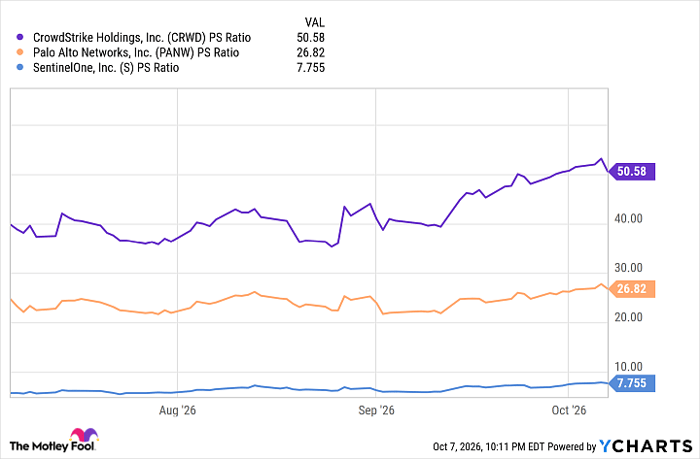
CRWD PS Ratio data by YCharts
Both Palo Alto and CrowdStrike generate significantly more revenue than SentinelOne, so they have a much bigger market share. And CrowdStrike specifically is growing faster; its ARR jumped 25% to $5.8 billion in its most recent quarter. As a result, these vendors deserve to trade at premium valuations.
However, I would argue that the valuation gap is currently too wide, given the momentum in SentinelOne's AI product portfolio. I'm not suggesting it will ever match the valuations of Palo Alto or CrowdStrike, but there is certainly some room for upside.
After all, Jamie Dimon is definitely not the only CEO of a major company making cybersecurity a top priority right now. AI-related threats could force every public and private organization to spend more on protection in the coming years, making this the biggest opportunity in SentinelOne's history.
Should you buy stock in SentinelOne right now?
Before you buy stock in SentinelOne, consider this:
The Motley Fool Stock Advisor analyst team just identified what they believe are the 10 best stocks for investors to buy now… and SentinelOne wasn’t one of them. The 10 stocks that made the cut could produce monster returns in the coming years.
Consider when Netflix made this list on December 17, 2004... if you invested $1,000 at the time of our recommendation, you’d have $385,972!* Or when Nvidia made this list on April 15, 2005... if you invested $1,000 at the time of our recommendation, you’d have $1,416,196!*
Now, it’s worth noting Stock Advisor’s total average return is 951% — a market-crushing outperformance compared to 214% for the S&P 500. Don't miss the latest top 10 list, available with Stock Advisor, and join an investing community built by individual investors for individual investors.
See the 10 stocks »
*Stock Advisor returns as of October 10, 2026.
JPMorgan Chase is an advertising partner of Motley Fool Money. Anthony Di Pizio has no position in any of the stocks mentioned. The Motley Fool has positions in and recommends CrowdStrike and JPMorgan Chase. The Motley Fool recommends Palo Alto Networks. The Motley Fool has a disclosure policy.
Recommended Articles


