


Why Legendary Investor Peter Lynch Ignored Stock Market Crash Predictions, and Why You Should Too
Key Points
Famed investors Michael Burry and Ray Dalio have both been expecting a large market correction.
Nevertheless, following Peter Lynch's simple advice is likely the best thing investors can do today.
- 10 stocks we like better than S&P 500 Index ›
The calls for a potential stock market crash have been increasing, with two prominent investors recently ringing the alarm bell.
Michael Burry, who gained fame by correctly calling the housing market collapse, recently warned the AI bubble was about to burst. In a post on X, he wrote: "The stock market is quite obviously in its first stage of grief, denial. Per 2000 and 2008, this stage lasts 6-9 months." Burry has been a vocal bear, while shorting Nvidia, Palantir Technologies, Micron Technology, and other AI stocks.
Missed AI’s "Act 1"? Act 2 Could Be 15x Bigger. Most investors think they missed the AI boat because they didn't buy Nvidia in 2005. But according to our analysts, we’re only at the end of "Act 1"—the R&D phase. "Act 2" is the global rollout. Continue »
Billionaire investor Ray Dalio, meanwhile, also joined the bear party, cautioning that the AI boom was showing classic signs of a bubble that is about to burst. At the Forbes Global CEO Conference in Singapore, Dalio highlighted how the combination of increasing debt used to fund the AI infrastructure buildout and rising interest rates could lead to a sharp market pullback. Meanwhile, on Bloomberg News, Dalio further said that people starting to cash out of investments, a wealth tax, or having to pay back loans could also trigger the bubble bursting.
Meanwhile, market pundits have pointed to the S&P 500 (SNPINDEX: ^GSPC) trading at valuations rarely seen in the past. The S&P 500 cyclically adjusted PE (CAPE) ratio has hit 40 for only the second time in history, with the last time being right before the dot-com bubble burst. The valuation metric, created by Yale economist Robert Shiller, uses 10 years of inflation-adjusted S&P 500 earnings to smooth out spikes and drops that come with business cycles.
At the same time, the so-called Buffett Indicator, named after famed investor Warren Buffett because it is one of his favorite valuation metrics, has also reached an all-time high. The metric measures the value of the entire U.S. stock market against the country's gross domestic product (GDP). A reading over 120% is considered overvalued, while the ratio is now over 238%.
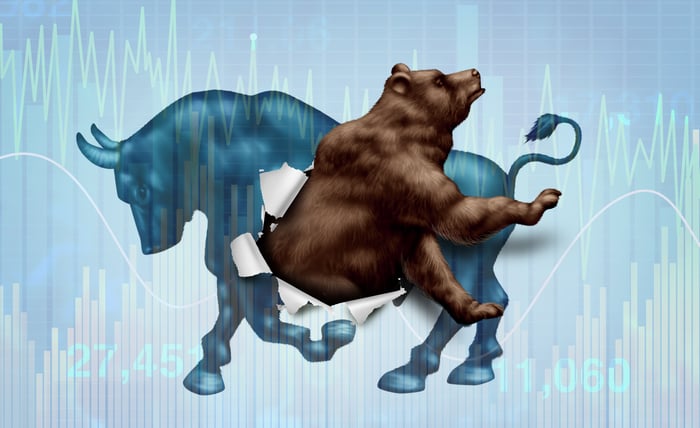
Image source: Getty Images
How should investors prepare for a potential market crash?
If you're afraid of a potential stock market crash, I'd follow the advice of legendary investor Peter Lynch. He ran Fidelity's flagship Magellan Fund from 1977 to 1990, generating an outstanding average annual return of over 29% during that period.
In an essay in the September 1995 issue of Worth magazine, Lynch famously said: "Far more money has been lost by investors preparing for corrections or trying to anticipate corrections than has been lost in corrections themselves."
In the article, Lynch then went on to highlight the mistake investors make when trying to hedge their investments with options or lightening up positions. He noted that if you invested $2,000 in the S&P 500 every year on Jan. 1 since 1965, your average annual return would be 11% (I'm assuming this is ending in 1994, given when the article was published), while if you invested the same amount at the market peak each year, your return would only drop to 10.6%.
Lynch added: "Whether your timing is good or bad. What matters is that you stay invested in stocks."
What Lynch is essentially advocating is for investors to ignore calls for any market correction or crash and to stay disciplined using a dollar-cost averaging strategy. I think the best way to do this is through index-focused exchange-traded funds (ETFs), like the Vanguard S&P 500 ETF (NYSEMKT: VOO) or Invesco QQQ Trust (NASDAQ: QQQ), which tracks the tech-heavy Nasdaq 100 index.
The reason why I think these are the best investment options to dollar cost into consistently also follows one of Lynch's other big mantras of not selling your winners too soon. Market cap-weighted ETFs actually force investors to follow this advice, since when a company's stock outperforms, it naturally becomes a greater percentage of the fund.
So while it's normal to get nervous when famous investors are calling for a market crash, remember that time in the market beats timing the market over the long run.
Should you buy stock in S&P 500 Index right now?
Before you buy stock in S&P 500 Index, consider this:
The Motley Fool Stock Advisor analyst team just identified what they believe are the 10 best stocks for investors to buy now… and S&P 500 Index wasn’t one of them. The 10 stocks that made the cut could produce monster returns in the coming years.
Consider when Netflix made this list on December 17, 2004... if you invested $1,000 at the time of our recommendation, you’d have $385,972!* Or when Nvidia made this list on April 15, 2005... if you invested $1,000 at the time of our recommendation, you’d have $1,416,196!*
Now, it’s worth noting Stock Advisor’s total average return is 951% — a market-crushing outperformance compared to 214% for the S&P 500. Don't miss the latest top 10 list, available with Stock Advisor, and join an investing community built by individual investors for individual investors.
See the 10 stocks »
*Stock Advisor returns as of October 9, 2026.
Recommended Articles


