


SoundHound AI Stock: Is it a Bargain Buy at $6?
Key Points
SoundHound AI achieved 45% revenue growth in its most recent quarter.
Acquisitions have given the business a boost over the years.
The company, however, is still nowhere near breakeven.
- 10 stocks we like better than SoundHound AI ›
SoundHound AI (NASDAQ:SOUN)'s stock has been struggling badly this year. It's already down more than 40%, even as other stocks involved in artificial intelligence (AI) are soaring. The market has been doing well, but SoundHound AI has not.
That's a troubling sign, but it might also mean that there's an opportunity here. The key is to understand why the stock is down, and whether the market is overreacting to a recent news event involving the business, or if there are truly fundamental issues that are preventing SoundHound AI from joining the larger tech rally.
Missed AI’s "Act 1"? Act 2 Could Be 15x Bigger. Most investors think they missed the AI boat because they didn't buy Nvidia in 2005. But according to our analysts, we’re only at the end of "Act 1"—the R&D phase. "Act 2" is the global rollout. Continue »
Below, I'll look at what the real reason for SoundHound AI's decline is, and whether the tech stock is a steal of a deal while it's trading at around $6.

Image source: Getty Images.
Why isn't SoundHound's strong growth enough to lift the stock higher?
Over the past few years, SoundHound has experienced significant growth as opportunities in voice AI have taken off. Acquisitions have given the business a boost, and its growth rate has remained fairly strong.
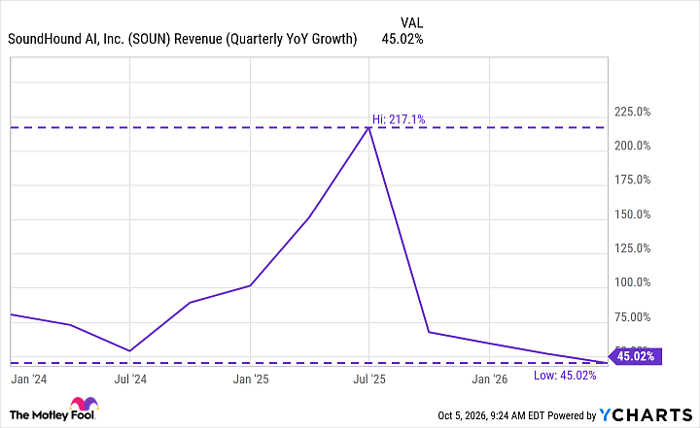
SOUN Revenue (Quarterly YoY Growth) data by YCharts
The challenge for investors is that, while the growth looks impressive, SoundHound has been heavily focused on acquisitions to expand its business. While that can be an effective way to grow and diversify, it may not improve prospects for profitability. Meanwhile, investors have a more difficult time assessing whether the business is growing organically or whether it's simply due to acquisitions.
In the June quarter, SoundHound's revenue hit a record high of $61.9 million, but its net loss was also fairly significant at $42.8 million. That was down from a loss of $74.7 million in the same period a year ago, but given such a steep loss, investors may be wondering whether the business will ever become profitable.
SoundHound AI stock deserves to be trading at a discount
The greater the risk and uncertainty around a business, the larger a discount investors should demand on the stock. The question marks around SoundHound's organic growth and its bottom line make it little wonder that the stock hasn't been doing all that well this year, despite seemingly impressive top-line numbers.
SoundHound has been expanding via acquisitions, but simply adding more businesses into the fold doesn't make it a better investment. Integrating them and becoming profitable while doing so is the big test, which it still hasn't passed.
The stock may be trading at a drastically reduced valuation, but with ample competition in AI and SoundHound still deep in the red, I'd avoid it.
Should you buy stock in SoundHound AI right now?
Before you buy stock in SoundHound AI, consider this:
The Motley Fool Stock Advisor analyst team just identified what they believe are the 10 best stocks for investors to buy now… and SoundHound AI wasn’t one of them. The 10 stocks that made the cut could produce monster returns in the coming years.
Consider when Netflix made this list on December 17, 2004... if you invested $1,000 at the time of our recommendation, you’d have $361,650!* Or when Nvidia made this list on April 15, 2005... if you invested $1,000 at the time of our recommendation, you’d have $1,437,517!*
Now, it’s worth noting Stock Advisor’s total average return is 936% — a market-crushing outperformance compared to 213% for the S&P 500. Don't miss the latest top 10 list, available with Stock Advisor, and join an investing community built by individual investors for individual investors.
See the 10 stocks »
*Stock Advisor returns as of October 5, 2026.
David Jagielski, CPA has no position in any of the stocks mentioned. The Motley Fool has positions in and recommends SoundHound AI. The Motley Fool has a disclosure policy.
Recommended Articles


