


Should Investors Be Worried About an AI Bubble? Here's What History Says.
Key Points
The last big technology bubble was the dot-com mania at the turn of the century.
The AI bubble isn't likely to avoid the same fate because Wall Street almost always pushes companies to extremes.
- 10 stocks we like better than Nvidia ›
Financial history is filled with bubbles, going all the way back to the Tulip Bulb mania in the 17th century. There are entire books written about how investors frequently take good investment ideas and push them way too far. To think that artificial intelligence (AI) will somehow avoid the same fate is shortsighted. And the best evidence comes from the last technology-related bubble.
The internet changed the world, but Wall Street still crashed
At the turn of the century, Wall Street was enamored of internet stocks. Companies would simply append ".com" to their names to gain investor attention. And far too often it worked! The technology has, in fact, changed the world. But that doesn't mean investors who bought into the emerging bubble at the time made out.
Missed AI’s "Act 1"? Act 2 Could Be 15x Bigger. Most investors think they missed the AI boat because they didn't buy Nvidia in 2005. But according to our analysts, we’re only at the end of "Act 1"—the R&D phase. "Act 2" is the global rollout. Continue »

Image source: Getty Images.
The S&P 500 index (SNPINDEX: ^GSPC) fell more than 45% after the bubble burst. The technology-heavy Nasdaq-100 lost more than 80% of its value. It was a brutal period for investors, and the downturn was clearly led by technology stocks. The very same stocks that inflated the bubble in the first place.
The poster child for the dot-com crash is Cisco (NASDAQ: CSCO). Its stock took roughly a quarter of a century to recover from its decline. The Nasdaq-100 "only" took around 15 years. But the problem wasn't the technology. The problem, as it has always been, is investor emotions.
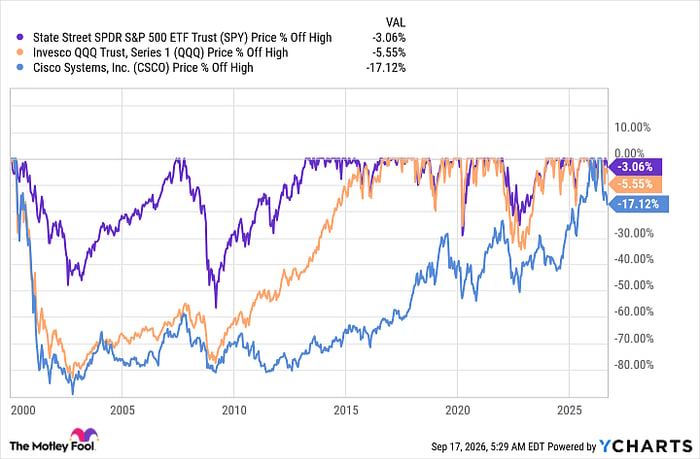
SPY data by YCharts
When Wall Street gets an idea in its teeth, it runs with it. Usually, it runs too far. Early investors make a lot of money, which leads more investors to jump into the space, fearing they are missing out on big gains. Eventually, emotionally driven investors push stock prices beyond what most would consider reasonable valuations. But people believe they can get out before the bubble bursts. Some do, but trees don't grow to the sky.
At some point, it becomes clear that too much capital was wasted on projects that won't produce the promised returns. Why? Because companies were indiscriminately throwing money at the technology because that's what investors were demanding.
The signs of a bubble are here
Nvidia (NASDAQ: NVDA) is a well-run chipmaker with impressive technology. But it is subsidizing its customers in unique ways that are bolstering demand for its AI chips. Market watchers are already questioning these arrangements. History shows that spending on AI will likely be overdone, leading to supply outstripping demand and capital investment projects that don't live up to expectations. When that happens, the bubble is likely to burst.
The good news here is that too much supply usually reduces the cost of new technologies. That allows more companies to use the new technologies, further increasing their impact. So while the artificial intelligence bubble that is building today could be bad for investors, it might be the best thing that could happen for the world.
Should you buy stock in Nvidia right now?
Before you buy stock in Nvidia, consider this:
The Motley Fool Stock Advisor analyst team just identified what they believe are the 10 best stocks for investors to buy now… and Nvidia wasn’t one of them. The 10 stocks that made the cut could produce monster returns in the coming years.
Consider when Netflix made this list on December 17, 2004... if you invested $1,000 at the time of our recommendation, you’d have $387,158!* Or when Nvidia made this list on April 15, 2005... if you invested $1,000 at the time of our recommendation, you’d have $1,365,749!*
Now, it’s worth noting Stock Advisor’s total average return is 932% — a market-crushing outperformance compared to 211% for the S&P 500. Don't miss the latest top 10 list, available with Stock Advisor, and join an investing community built by individual investors for individual investors.
See the 10 stocks »
*Stock Advisor returns as of September 19, 2026.
Reuben Gregg Brewer has no position in any of the stocks mentioned. The Motley Fool has positions in and recommends Cisco Systems and Nvidia. The Motley Fool has a disclosure policy.
Recommended Articles


