


The HBM Bottleneck: 3 Tech Companies Have Locked Up 85% of the Supply of AI's Scarcest Asset
Key Points
Access to high bandwidth memory is becoming a big differentiator in the AI infrastructure market.
Locking up deals for HBM supply gives Nvidia, Alphabet, and AMD a big edge.
- 10 stocks we like better than Nvidia ›
One of the biggest bottlenecks in the AI infrastructure market is high bandwidth memory (HBM), and according to Morgan Stanley, three companies have locked up 85% of next year's production in advance: Nvidia (NASDAQ: NVDA), Alphabet (NASDAQ: GOOGL) (NASDAQ: GOOG), and Advanced Micro Devices (NASDAQ: AMD).
HBM is a specialized form of DRAM that is frequently packaged with AI accelerators to reduce latency and optimize their performance. As the balance of AI workloads has shifted away from training and toward inference (in other words, putting trained models to work), demand for HBM has accelerated even more. Meanwhile, HBM supply remains constrained due to a few factors.
Missed AI’s "Act 1"? Act 2 Could Be 15x Bigger. Most investors think they missed the AI boat because they didn't buy Nvidia in 2005. But according to our analysts, we’re only at the end of "Act 1"—the R&D phase. "Act 2" is the global rollout. Continue »
The first reason is that while the big three HBM makers -- SK Hynix, Samsung, and Micron -- are working to rapidly increase their production capacity, to do so, they need extreme ultraviolet (EUV) lithography machines -- the same ones that processor chip foundries need to make advanced logic chips such as graphics processing units (GPUs). Those are in limited supply. ASML is the only company in the world with this technology, and it is increasing its capacity at about a 30% rate.
In addition, to manufacture an HBM chip requires upwards of three times the wafer capacity of an ordinary DRAM chip. That, too, limits memory makers' ability to rapidly increase production. Finally, it generally takes a couple of years to construct new clean rooms.
With demand for additional computing power so high, the reality is that having the best AI accelerator sometimes isn't the biggest advantage; having access to the necessary components and manufacturing capacity is. The huge edge that Nvidia, AMD, and Alphabet have gained by ensuring they'll have the HBM they need is one reason why all three stocks look like buys.
1. Nvidia
Nvidia has locked up the largest supply of HBM for 2027, according to Morgan Stanley estimates, taking 37% of capacity. With the company signing a $500 billion multiyear partnership with HBM leader SK Hynix in June, it has also secured a significant volume of HBM supply in future years. It has also locked down CoWoS capacity, the advanced packaging technology that stacks logic chips and HBM together, for its GPUs and CPUs (central processing units).
While Nvidia has an additional competitive moat thanks to the wide use of its CUDA software platform among AI developers, the supply chain advantages it has gained by ensuring its access to HBM should not be overlooked.
2. Alphabet
While Alphabet is best known for Google Search, the company has become a major force in the AI semiconductor space with its Tensor Processing Units (TPUs). It has also secured 36% of 2027's HBM capacity. It will split that memory between the custom chips it co-designed with Broadcom and those it co-desgned with MediaTek.
In July, Broadcom signed a long-term HBM supply deal with Samsung worth $200 billion through 2030, and it has stated that Anthropic will become its largest customer, as it will be selling the frontier lab Alphabet's TPUs. The three companies have also signed a long-term partnership for future TPU iterations.
While Alphabet is a complete AI company with its own foundational model, its TPU business is set to be its biggest growth driver. TPU sales to Anthropic will provide a new high-margin revenue stream, while the company has said it gets a quick one-year payback for cloud computing when it uses its own chips.
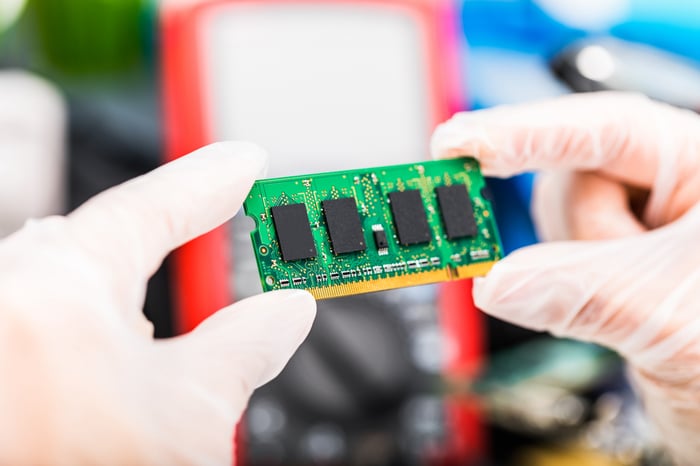
Image source: Getty Images.
3. AMD
AMD has secured the third-largest supply of HBM, locking up about 12% of 2027's production, as well as significant CoWoS capacity for both its GPUs and CPUs. In March, it signed a long-term memory deal with Samsung to secure future supply.
The company's new MI455X GPU uses 50% more HBM than both its previous-generation MI355X and Nvidia's brand-new Rubin GPU, and AMD has recently said it is feeling the HBM supply crunch as demand for its new Helios server has surpassed expectations.
With HBM in tight supply, AMD is also getting innovative. Its new Versal SoC (system-on-a-chip) will integrate LPDDR5X memory-on-package (MoP) architecture to boost bandwidth without needing HBM. This will be more aimed at the physical AI market and will help shield embedded clients from the HBM supply crunch. That has the added benefit of freeing up HBM for its new GPUs aimed at AI workloads.
Should you buy stock in Nvidia right now?
Before you buy stock in Nvidia, consider this:
The Motley Fool Stock Advisor analyst team just identified what they believe are the 10 best stocks for investors to buy now… and Nvidia wasn’t one of them. The 10 stocks that made the cut could produce monster returns in the coming years.
Consider when Netflix made this list on December 17, 2004... if you invested $1,000 at the time of our recommendation, you’d have $406,141!* Or when Nvidia made this list on April 15, 2005... if you invested $1,000 at the time of our recommendation, you’d have $1,347,745!*
Now, it’s worth noting Stock Advisor’s total average return is 940% — a market-crushing outperformance compared to 211% for the S&P 500. Don't miss the latest top 10 list, available with Stock Advisor, and join an investing community built by individual investors for individual investors.
See the 10 stocks »
*Stock Advisor returns as of September 18, 2026.
Geoffrey Seiler has positions in Advanced Micro Devices, Alphabet, and Broadcom. The Motley Fool has positions in and recommends ASML, Advanced Micro Devices, Alphabet, Broadcom, Micron Technology, and Nvidia. The Motley Fool has a disclosure policy.
Recommended Articles


