


Should You Buy Oracle Stock While It's Down 53% From Its Peak? The Answer Might Surprise You.
Key Points
AI companies like OpenAI are lining up to rent computing capacity from Oracle's powerful data centers.
Oracle's infrastructure business produced lightning-fast revenue growth of 120% during the company's recent fiscal 2027 first quarter.
Oracle stock looks like a bargain right now, but concerns about the company's future are mounting.
- 10 stocks we like better than Oracle ›
Oracle (NYSE: ORCL) stock is down 53% from last year's record high and is currently trading at a very attractive valuation, but that doesn't necessarily mean it's a buy. Even though the company operates some of the best data centers for processing artificial intelligence (AI) workloads, investors are worried about its significant debt, particularly because some of its biggest customers might not be able to meet their financial commitments over the next few years.
Oracle's latest operating results for its fiscal 2027 first quarter (ended Aug. 31) did little to ease those concerns, despite blistering revenue growth from its cloud infrastructure business. Here's why investors should think twice before buying the stock.
Missed Nvidia in 2009? This Rare Signal Is Flashing Again. In 2009, a "Double Down" signal flashed for a little-known chipmaker called Nvidia. For the first time in years, that same "Total Conviction" signal is flashing for a company 1/100th the size of Nvidia. Continue »
Image source: The Motley Fool.
Oracle operates some of the world's best AI data centers
Developing an AI model requires substantial computing power, typically delivered by large data centers that house thousands of specialized chips called graphics processing units (GPUs). The average business doesn't have billions of dollars to build this infrastructure, so they rent it from cloud providers like Oracle instead.
Oracle's data centers are equipped with GPUs from leading suppliers such as Nvidia and Advanced Micro Devices, giving developers some optionality. It connects these chips using a proprietary remote direct memory access (RDMA) technology, which transfers data between components faster than traditional Ethernet networks, resulting in higher processing speeds.
All of Oracle's data centers use a similar architecture regardless of their size, and they are also highly automated by software. These attributes enable the company to bring infrastructure online faster than most competitors, which is attractive to developers eagerly awaiting more computing capacity.
OpenAI, xAI, and Meta Platforms are just some of Oracle's top AI customers. In fact, OpenAI recently trained its latest GPT-6 Astra models at Oracle's data center campus in Abilene, Texas.
Infrastructure revenue growth continues to accelerate, but the risks are mounting
Oracle generated $19.3 billion in total revenue during its fiscal 2027 first quarter, a 30% increase from the year-ago period. But all eyes were on the company's cloud infrastructure business, which accounts for the money it earned by renting computing capacity to customers. Its Q1 revenue exploded by a whopping 120% to $7.4 billion, accelerating from the 93% growth it posted three months earlier.
Management expects infrastructure revenue growth to continue accelerating, partly because of Oracle's $664 billion in remaining performance obligations (RPO). RPO reflects the value of signed contracts for services that haven't been delivered yet, so it's like an order backlog from customers who are waiting for more data center capacity to come online.
But there are growing concerns that Oracle won't be able to convert all of its RPO into actual revenue. According to a report by The Wall Street Journal last September, OpenAI alone accounts for $300 billion of Oracle's total backlog. OpenAI currently has just $40 billion in annualized revenue and is losing money, so there is no guarantee it will ever be able to fulfill its commitments.
Plus, OpenAI CEO Sam Altman recently expressed support for Anthropic's strategy to pace AI development to curb some of the risks to humanity, which could alter the trajectory of the company's spending plans.
Oracle has borrowed a significant amount of money to fund the build-out of its data centers and now carries over $117 billion in long-term debt. The company could find itself in a dire financial situation if its customers don't meet their obligations.
Oracle stock looks cheap, but that doesn't mean it will rise
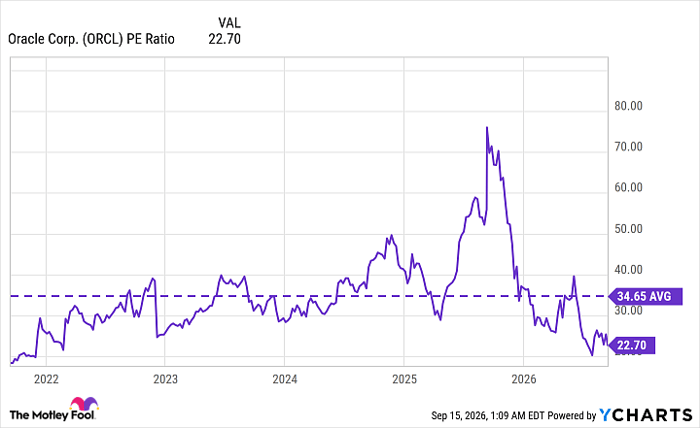
Oracle delivered generally accepted accounting principles (GAAP) earnings of $6.38 per share over the last four quarters, placing its stock at a price-to-earnings (P/E) ratio of 22.6. That is a steep discount to its five-year average P/E of 34.6, suggesting the stock is undervalued.
Data by YCharts.
Moreover, Oracle is cheaper than both the S&P 500 and Nasdaq-100 indexes, which have P/E ratios of 23.2 and 33.8, respectively. Therefore, this stock looks like an attractive buy based on valuation alone.
However, there is a big question mark over Oracle's future earnings, because it's hard to predict how much of its RPO will actually translate into revenue and profit. It seems investors aren't willing to pay a premium valuation for the company due to that uncertainty, which is understandable, as its substantial debt adds even more risk to the equation.
This is why a beaten-down stock isn't always a cheap stock, so I think investors might be better off steering clear of Oracle for the time being.
Should you buy stock in Oracle right now?
Before you buy stock in Oracle, consider this:
The Motley Fool Stock Advisor analyst team just identified what they believe are the 10 best stocks for investors to buy now… and Oracle wasn’t one of them. The 10 stocks that made the cut could produce monster returns in the coming years.
Consider when Netflix made this list on December 17, 2004... if you invested $1,000 at the time of our recommendation, you’d have $420,109!* Or when Nvidia made this list on April 15, 2005... if you invested $1,000 at the time of our recommendation, you’d have $1,303,689!*
Now, it’s worth noting Stock Advisor’s total average return is 938% — a market-crushing outperformance compared to 211% for the S&P 500. Don't miss the latest top 10 list, available with Stock Advisor, and join an investing community built by individual investors for individual investors.
See the 10 stocks »
*Stock Advisor returns as of September 17, 2026.
Anthony Di Pizio has no position in any of the stocks mentioned. The Motley Fool has positions in and recommends Advanced Micro Devices, Meta Platforms, Nvidia, and Oracle. The Motley Fool has a disclosure policy.
Recommended Articles


