


Step Aside, ExxonMobil: 2 Foundational AI Stocks Now Pay Larger Dividends
Key Points
Statistically, dividend stocks have run circles around non-payers in the return column over the previous 52 years.
The backbone of AI-accelerated data centers recently increased its quarterly payout 25-fold.
Meanwhile, a legacy software company that’s become an AI applications leader has raised its annual dividend for 21 consecutive years.
- 10 stocks we like better than Nvidia ›
Though there is no shortage of ways to make money on Wall Street, buying and holding high-quality dividend stocks is near the top of the list. In "The Power of Dividends: Past, Present, and Future," the analysts at Hartford Funds, in collaboration with Ned Davis Research, found that dividend stocks crushed non-payers in average annual return from 1973-2025 (9.2% vs. 4.21%).
Historically, oil stocks like ExxonMobil (NYSE:XOM) have been top-tier sources of income. ExxonMobil's $4.12/share annual dividend equates to more than $16.9 billion in payouts. But you might be surprised to learn that two of Wall Street's foundational artificial intelligence (AI) stocks -- Nvidia (NASDAQ:NVDA) and Microsoft (NASDAQ:MSFT) -- have leapfrogged ExxonMobil in annual payouts.
Missed Nvidia in 2009? This Rare Signal Is Flashing Again. In 2009, a "Double Down" signal flashed for a little-known chipmaker called Nvidia. For the first time in years, that same "Total Conviction" signal is flashing for a company 1/100th the size of Nvidia. Continue »

Image source: Getty Images.
Nvidia: $24.15 billion in annual dividend payouts
Dividends have never played a particularly large role in the Nvidia investment thesis. However, the AI revolution changed everything.
Nvidia's graphics processing units (GPUs) are essentially the brains that power AI-accelerated data centers. Four generations of Nvidia's GPUs (Hopper, Blackwell, Blackwell Ultra, and Vera Rubin) collectively hold a virtual monopoly in enterprise data centers. The company's chips possess clear compute advantages that businesses have been willing to pay a premium for.
Additionally, CEO Jensen Huang aims to bring a new advanced chip to market each year. Such an aggressive innovation cycle should help Nvidia to retain its clear-cut compute edge.
The AI hardware supply-demand mismatch is working in Nvidia's favor, as well. Even with Taiwan Semiconductor Manufacturing's (NYSE:TSM) best efforts to expand its chip-on-wafer-on-substrate capacity, demand for GPUs (and other AI infrastructure) has overwhelmed supply, leading to otherworldly pricing power for hardware providers.
With Nvidia rolling in the dough, courtesy of insatiable GPU demand, the company has increased its quarterly dividend 25-fold to $0.25. This works out to an annual dividend payout of $24.15 billion.

Image source: Getty Images.
Microsoft: $27.05 billion in annual dividend payouts
But when it comes to the kingpin of dividend stocks on Wall Street, it's legacy software giant Microsoft that takes the crown. Even though Microsoft is only yielding 0.73%, the company has raised its payout for 21 consecutive years, with its $3.64/share dividend equating to more than $27 billion in annual payments.
Although Microsoft's legacy software platforms, such as Windows and Office, left their growth heydays long ago, they're still dominant and capable of generating a boatload of operating cash flow. The cash flow generated from Microsoft's legacy operations helps to fund acquisitions and its AI ambitions.
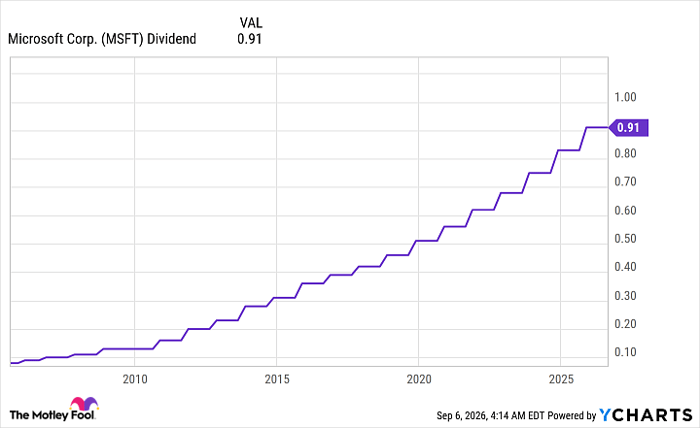
MSFT Dividend data by YCharts
Whereas Nvidia is a foundational hardware company, Microsoft is at the forefront of AI applications.
Before artificial intelligence became the hottest thing since sliced bread, Microsoft's Azure cloud platform was steadily growing sales by around 30% annually. Since integrating generative AI and large language model capabilities into Azure, the world's No. 2 cloud infrastructure services platform by total spend, sales growth has reaccelerated to 43%, as of the fiscal fourth quarter (ending June 30).
Microsoft closed out fiscal 2026 with more than $76.8 billion in cash, cash equivalents, and short-term investments, and generated close to $183 billion in net cash from its operations for the full year. It has more than enough capital flowing into its coffers to invest aggressively in AI and take care of its shareholders.
Should you buy stock in Nvidia right now?
Before you buy stock in Nvidia, consider this:
The Motley Fool Stock Advisor analyst team just identified what they believe are the 10 best stocks for investors to buy now… and Nvidia wasn’t one of them. The 10 stocks that made the cut could produce monster returns in the coming years.
Consider when Netflix made this list on December 17, 2004... if you invested $1,000 at the time of our recommendation, you’d have $421,997!* Or when Nvidia made this list on April 15, 2005... if you invested $1,000 at the time of our recommendation, you’d have $1,413,876!*
Now, it’s worth noting Stock Advisor’s total average return is 978% — a market-crushing outperformance compared to 213% for the S&P 500. Don't miss the latest top 10 list, available with Stock Advisor, and join an investing community built by individual investors for individual investors.
See the 10 stocks »
*Stock Advisor returns as of September 9, 2026.
Sean Williams has no position in any of the stocks mentioned. The Motley Fool has positions in and recommends Microsoft, Nvidia, and Taiwan Semiconductor Manufacturing. The Motley Fool has a disclosure policy.
Recommended Articles


