


Prediction: This Is What a $5,000 Investment in Eli Lilly Will Be Worth in 2031
Key Points
Eli Lilly has crushed broader equities in recent years.
The company's leadership in the fast-growing GLP-1 market grants it attractive medium-term prospects.
The stock can deliver competitive returns over the next five years.
- 10 stocks we like better than Eli Lilly ›
If you had invested $5,000 in Eli Lilly (NYSE: LLY) five years ago, you'd be sitting pretty today. The stock has delivered a compound annual growth rate (CAGR) of 35.86% over this period (as of writing), turning $5,000 into about $23,143. This is much better than the S&P 500's 12.82% CAGR since 2021, which would have grown $5,000 into $9,139. While Eli Lilly's performance in recent years has been impressive, it's much more important to try to determine whether the drugmaker can also beat the market going forward. Here's my prediction for Eli Lilly through 2031.
Image source: The Motley Fool.
Missed Nvidia in 2009? This Rare Signal Is Flashing Again. In 2009, a "Double Down" signal flashed for a little-known chipmaker called Nvidia. For the first time in years, that same "Total Conviction" signal is flashing for a company 1/100th the size of Nvidia. Continue »
Is it too late to buy?
One interesting feature of the pharmaceutical industry is that companies often experience substantial gains from clinical and regulatory progress before even generating significant sales for leading candidates. That's what happened to Eli Lilly. Even before tirzepatide's approval, analysts had high hopes for the medicine. Tirzepatide is currently Eli Lilly's most important growth driver and is sold under the brand names Mounjaro (for diabetes) and Zepbound (for weight management in some regions).
The medicine was first approved in 2022 and is already the world's best-selling compound. Tirzepatide has arguably exceeded expectations, driving Eli Lilly's sales and stock price higher. But it could run into several issues in the medium term. Other companies will launch competing weight-loss medicines, potentially leading to lower tirzepatide sales (due to decreased sales volume and lower realized prices). Eli Lilly's revenue and earnings have grown at rates well above average for pharmaceutical giants over the past five years.
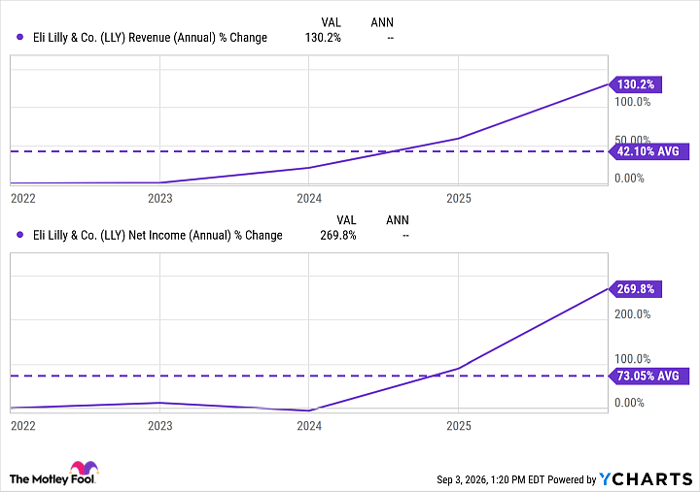
LLY Revenue (Annual) data by YCharts
The drugmaker is unlikely to maintain this pace through 2031.
That said, there are also reasons to be bullish on the stock. Let's consider three of them. First, even with increased competition in its core GLP-1 area, this corner of the pharmaceutical industry is projected to grow rapidly over the next five years (and likely beyond). Some medicines will compete directly with Mounjaro and Zepbound, but the market will also expand as breakthroughs open new opportunities.
Take Eli Lilly's Foundayo, an oral weight loss GLP-1 medication that earned approval in April. The company noted that 80% of Foundayo's prescriptions were for patients who had never taken GLP-1s before.
Translation: Foundayo isn't just cannibalizing Zepbound's sales. It is expanding the market. Second, Eli Lilly has a pipeline full of products that could establish it as a leader in new categories of the GLP-1 space. Consider, once again, tirzepatide. It is showing promise as a combination therapy for autoimmune disorders and is being investigated across other areas as well.
Eli Lilly's next-gen obesity drug, retatrutide, posted efficacy results that some have compared to what we typically see in weight loss surgery, something never before seen in the industry. That's another medicine that will help expand the market, as early access to retatrutide is showing. Eli Lilly is offering it to certain patients, even though it hasn't received approval. One criterion these patients must meet is to have treatment-resistant obesity. Eli Lilly is also developing eloralintide, which mimics the amylin hormone. Eloralintide's differentiator could be its better tolerability compared with GLP-1 medicines.
Eli Lilly's GLP-1 pipeline is arguably second to none, so as the market expands, expect the company to stay in the lead. Third, Eli Lilly has an attractive approved lineup and pipeline even beyond its core area. Several of the company's newer products will continue posting strong results over the next five years. It should also launch new products in areas such as neuroscience, immunology, and oncology.
Here's the math
Eli Lilly is trading at 24.6x forward earnings, compared to the average of 18.9x for healthcare stocks. The premium is well-deserved, given its outstanding results. Let's assume its earnings per share (EPS) grow at an average of 20% over the next five years and its forward price-to-earnings ratio contracts to 20. Under this scenario, the stock will grow from its current market cap of $1.09 trillion to $2.2 trillion, or a roughly 15.1% annualized return. So a $5,000 investment could be worth about $10,100 in five years.
That's not bad at all, and the 20% average EPS growth assumption seems reasonable, considering Eli Lilly will almost certainly substantially top that over the next couple of years, at least, as its tirzepatide-bound tailwind continues. Now, a lot could go wrong. Clinical setbacks, the GLP-1 market not growing as fast as we expect, more competition or price erosion in this area than expected, etc. However, my view is that Eli Lilly remains well-positioned to deliver solid returns through 2031.
Should you buy stock in Eli Lilly right now?
Before you buy stock in Eli Lilly, consider this:
The Motley Fool Stock Advisor analyst team just identified what they believe are the 10 best stocks for investors to buy now… and Eli Lilly wasn’t one of them. The 10 stocks that made the cut could produce monster returns in the coming years.
Consider when Netflix made this list on December 17, 2004... if you invested $1,000 at the time of our recommendation, you’d have $421,997!* Or when Nvidia made this list on April 15, 2005... if you invested $1,000 at the time of our recommendation, you’d have $1,413,876!*
Now, it’s worth noting Stock Advisor’s total average return is 978% — a market-crushing outperformance compared to 213% for the S&P 500. Don't miss the latest top 10 list, available with Stock Advisor, and join an investing community built by individual investors for individual investors.
See the 10 stocks »
*Stock Advisor returns as of September 9, 2026.
Prosper Junior Bakiny has positions in Eli Lilly. The Motley Fool has positions in and recommends Eli Lilly. The Motley Fool has a disclosure policy.
Recommended Articles


