


Not a Crash, Not a Correction: What the September Effect Really Means for Artificial Intelligence (AI) Chip Stocks
Key Points
Over the last several decades, the S&P 500, Nasdaq Composite, and Dow Jones Industrial Average have averaged negative returns during September.
Artificial intelligence (AI) chip stocks had mixed performances during the last three Septembers.
Chip-themed ETFs offer a compelling way to invest in semiconductor stocks without picking individual names.
- 10 stocks we like better than iShares Trust - iShares Semiconductor ETF ›
Wall Street has a habit of turning the occasional quirk into full-blown folklore, and few stories get recycled as hard as the September Effect. Every year around Labor Day, the same storyline makes its way into the headlines: Money managers come back from vacation, they start rebalancing their funds, and stocks subsequently take a hit.
For most of the market, this pattern brings unwanted selling pressure. For names that have already run hot for years, namely artificial intelligence (AI) chip stocks, it can feel like someone purposely yanked the rug from underneath things.
Missed Nvidia in 2009? This Rare Signal Is Flashing Again. In 2009, a "Double Down" signal flashed for a little-known chipmaker called Nvidia. For the first time in years, that same "Total Conviction" signal is flashing for a company 1/100th the size of Nvidia. Continue »
The question right now isn't whether the September Effect actually exists. It's whether they will deliver a lasting punch while the market leans hard on semiconductor leaders like Nvidia (NASDAQ: NVDA), Broadcom (NASDAQ: AVGO), Advanced Micro Devices (NASDAQ: AMD), and a handful of other silicon darlings.

Image source: Getty Images.
What does the September Effect actually look like?
Over the long haul, September is the only month that features a negative average return. Since 1928, the S&P 500 (SNPINDEX: ^GSPC) has lost 1.1% on average during the month of September and finished lower roughly 56% of the time. Meanwhile, the Nasdaq Composite (NASDAQINDEX: ^IXIC) has dropped 0.9% on average since its inception in 1971. What's interesting is that the Nasdaq has actually finished in the green 52% of the time, but the ugly years drag the index's long-term September average below zero.
The Dow Jones Industrial Average (DJINDICES: ^DJI) isn't any prettier. Since 1897, the Dow has dropped 1.1% on average during September and finished the month positive only 42% of the time.
As you can see, not every September is a bloodbath for stocks. Nevertheless, the pattern is consistent enough that traders treat this month as a legitimate seasonal headwind rather than a coincidence. The usual explanations are pretty straightforward: Portfolio managers rebalance after summer and get a head start on tax-loss harvesting. From there, it's just a self-fulfilling prophecy once enough investors decide to get defensive and rotate out of growth and into areas like consumer staples and utilities.
How have AI chip stocks performed during the September Effect?
The AI revolution includes a small number of September Effects so far: 2023, 2024, and 2025. To see how semiconductor stocks fared during these periods, I'll benchmark the category leaders against two popular chip-themed exchange-traded funds (ETFs).
The VanEck Semiconductor ETF (NASDAQ: SMH) is a concentrated basket of 26 chip names. Nvidia is the 800-pound gorilla, comprising roughly 23% of the fund. Other major holdings include Taiwan Semiconductor Manufacturing, Broadcom, Micron Technology, AMD, and ASML. The iShares Semiconductor ETF (NASDAQ: SOXX) is built around 30 AI chip stocks, including Nvidia, Micron, Intel, Marvell Technology, and Applied Materials.
In September 2023, both SMH and SOXX dropped about 7%. While that's pretty ugly, it beat Nvidia's decline of 10% and was on par with TSMC, AMD, and Marvell. In September 2024, both ETFs finished the month flat. While this underperformed the positive performances of major AI chip stocks, it was also insulated from the losses seen in select laggards.
Last year, the VanEck Semiconductor ETF gained 12% in September while the iShares Semiconductor ETF soared 11%. As you'd expect, the broader chip complex sported much higher gains.
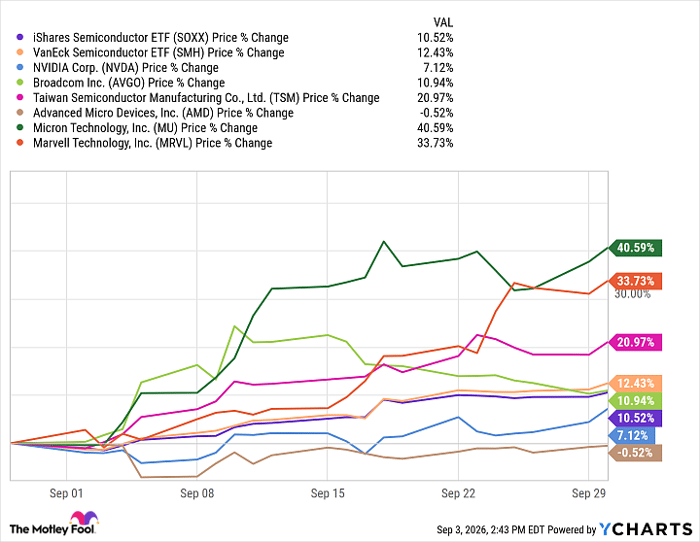
Data by YCharts.
The lesson here is straightforward: Individual chip stocks can move much higher or much lower relative to a basket of stocks. These ETFs give investors exposure to the same AI chip theme, but come with less of the whiplash from single stocks.
Will the stock market correct this September?
The analysis in this piece is meant to drive home the point that September has never been a reliable signal that a correction or crash is on the way. At best, it is a seasonal phenomenon that sometimes shows up and drags the market down. The last two years proved that strong earnings, falling interest rates, and insatiable demand for AI compute can overpower the historical pattern.
Investors need to accept that AI chip stocks are growth names with frothy valuations and high liquidity. When the market gets uneasy, stocks that previously rallied hard are precisely the ones that get sold first. This is not the same thing as a fracture in the AI infrastructure thesis. Data center build-outs are accelerating, hyperscalers are investing in custom ASICs, and memory demand is not going away just because September arrived.
The practical move is not to dump all of your chip stocks this month. Instead, you need to decide how much volatility you can actually tolerate. If you own individual stocks, size them in such a way that a 10% drop doesn't force you to panic-sell.
If you want to participate in the AI chip theme without the risks that come with picking individual stocks, SMH and SOXX offer compelling upside while keeping downside pressure relatively insulated.
Remember, the market's worst month has a history of being followed by better ones -- I'm looking at you, Santa Claus rally! While the September Effect is real enough to respect, it should not be influential enough to dictate decisions that can affect your portfolio for the rest of the year.
Should you buy stock in iShares Trust - iShares Semiconductor ETF right now?
Before you buy stock in iShares Trust - iShares Semiconductor ETF, consider this:
The Motley Fool Stock Advisor analyst team just identified what they believe are the 10 best stocks for investors to buy now… and iShares Trust - iShares Semiconductor ETF wasn’t one of them. The 10 stocks that made the cut could produce monster returns in the coming years.
Consider when Netflix made this list on December 17, 2004... if you invested $1,000 at the time of our recommendation, you’d have $421,997!* Or when Nvidia made this list on April 15, 2005... if you invested $1,000 at the time of our recommendation, you’d have $1,413,876!*
Now, it’s worth noting Stock Advisor’s total average return is 978% — a market-crushing outperformance compared to 213% for the S&P 500. Don't miss the latest top 10 list, available with Stock Advisor, and join an investing community built by individual investors for individual investors.
See the 10 stocks »
*Stock Advisor returns as of September 7, 2026.
Adam Spatacco has positions in Nvidia. The Motley Fool has positions in and recommends ASML, Advanced Micro Devices, Applied Materials, Broadcom, Intel, Marvell Technology, Micron Technology, Nvidia, Taiwan Semiconductor Manufacturing, and iShares Trust-iShares Semiconductor ETF. The Motley Fool has a disclosure policy.
Recommended Articles


