


Snowflake Stock Price Prediction: Earnings Beat Across the Board Sparks Stock Surge of Over 23%, Can SNOW Break $400?
TradingKey - AI data cloud company Snowflake (SNOW) delivered an earnings report that was significantly stronger than market expectations. Driven by revenue, earnings, and full-year guidance all beating expectations, the company's stock rose over 23% in extended trading on September 2, breaking above $370.
This performance is particularly noteworthy because Snowflake's stock had already fallen about 4.4% during regular trading hours that day, meaning the strong rebound following the earnings release was driven almost entirely by the company's own performance.
Prior to this, as of the close on September 2, SNOW had gained about 39% year-to-date, significantly outperforming the S&P 500 Index's gain of roughly 12% over the same period. With the stock price already at a high level, the company was still able to further raise market expectations with its results and guidance, indicating that investors are re-evaluating the growth potential of its AI business.
For the second quarter of fiscal 2027 ended July 31, 2026, Snowflake's total revenue reached $1.55 billion, up 35% year-over-year, exceeding analysts' expectations of $1.48 billion surveyed by LSEG; adjusted earnings per share were $0.62, also significantly beating the expected $0.45. On a GAAP basis, the company's net loss narrowed to $192 million from $298 million in the same period last year, with loss per share dropping from $0.89 to $0.55.
Product Revenue Continues to Accelerate as AI Begins Translating into Actual Consumption
Product revenue accelerating for consecutive quarters was one of the most important changes in this earnings report.
Snowflake operates on a consumption-based business model, making product revenue a better reflection of clients' actual platform usage than mere contract signings. Product revenue in the second quarter grew 37% year-over-year, accelerating for the third consecutive quarter. Meanwhile, management stated that growth in AI-related revenue has made a notable contribution to the overall acceleration of the business.
This contrasts with the market's past skepticism regarding Snowflake's AI story. Previously, investors' biggest question was not whether enterprises were experimenting with AI, but whether these AI projects could actually translate into increased demand for data storage, compute, and analytics. Today, judging from product revenue and customer usage, this conversion is becoming much clearer.
Cortex Code, also known as CoCo, is one of the most watched products. The AI coding agent currently has over 9,100 accounts, adding more than 2,000 in a single quarter. The number of accounts for CoWork, tailored for enterprise data analytics, also reached 5,800. As more enterprises build AI applications directly on top of their own data, Snowflake is expected to further extend from a traditional data platform into the execution and management layer for AI applications.
CEO Sridhar Ramaswamy also emphasized that the AI transformation is driving more customers to migrate data and workloads to the Snowflake platform. For investors, the significance of this lies in the fact that if AI workloads continue to expand, it will bring not only increased usage of software features, but could also further boost consumption on the underlying data platform.
SNOW's High Valuation Starts to Gain Earnings Support as Guidance Raised
Snowflake expects third-quarter product revenue to be between $1.588 billion and $1.593 billion, representing year-over-year growth of 37% to 38%, well above market expectations of approximately $1.5 billion. This guidance suggests that the growth acceleration in the second quarter was not a one-off event, and the company expects demand for AI workloads and its core data platform to continue expanding in the second half of the year.
Management also significantly raised its fiscal 2027 product revenue forecast from $5.84 billion to $6.07 billion, expecting year-over-year growth of 36%, up from its prior forecast of 31%. Full-year adjusted operating margin guidance was also raised from 13.5% to 14.5%.
Second-quarter adjusted operating profit reached $237 million, corresponding to a margin of 15.3%, up 4.1 percentage points from the same period last year. Sales, research and development, and general and administrative expenses as a percentage of revenue all declined, indicating that Snowflake is leveraging its existing workforce and infrastructure to handle more revenue rather than relying solely on increased spending to drive growth.
However, AI workloads have also brought higher compute costs, with second-quarter adjusted product gross margin dropping to 74.7% from 75.8% in the same period last year. Snowflake's five-year, $6 billion agreement with Amazon Web Services helps the company lock in prices for certain cloud infrastructure and compute resources, but increased AI usage could still put pressure on gross margins in the short term.
Snowflake Technical Analysis: Can SNOW Break $400?
Source: TradingView
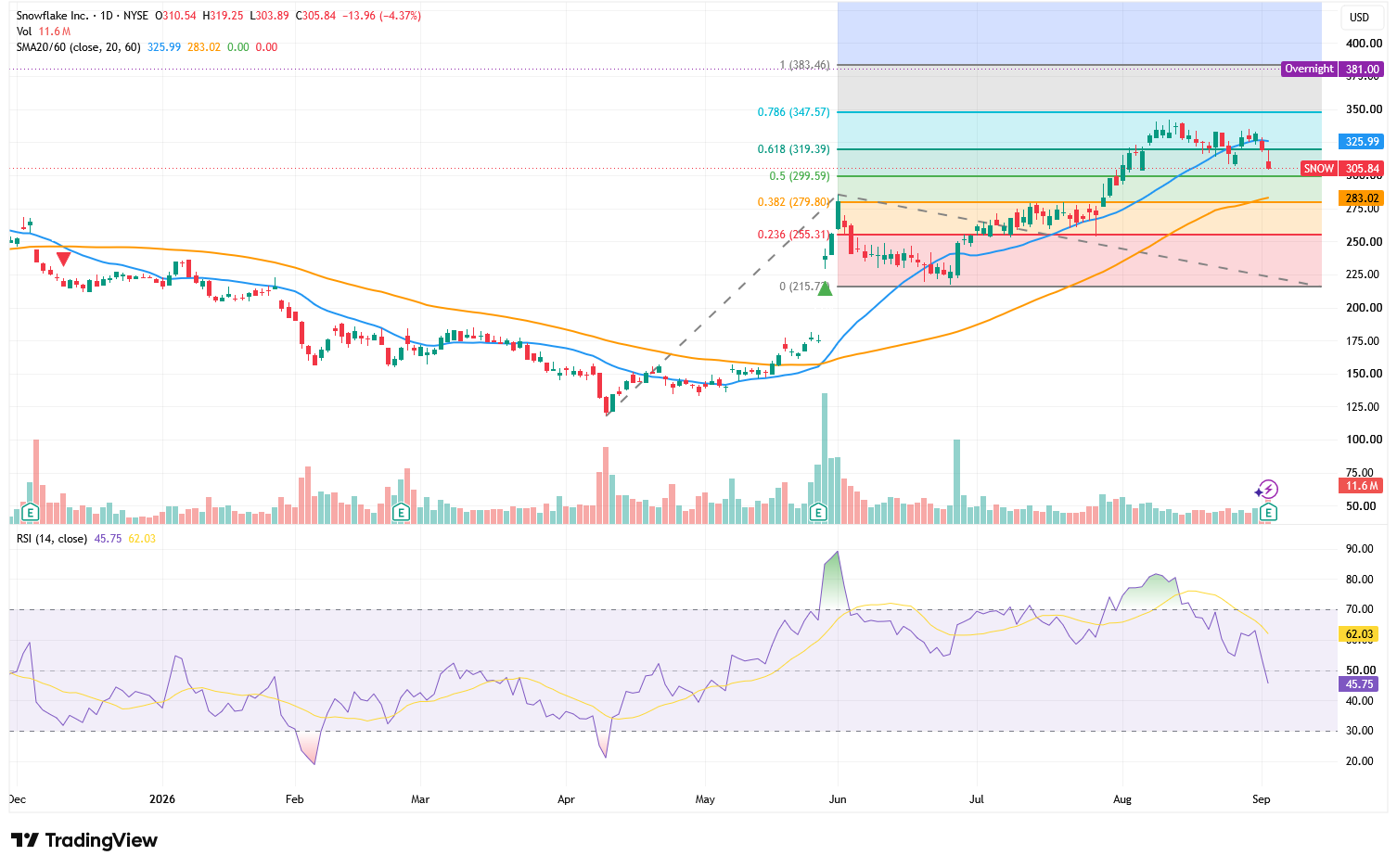
On the daily chart, SNOW closed at $305.84 prior to its earnings release, below its 20-day moving average of $325.99 but still above its 60-day moving average of $283.02, indicating a weak short-term trend while the medium-term upward structure remains intact. The RSI stood at 45.75, below both the 50 midpoint and its signal line of 62.03, suggesting the stock was still in a consolidation phase ahead of the earnings report.
After rising to $379.40 in extended trading, SNOW will reclaim both its 20-day and 60-day moving averages and break above the 0.786 Fibonacci extension level at $347.57. Currently, it faces initial resistance in the $379 to $383.46 range, with $383.46 corresponding to the 1.0 Fibonacci extension target. Note that after-hours prices are not yet reflected in the daily candlestick, RSI, or regular trading session volume, so confirmation upon a formal close is still required.
If SNOW can close above $383.46 on heavy volume during regular trading hours, $400 to $405 will become the next target. A further breakthrough above $405 could push the stock into a price discovery stage, with upside attention on the 1.272 extension level around $429.
If the stock encounters resistance near $380 to $383, primary support lies at $347.57. As long as any pullback holds above $347, the post-earnings breakout structure remains intact; if it falls below this level, the stock may fill the gap and test the $319.39 to $325.99 zone. Lower support levels sit at $299.59 and the 60-day moving average of $283.02, respectively.
Recommended Articles


