


The Strait of Hormuz Conflict Just Escalated Again. Here's What It Means for Shell.
Key Points
Over the weekend, the U.S. resumed military strikes on Iran, which hadn't taken place in nearly a month.
The price of oil jumped 2% in response.
Oil price increases have caused the stock prices of Shell and other oil majors to rise.
Shell has natural gas assets in Qatar that have been affected by the war.
- 10 stocks we like better than Shell Plc ›
The war in Iran, now more than six months old, had seen a lull in fighting since late July. But that all changed over the weekend as the U.S. launched its first known military strikes on the country in a month.
Over the weekend, the U.S. struck two rocket launchers on Iran's Larak Island in the Strait of Hormuz. The U.S. claimed that Iran was planning to use the launchers to launch sea mines into the Strait.
Missed Nvidia in 2009? This Rare Signal Is Flashing Again. In 2009, a "Double Down" signal flashed for a little-known chipmaker called Nvidia. For the first time in years, that same "Total Conviction" signal is flashing for a company 1/100th the size of Nvidia. Continue »
In response, Iran fired missiles at U.S. bases in Jordan. Jordanian officials said that their air defense systems successfully intercepted and destroyed all eight of the missiles.

Image source: Getty Images.
The rekindling of hostilities caused oil prices to rise by 2%, sending benchmark Brent Crude above $90/barrel again. The war has caused maritime traffic through the Strait of Hormuz to drop to nearly non-existent levels. Only an average of 5 ships a day have been traversing the Strait in August, down from more than 130 per day before the war.
As the war has pushed global oil prices higher, it has also affected the stock prices of the world's largest integrated oil and gas companies, including Shell (NYSE:SHEL), Chevron (NYSE:CVX), and ExxonMobil (NYSE:XOM). Here's how this latest reescalation is likely to affect Shell's stock compared to its peers.
What will be the impact on Shell's stock?
Over the course of the conflict, global oil prices have fluctuated wildly, rising from about $70/barrel at the beginning of the war to $114/barrel in early May.
When the two sides seem to be on the verge of a breakthrough, as when the U.S. and Iran signed a ceasefire in mid-June, the price has sharply declined. When hostilities flare up again, the price rises.
The stock prices of all five global oil majors, including Shell, Chevron, ExxonMobil, British BP PLC (NYSE:BP), and French TotalEnergies SE (NYSE:TTE), have largely moved in tandem with crude oil prices, surging when oil prices rise and dropping when they fall.
Earlier in the year, that meant all of the oil majors were outperforming the S&P 500, but even at the current high prices, the S&P 500 is outperforming all of them since the war began:
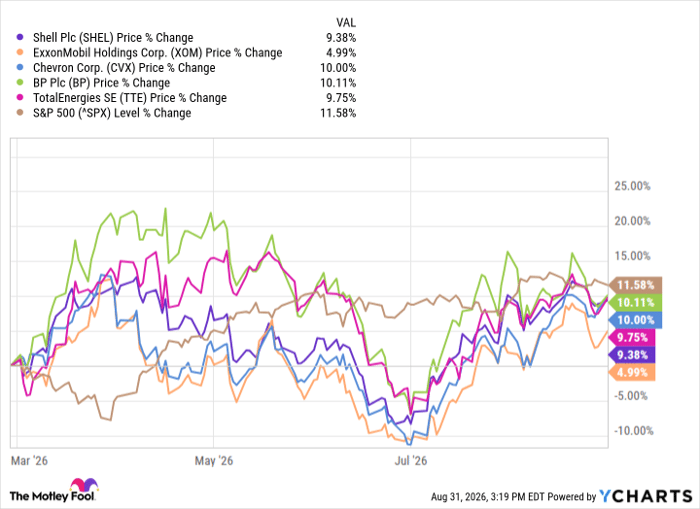
SHEL data by YCharts
Shell has been one of the worst-performing oil majors during the conflict, if only by a fraction of a percentage point. Unlike some of the other oil majors, it has Middle East assets affected by the war, specifically a co-ownership stake in the Pearl Gas-to-Liquids (GTL) plant in Ras Laffan.
On March 18, the plant was struck by an Iranian attack, with one of the two production trains damaged. Shell expects repairs to the damaged train to take about another six months.

Image source: Getty Images.
Shell's natural gas production fell in the second quarter, but was more than offset by higher realized natural gas prices. Further strikes in the region would likely contribute to even higher natural gas prices. Along with higher oil prices, this would likely temporarily boost Shell's bottom line and its share price.
As we saw in June, any oil stock price boost caused by higher oil prices has so far been temporary as well. This latest surge in oil prices, if it continues, could push Shell's stock higher and allow it to outperform the S&P 500. But whether such outperformance would last is a much less certain proposition.
Should you buy stock in Shell Plc right now?
Before you buy stock in Shell Plc, consider this:
The Motley Fool Stock Advisor analyst team just identified what they believe are the 10 best stocks for investors to buy now… and Shell Plc wasn’t one of them. The 10 stocks that made the cut could produce monster returns in the coming years.
Consider when Netflix made this list on December 17, 2004... if you invested $1,000 at the time of our recommendation, you’d have $440,710!* Or when Nvidia made this list on April 15, 2005... if you invested $1,000 at the time of our recommendation, you’d have $1,335,252!*
Now, it’s worth noting Stock Advisor’s total average return is 978% — a market-crushing outperformance compared to 213% for the S&P 500. Don't miss the latest top 10 list, available with Stock Advisor, and join an investing community built by individual investors for individual investors.
See the 10 stocks »
*Stock Advisor returns as of August 31, 2026.
John Bromels has positions in BP. The Motley Fool has positions in and recommends Chevron. The Motley Fool recommends BP. The Motley Fool has a disclosure policy.
Recommended Articles


