


Tim Cook Committed Apple to a $60 Billion Domestic Manufacturing Bet Just Weeks Before Handing Off the CEO Job. Here's What It Means for Apple Investors.
Key Points
Apple is investing $60 billion in Texas as part of a $600 billion, four-year U.S. manufacturing commitment.
A new manufacturing facility in Houston will produce the Mac mini and advanced AI servers.
A stronger U.S. supply chain should reduce tariff-driven cost shocks, helping support more stable earnings.
- 10 stocks we like better than Apple ›
Under CEO Tim Cook, Apple (NASDAQ: AAPL) has delivered an impressive 2,000%-plus return since 2011. Now, as Cook prepares to hand the reins to Apple's senior vice president of hardware engineering, John Ternus, he's doubling down on a stronger domestic supply chain -- with $60 billion earmarked for Texas.
The goal appears straightforward: reduce the risk of future tariff disruptions and protect Apple's margins and earnings path, freeing Ternus, who takes the top job on Sept. 1, to focus on what he does best: building world-class products and services.
Missed Nvidia in 2009? This Rare Signal Is Flashing Again. In 2009, a "Double Down" signal flashed for a little-known chipmaker called Nvidia. For the first time in years, that same "Total Conviction" signal is flashing for a company 1/100th the size of Nvidia. Continue »
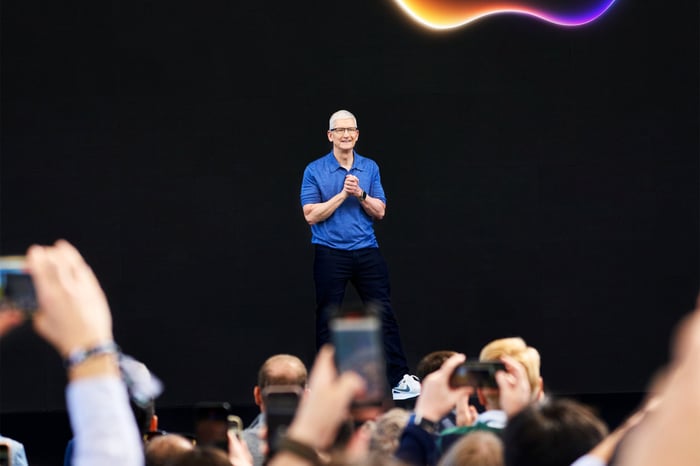
Apple CEO Tim Cook. Image source: Apple.
Apple's domestic manufacturing push
The Texas investment is part of a broader $600 billion, four-year U.S. manufacturing commitment Apple announced last year. Apple still won't be making iPhones in the U.S., but it will manufacture the Mac mini at a new facility in Houston. The new facility will also build and ship Apple's advanced AI servers.
Separately, Apple recently announced a long-term agreement with Broadcom to design and produce custom silicon components and advanced wireless technologies -- a deal expected to exceed $30 billion.
On the company's fiscal Q3 earnings call, Cook said, "This marks our largest-ever American manufacturing program commitment. It's also an important step forward in our work to build an end-to-end silicon supply chain here in the U.S."
Even if making iPhones domestically remains out of reach without meaningfully higher prices, shifting more of the supply chain to U.S. sources should help Apple better manage future changes in tariff and trade policy.
What the domestic investment means for earnings
Apple's latest quarterly report showed how much tariff policies can swing results. Gross margin was 50.1%, with 2 percentage points coming from tariff refunds. Diluted earnings per share grew 29% year over year to $2.02, including $0.11 from refunds. Apple said it is reinvesting those tariff refunds into the U.S. supply chain.
The refunds are for tariffs already paid before the U.S. Supreme Court ruled in February 2026 that certain tariffs were unlawful. But that doesn't eliminate the risk of other tariffs being imposed under different statutes, prompting Apple to continue investing in the U.S.
The near-term pressure point is memory costs. Management described today's surge in memory pricing as a "100-year flood." For fiscal Q4 ending in September, Apple expects gross margin between 47% and 48%, including a one-point benefit from tariff refunds.
Overall, Cook will hand off to Ternus a more resilient U.S. supply chain. Analysts still expect Apple to grow earnings at a low double-digit rate over the long term. While the memory price surge could be a near-term headwind, Apple's efforts to bolster its U.S. supply chain essentially serve as tariff insurance over the long term, helping keep earnings and margins more stable in the event of future policy changes.
Should you buy stock in Apple right now?
Before you buy stock in Apple, consider this:
The Motley Fool Stock Advisor analyst team just identified what they believe are the 10 best stocks for investors to buy now… and Apple wasn’t one of them. The 10 stocks that made the cut could produce monster returns in the coming years.
Consider when Netflix made this list on December 17, 2004... if you invested $1,000 at the time of our recommendation, you’d have $440,710!* Or when Nvidia made this list on April 15, 2005... if you invested $1,000 at the time of our recommendation, you’d have $1,335,252!*
Now, it’s worth noting Stock Advisor’s total average return is 978% — a market-crushing outperformance compared to 213% for the S&P 500. Don't miss the latest top 10 list, available with Stock Advisor, and join an investing community built by individual investors for individual investors.
See the 10 stocks »
*Stock Advisor returns as of August 30, 2026.
John Ballard has no position in any of the stocks mentioned. The Motley Fool has positions in and recommends Apple and Broadcom. The Motley Fool has a disclosure policy.
Recommended Articles


