


TSMC vs. ASML: Which Semiconductor Giant Is the Better Stock Buy?
Key Points
Taiwan Semiconductor Manufacturing is growing faster.
ASML's stock gets a valuation boost due to its technology.
- 10 stocks we like better than Taiwan Semiconductor Manufacturing ›
Taiwan Semiconductor Manufacturing (NYSE: TSM) and ASML (NASDAQ: ASML) are two vital companies for the world economy, even if they may not be well known. Taiwan Semiconductor, or TSMC as it is also known, is by far the largest chip foundry in the world, and produces logic chips for nearly every major tech company. ASML provides machinery to produce the advanced chips that TSMC and its peers manufacture, and is the only company in the world with this technology, giving it a rare technological monopoly.
Both of these companies have seen their stocks skyrocket over the past few years, but with the AI build-out projected to last for several more years, they have more upside ahead.
Missed Nvidia in 2009? This Rare Signal Is Flashing Again. In 2009, a "Double Down" signal flashed for a little-known chipmaker called Nvidia. For the first time in years, that same "Total Conviction" signal is flashing for a company 1/100th the size of Nvidia. Continue »
But which of these two stocks makes for the better long-term buy at the moment? Let's take a look.

Image source: Getty Images.
A technological monopoly is hard to beat
ASML makes extreme ultraviolet (EUV) lithography machines. These machines are massive, cost hundreds of millions of dollars, and take a very specific supply chain to deliver and install. The end product is the size of a school bus, and it helps lay the tiny electrical traces on a chip. TSMC's current most advanced chip generation is 2nm chips, which indicates 2 nanometers of spacing between electrical traces. For reference, a human hair measures between 80,000 and 100,000 nanometers wide.
ASML's business booms when chip production increases, as it supplies the machines critical to chip production. Right now, there is a major chip production capacity build-out going on, so ASML's business is booming. It's a no-brainer beneficiary of the AI build-out, but it's a bit more lumpy than TSMC's business.
TSMC is a chip foundry and takes chip designs from its clients and manufactures them at scale. This is a technologically complex process involving hundreds of steps, but the business is pretty straightforward. If chip demand increases, TSMC does well. That's exactly what we're seeing right now. With its CEO projecting elevated AI chip demand through 2029 and into 2030, there is a long time left before demand might decrease.
So, which has the better business?
While I'm inclined to give ASML the win here due to its technological monopoly, it could go through a rough patch if it builds a lot of machines, and then chip production demand drops. Meanwhile, TSMC can continue to use ASML's machines to produce chips, and there could be other technological arms races after the AI build-out wraps up to keep TSMC's business thriving.
As a result, I'm going to give this category to TSMC, although it was a close call.
Winner: TSMC
TSMC has better growth rates
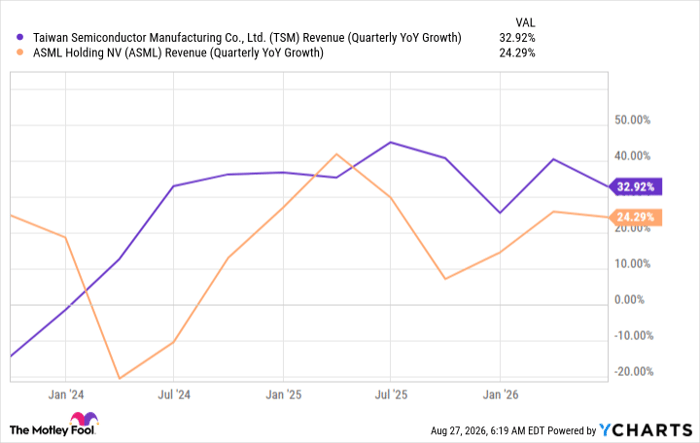
From a growth perspective, TSMC has consistently grown revenue faster than ASML.
Data by YCharts.
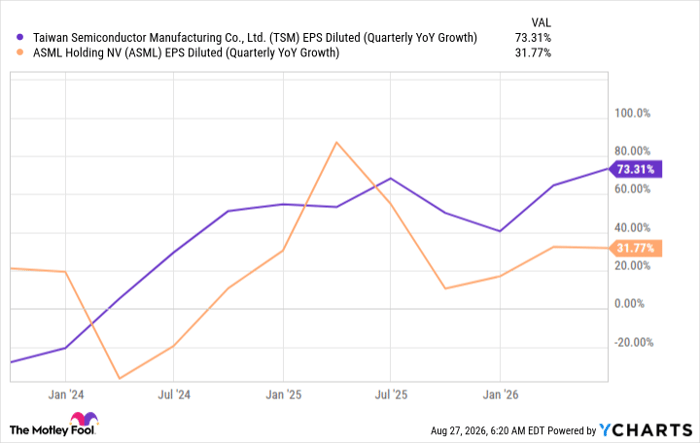
This also holds when earnings per share are analyzed.
Data by YCharts.
There's really no contest here in the growth category, so TSMC easily walks away with a win here.
Winner: TSMC
ASML isn't cheap
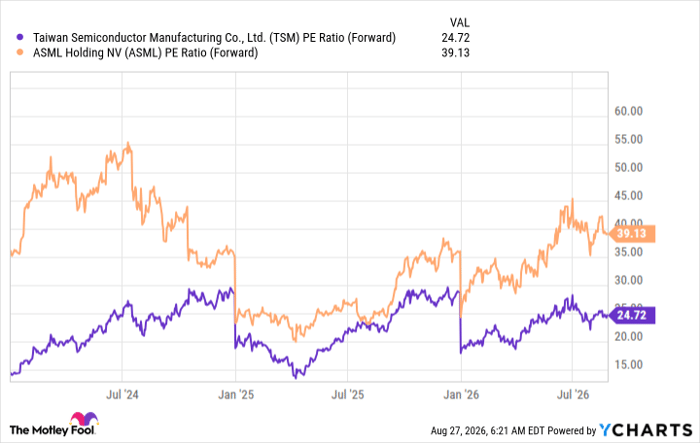
Because each of these companies is growing at a rapid pace and expects strong growth in the future, valuing the stocks based on their forward price-to-earnings ratio is a smart idea. From this perspective, ASML trades at a far higher premium.
Data by YCharts.
ASML's premium may be able to be explained by its technological monopoly, but this can only take it so far when it's being outgrown by other investments.
As a result, I think that TSMC completes the clean sweep over ASML, as it's growing faster, is cheaper, and has a more sustainable business over the long term. While ASML is still a great company and I'm excited to watch it, TSMC makes for the better investment.
Should you buy stock in Taiwan Semiconductor Manufacturing right now?
Before you buy stock in Taiwan Semiconductor Manufacturing, consider this:
The Motley Fool Stock Advisor analyst team just identified what they believe are the 10 best stocks for investors to buy now… and Taiwan Semiconductor Manufacturing wasn’t one of them. The 10 stocks that made the cut could produce monster returns in the coming years.
Consider when Netflix made this list on December 17, 2004... if you invested $1,000 at the time of our recommendation, you’d have $440,710!* Or when Nvidia made this list on April 15, 2005... if you invested $1,000 at the time of our recommendation, you’d have $1,335,252!*
Now, it’s worth noting Stock Advisor’s total average return is 978% — a market-crushing outperformance compared to 213% for the S&P 500. Don't miss the latest top 10 list, available with Stock Advisor, and join an investing community built by individual investors for individual investors.
See the 10 stocks »
*Stock Advisor returns as of August 29, 2026.
Keithen Drury has positions in Taiwan Semiconductor Manufacturing. The Motley Fool has positions in and recommends ASML and Taiwan Semiconductor Manufacturing. The Motley Fool has a disclosure policy.
Recommended Articles


