


If You Invested $1,000 in D-Wave Quantum Stock 3 Years Ago, This Is How Much You Would Have Today
Key Points
D-Wave Quantum's ability to apply its technology to real-world problems has increased interest in the stock.
Its stratospheric price-to-sales ratio leaves it without a meaningful valuation metric.
- 10 stocks we like better than D-Wave Quantum ›
D-Wave Quantum (NASDAQ: QBTS) stock got off to a rough start following its debut on the market in August 2022, when it went public via a reverse merger with a special purpose acquisition company (SPAC). By the end of 2023, it had lost over 90% of its value.
However, investors who waited until the end of 2023 to open a position are likely very happy with their purchase of the quantum computing stock, and here's why.
Missed Nvidia in 2009? This Rare Signal Is Flashing Again. In 2009, a "Double Down" signal flashed for a little-known chipmaker called Nvidia. For the first time in years, that same "Total Conviction" signal is flashing for a company 1/100th the size of Nvidia. Continue »
Image source: The Motley Fool.
The recovery of D-Wave Quantum stock
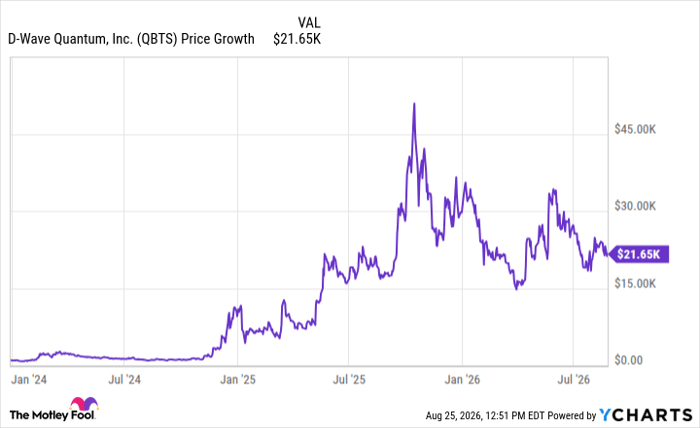
Investors who invested $1,000 in D-Wave Quantum stock at the end of 2023 and held on now have an investment worth about $21,650.
QBTS data by YCharts.
Investors who may have been skeptical about quantum computing's practicality warmed to D-Wave Quantum as other companies found they could apply its quantum annealing computers to rapidly solve vexing problems in supply chain logistics or portfolio optimization. This gives it more obvious potential to build on the tech industry's AI-driven advances.
Despite those gains, the lion's share of which occurred in 2025, D-Wave Quantum stock faces considerable uncertainty. Peers like IonQ and Rigetti Computing are developing competing quantum computing systems, as are a host of established tech giants including Google parent Alphabet and IBM.
Moreover, the company has thus far booked only modest revenues accompanied by massive losses, and its price-to-sales ratio of around 550 leaves it without a meaningful valuation measure. Those factors could leave investors wondering whether they should consider D-Wave Quantum a buy.
D-Wave has reported a free cash flow of negative $119 million over the trailing 12 months. Due to the $546 million in liquidity it has on its books, it can probably survive burning cash at that rate for a few more years without needing to issue new shares or add to its debt.
However, that negative free cash flow also means it will have to increase revenue growth and improve its financials. Its prospects on those fronts remain uncertain, but if it can make financial improvements while remaining a leader in the quantum computing industry, its stock gains since the end of 2023 could be just the beginning.
Should you buy stock in D-Wave Quantum right now?
Before you buy stock in D-Wave Quantum, consider this:
The Motley Fool Stock Advisor analyst team just identified what they believe are the 10 best stocks for investors to buy now… and D-Wave Quantum wasn’t one of them. The 10 stocks that made the cut could produce monster returns in the coming years.
Consider when Netflix made this list on December 17, 2004... if you invested $1,000 at the time of our recommendation, you’d have $443,461!* Or when Nvidia made this list on April 15, 2005... if you invested $1,000 at the time of our recommendation, you’d have $1,307,633!*
Now, it’s worth noting Stock Advisor’s total average return is 973% — a market-crushing outperformance compared to 213% for the S&P 500. Don't miss the latest top 10 list, available with Stock Advisor, and join an investing community built by individual investors for individual investors.
See the 10 stocks »
*Stock Advisor returns as of August 27, 2026.
Will Healy has no position in any of the stocks mentioned. The Motley Fool has positions in and recommends Alphabet, International Business Machines, and IonQ. The Motley Fool has a disclosure policy.
Recommended Articles


