


The Fed's Preferred Inflation Gauge Came In Slightly Hotter Than Expected. Here's What Investors Need to Know
Key Points
The Personal Consumption Expenditures (PCE) price index rose slightly higher than expected in July.
Core PCE came in as expected.
The Federal Reserve is still grappling with how to proceed with interest rates later this year.
- These 10 stocks could mint the next wave of millionaires ›
The Federal Reserve's preferred inflation gauge, the Personal Consumption Expenditures (PCE) price index, rose a seasonally adjusted 0.2% in July and was up 3.7% year over year.
Both numbers came in at 0.1% above economists' expectations.
Missed Nvidia in 2009? This Rare Signal Is Flashing Again. In 2009, a "Double Down" signal flashed for a little-known chipmaker called Nvidia. For the first time in years, that same "Total Conviction" signal is flashing for a company 1/100th the size of Nvidia. Continue »
Core PCE, which excludes more volatile food and energy prices, rose 0.2% during the month and came in 3.3% higher year over year, both in line with estimates.
It's another data point the Federal Reserve will have to contend with as it considers whether to raise interest rates this year.
Here's what investors need to know.

Image source: Getty Images.
Breaking a trend
Not only is the 3.3% core PCE reading still well above the Fed's preferred 2% target, but the stickier PCE reading also breaks a recent trend, suggesting inflation might be slowing.
The Consumer Price Index (CPI) came in soft in both June and July, and July's jobs report also showed that nonfarm payrolls lost 23,000 jobs, well below consensus estimates calling for an 85,000 gain.
The latest PCE report showed that personal income rose 0.4% in the month, while spending rose 0.2%, both higher than expected and potentially indicative of inflation.
Over two quarters of U.S. gross domestic product (GDP) is driven by consumer spending, so if people have money to spend and are spending that can drive inflation higher.
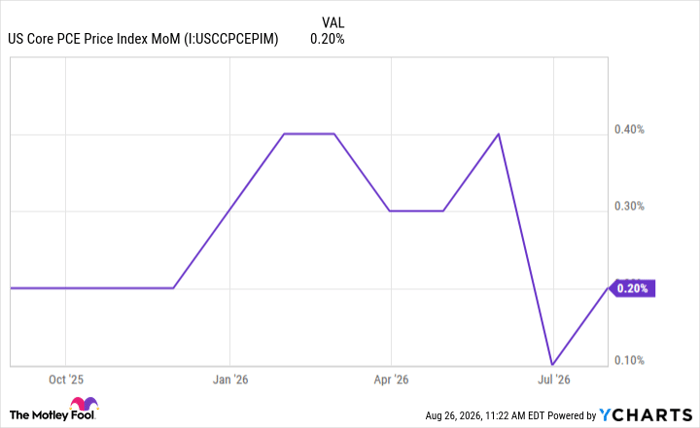
US Core PCE Price Index MoM data by YCharts
"The United States still has an inflation problem. PCE inflation came in hotter than expected," Heather Long, chief economist at the Navy Federal Credit Union, told CBS News in an email. "The impacts of the war in Iran are still apparent with $4 gas and $5.60 diesel."
Due to high gas prices, economists and investors have focused more on core inflation data, which excludes energy prices that have been on a roller coaster ride since the Iran war began.
However, gas prices have a way of trickling down into all parts of the economy. For instance, many businesses that have items shipped to them may be facing higher costs on this front due to higher gas prices.
Will this impact the Fed's trajectory?
Aside from persistently elevated costs significantly hurting Americans' purchasing power, the other big focus is on the Fed and whether it will raise interest rates at any of its three remaining meetings in 2026.
The Fed is divided on the matter. The rate-setting Federal Open Market Committee (FOMC) elected to keep interest rates steady at its last meeting, but three members dissented in favor of a hike.
Looking at CME Group's FedWatch tool, the likelihood of the FOMC holding interest rates within their current 3.50%-3.75% range in September actually increased slightly from yesterday to nearly 62%. The same trend is evident in the odds for the FOMC's October meeting.
However, the FOMC is still expected to hike rates by a quarter point in December, with a roughly 45% chance. There is a nearly 26.5% chance the Fed leaves rates where they are in December, and a nearly 24.5% chance the Fed hikes by half a point by then.
The big takeaway for me is that the recent PCE report didn't change much. It's likely not enough on its own to prompt a rate hike, but it doesn’t rule out one later this year, either.
Where to invest $1,000 right now
When our analyst team has a stock tip, it can pay to listen. After all, Stock Advisor’s total average return is 973%* — a market-crushing outperformance compared to 213% for the S&P 500.
They just revealed what they believe are the 10 best stocks for investors to buy right now, available when you join Stock Advisor.
See the stocks »
*Stock Advisor returns as of August 26, 2026.
Bram Berkowitz has no position in any of the stocks mentioned. The Motley Fool has positions in and recommends CME Group. The Motley Fool has a disclosure policy.
Recommended Articles


