


Micron Executive Reshuffle: Manish Bhatia Named COO, Scott DeBoer Named CTPO — Is It Bullish or Bearish for the Stock?
TradingKey - On August 26, US Eastern Time, Micron Technology (MU) announced two key executive promotions: Manish Bhatia was appointed President and Chief Operating Officer (COO), and Scott DeBoer was appointed President and Chief Technology and Products Officer (CTPO), with both reporting directly to CEO Sanjay Mehrotra. Sumit Sadana, former Executive Vice President and Chief Business Officer, transitioned to Senior Advisor to the CEO.
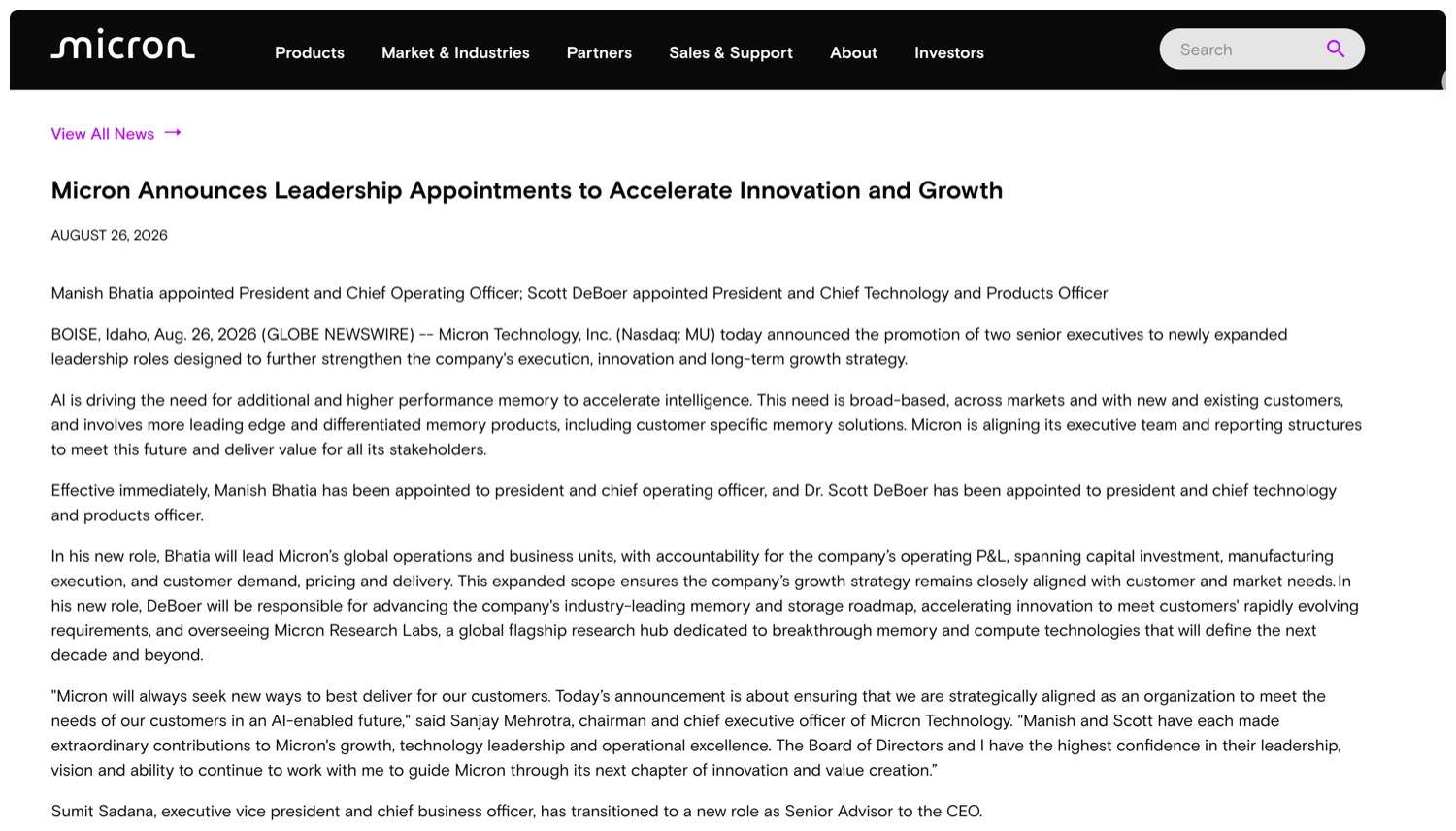
[Source: Micron Technology official website]
This adjustment does not directly change Micron's revenue or profit figures, but it signals to the market a shift in management focus toward AI memory. The core question of concern for the market is: Is this bullish or bearish for the stock price?
Why Is Micron Making Executive Adjustments?
The technical background of this personnel change is the widening gap between the growth of AI computing power and memory performance improvements. At this year's Hot Chips 2026 conference, a Micron researcher delivered a dedicated report on this issue, pointing out that AI accelerator computing power increases approximately threefold every two years, whereas HBM bandwidth grows by less than twofold over the same period. The divergence in these growth rates means that the memory bottleneck will not only persist, but could also further intensify.
According to Meta's Llama 3 training data cited by Micron, HBM failures account for approximately 17% of unscheduled training interruptions. This figure underscores that in AI large model training clusters, memory is not only a performance bottleneck but also directly impacts system reliability. Consolidating technology R&D, product management, and global operations under two senior executives is Micron's organizational adjustment to meet this challenge.
Why Micron’s Executive Changes Are Bullish
From a positive perspective, three key pillars support this adjustment.
Bhatia's background in operations should help resolve execution challenges in HBM mass production. He previously oversaw global operations, spanning manufacturing, supply chain, procurement, and government affairs, and his authority has now expanded to include capital investment decisions, manufacturing execution, as well as customer pricing and delivery. HBM production places extremely high demands on manufacturing precision, yields, and supply chain synergy. Having him coordinate global operations and business units is expected to shorten the cycle from R&D to mass production.
With DeBoer assuming the role of CTPO, departmental silos between technology R&D and product management have been broken down. He has led the development and delivery of 15 technology nodes and headed the Micron Research Lab. This laboratory serves as the core vehicle for Micron's $10 billion investment plan announced in mid-August, which will focus on areas such as advanced packaging, power optimization, and co-design with AI chips.
In the AI era, the dimensions of competition for memory products have expanded. Capacity and bandwidth are merely the foundation, while advanced packaging, power management, reliability, and compatibility with customer AI workloads jointly determine a product's market competitiveness. Remarks from CEO Sanjay Mehrotra indicate that Micron's AI strategy has been set, and the core task at this stage has shifted from strategy formulation to execution.
Is There Risk in Micron's Executive Changes?
However, executive adjustments also come with certain uncertainties.
First, Sadana has long overseen business operations and customer relations. Following his transition to Senior Advisor to the CEO, the handoff of customer communications will take time, which may entail certain communication costs in the short term. The new organizational structure will also require a period of adjustment.
The CTPO is a newly created position, and the scope of authority for the COO has also been expanded significantly, meaning that reporting lines and resource allocation will both be adjusted. Given the extremely rapid pace of technology iteration in the HBM sector, any internal coordination friction could impact product delivery schedules.
More importantly, the current HBM market is led by SK Hynix (SKHY), followed closely by Samsung, while Micron Technology remains in a catch-up position. Boosting organizational efficiency is a necessary condition for catching up, but not a sufficient one. Whether it can narrow the gap ultimately depends on product performance, yields, and customer qualification results.
Is It Bullish or Bearish for Micron’s Stock Price?
Taking into account the above factors, the short-term impact of this executive adjustment on the stock price leans neutral-to-positive. Markets typically interpret clear division of managerial responsibilities and an execution-oriented focus as positive signals; however, if there is no follow-up with concrete progress on HBM customer qualification or capacity ramp-up, this sentiment-driven boost could fade quickly.
Over the medium to long term, the direction of the stock price remains dependent on whether Micron can achieve substantive breakthroughs in the HBM sector.
If the combination of Bhatia and DeBoer can accelerate the mass production pace of HBM3E and next-generation products and enhance advanced packaging capabilities, Micron is expected to improve its position in the AI memory market, thereby supporting positive shifts in valuation. Conversely, if the adjustment fails to translate into enhanced product competitiveness, the stock price will revert to a trend governed by industry cycles and the competitive landscape.
This adjustment alone is not enough to directly drive the stock price up, but it provides investors with a window of observation: over the next few quarters, progress in HBM customer qualification and capacity ramp-up will be the key metrics for evaluating Micron's execution capability.
Only if the combination of Bhatia and DeBoer delivers concrete results in these areas can the organizational value of this personnel adjustment truly translate into stock price support.
Recommended Articles


