


Billionaire Druckenmiller Slams Bessent Buyback Plan as Doomed Price Control
TradingKey - On Tuesday, August 25 (ET), billionaire investor Stanley Druckenmiller publicly slammed the Treasury buyback program introduced by US Treasury Secretary Scott Bessent. The head of the Duquesne Family Office bluntly stated that the plan is a "price management" exercise in which the government attempts to intervene in the market through administrative means, and is doomed to fail.
In a recent op-ed, Druckenmiller pointed out that the buyback program led by Bessent severely distorts the market's fundamental mechanisms. He emphasized that this is by no means the "liquidity management" claimed by the Treasury, but is fundamentally "price management" of long-term Treasury yields by the government.
He bluntly stated that long-term yields are meant to be the US government's "only remaining fiscal disciplinarian," and forcibly depressing interest rates through buybacks is tantamount to removing the alarm that checks budget deficits. He said: "Any government that attempts to defend asset prices against fundamentals is ultimately doomed to fail. The only variable is how much money they will waste before surrendering to the market."
The debate escalated rapidly after the US Department of the Treasury announced an expansion of long-term Treasury buybacks on August 19. The Treasury announced that from September 9 to November 4, the maximum size per operation for liquidity support buybacks of certain long-term nominal Treasuries maturing in 10 to 30 years would be at least doubled, rising from up to $2 billion previously to at least $4 billion.
The decision came as the 30-year Treasury yield had risen to around 5.3%, reaching its highest level since 2007, while the 10-year yield also remained at elevated levels.
On August 20, Treasury Secretary Bessent stated in an interview with CNBC that the expanded buyback scale could be further increased in the future. He emphasized that the Treasury's primary goal is to improve liquidity in the long-term Treasury market, especially to ease market pressures amid quiet summer trading and increased corporate bond issuance related to AI infrastructure.
However, the policy quickly sparked controversy on Wall Street. Critics argued that the Treasury's proactive expansion of long-term bond buybacks could be interpreted by the market as an attempt to artificially suppress long-term yields, blurring the boundary between debt management and market intervention.
Following the announcement of the buyback plan, long-end Treasury yields dropped rapidly and prices rebounded. On August 19, the 10-year Treasury yield fell by approximately 5 basis points to around 4.65%, while the 30-year yield dropped by nearly 10 basis points at one point.
However, this boost was short-lived. On August 20, the 10-year yield rebounded to around 4.69%, and the 30-year yield rose to around 5.25%, crossing back above the 5% threshold. The market subsequently refocused on structural pressures such as the US fiscal deficit, inflation, energy prices, and long-term Treasury supply.
As of press time, the US Treasury has not issued an official response to Druckenmiller's criticism. The 10-year Treasury yield stood at 4.654%, down over 4 basis points on the day. As the debate continues to unfold, the market will keep a close eye on subsequent policy statements from the Treasury and relevant Congressional hearings in September.
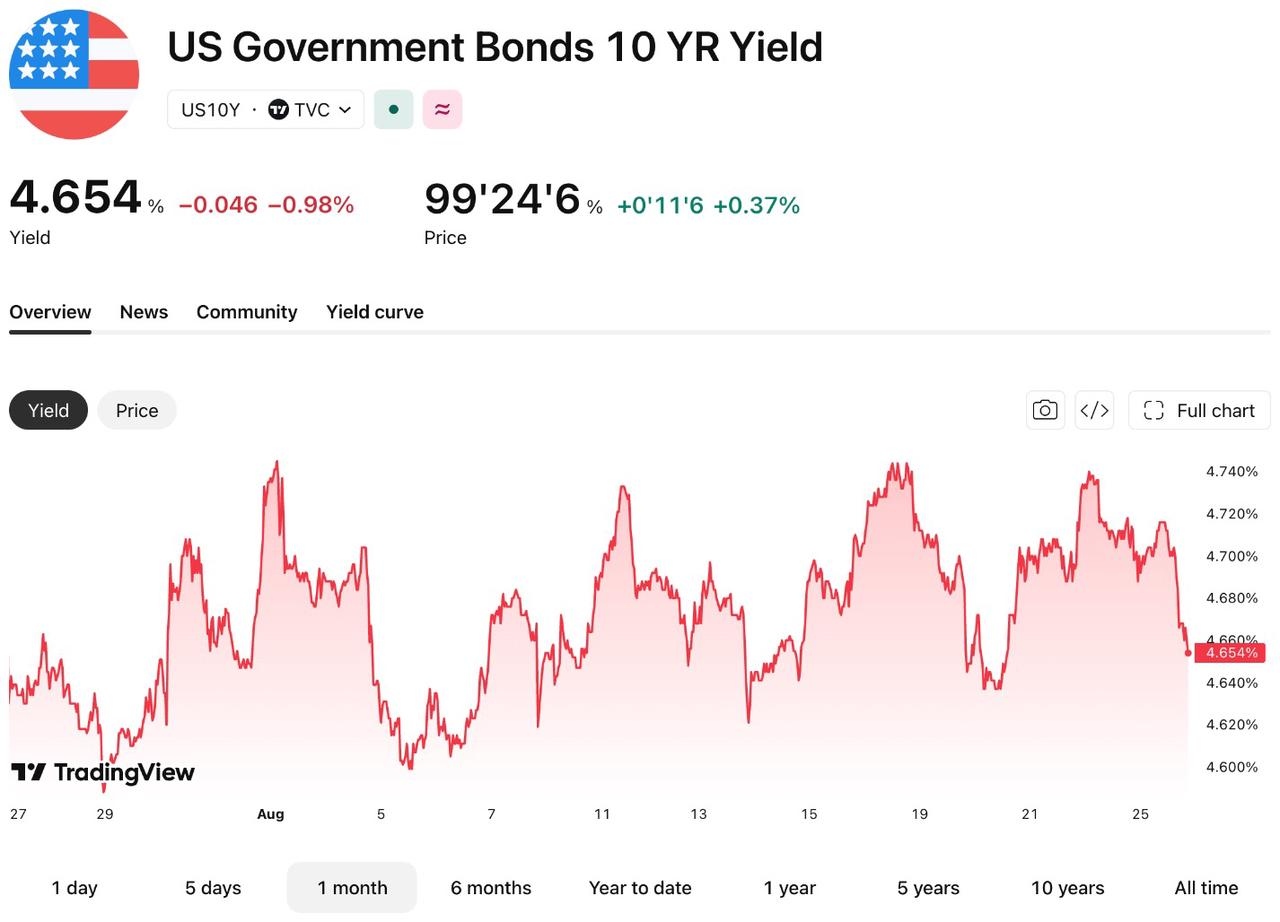
[Source: TradingView]
Recommended Articles


