


Scott Bessent's Big Announcement Could Be Bad News for These 2 Bond ETFs
Key Points
The 30-year Treasury yield recently hit 15-year highs.
U.S. Treasury Secretary Scott Bessent has floated a plan to buy back larger volumes of long-duration Treasury bonds, but the bond market isn’t impressed.
With U.S. national debt exceeding $40 trillion, long-term Treasury yields may rise.
- These 10 stocks could mint the next wave of millionaires ›
U.S. Treasury Secretary Scott Bessent made waves on Wall Street last Wednesday when he announced a plan to "at least double" the amount of buybacks of long-term U.S. Treasury bonds. Basically, this means the U.S. Treasury is trying to drive more demand for longer-duration U.S. government bonds.
By buying back a larger amount of longer-dated Treasury bonds, the yields on those bonds would (ideally) go lower. In this way, the Treasury Department intends to reduce borrowing costs for the government and, ultimately (hopefully), for U.S. businesses and consumers.
Missed Nvidia in 2009? This Rare Signal Is Flashing Again. In 2009, a "Double Down" signal flashed for a little-known chipmaker called Nvidia. For the first time in years, that same "Total Conviction" signal is flashing for a company 1/100th the size of Nvidia. Continue »
Here's the problem with Bessent's buyback plan: The Treasury bond market isn't buying it. Long-dated Treasury bond yields dropped at first when the buyback plan was announced, but have since climbed again. As of this writing, the 30-year Treasury yield is at 5.275%, its highest level in more than 15 years.
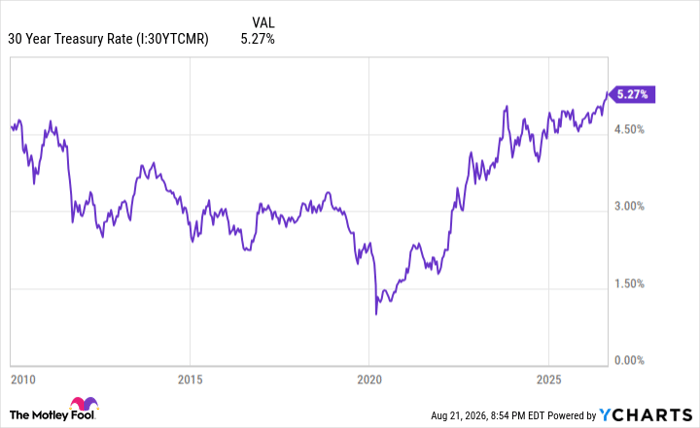
30 Year Treasury Rate data by YCharts
Investors seem skeptical that Bessent's buyback plan will make a meaningful difference for long-term Treasury bond yields. For these reasons, buying long-term Treasury bond ETFs could be a bad move. Let's look at why bond yields are going higher, and why that's bad news for bond investors.

Scott Bessent, U.S. Department of the Treasury Secretary. Image source: The White House.
The bond market is bearish on Bessent's buybacks
If Bessent's bond buybacks don't have the power to move the markets in the right direction, that could be a bad sign for the future yields on long-duration U.S. government debt. Investors seem skeptical that the U.S. Treasury Department is wielding a big enough stick.
What does this mean for bond ETF investors? It could be a sign that long-term Treasury bond ETFs could see further price declines (and higher yields) in the future. Bessent might not have the power to reduce yields as much as he hopes.
And even if Bessent's Treasury aggressively bought back massive quantities of long-term government bonds, successfully driving down long-term interest rates, that would likely cause other side effects in the bond market and the economy, such as a weaker dollar or higher yields on short-term bonds.
There's no easy fix for the problem of rising interest rates. It's outside of any one government official's control. And when a Treasury secretary tries to intervene in the bond market in this way, it might cause the bond market to lose confidence in the fundamentals of U.S. government debt.
The real problem with bond buybacks: $40 trillion of national debt
The biggest root cause of higher, longer-term Treasury bond yields is U.S. government borrowing. The U.S. national debt recently passed $40 trillion. That's the biggest cause of higher yields on long-term Treasuries, no matter what Bessent or any other Treasury secretary tries to do about it with a few billion dollars of bond buybacks.
Will America's federal government stop spending more than it receives in tax revenue? Probably not anytime soon. Congress and presidents from both parties have contributed to the national debt. And in fairness to the U.S. government, other governments around the world have also borrowed heavily recently due to the COVID-19 pandemic and other factors. But bond investors around the world are starting to demand higher yields on long-term U.S. government debt.
How should you invest for a future of higher long-term bond yields?
If you believe that the national debt and inflation are likely to rise in the future and that interest rates are likely to go up because of this, then long-term Treasury bonds are probably not a good choice. These types of bonds are sensitive to interest rate risk -- when interest rates rise, long-duration bond prices fall more than short-term bond prices. Buying long-term Treasury bonds feels too risky for me right now.
Here are two examples of long-term Treasury bond ETFs that have performed poorly over the past few years. The Vanguard Extended Duration Treasury ETF (NYSEMKT: EDV) holds a total of 80 U.S. Treasury bonds with an average effective maturity of 24.5 years. It has lost money for the past 10 years, with annualized returns (by net asset value) of -4.74%. In the past five years, it's done even worse, with annualized returns of -12.67%.
The iShares 20+ Year Treasury Bond ETF (NASDAQ: TLT) holds 46 U.S. Treasury bonds with a weighted average maturity of 25.7 years. This bond ETF has also lost money in recent years. It has delivered annualized returns of -2.59% for the past 10 years, and -8.18% for the past five years.
If you had put $10,000 into each of these bond ETFs 10 years ago, here's how much money you'd have left today:
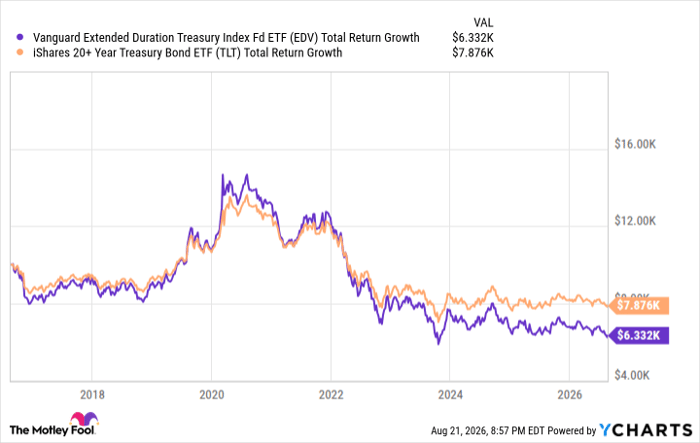
EDV Total Return Level data by YCharts
What bond ETF to buy instead of EDV or TLT
I'm not bullish on the future of long-term U.S. Treasury bonds. The national debt is too high; the uncertainty is too great. Interest rates might keep rising, which would drive down the prices of long-term Treasury ETFs like EDV and TLT. If there's an economic crisis that causes interest rates to fall, these long-term government bonds could be a good safe haven. But that's a bad outcome to root for.
Most individual investors who want to own some bonds as part of their portfolio should consider a well-diversified bond ETF, such as the Vanguard Total Bond Market ETF (NASDAQ: BND). This bond ETF holds a broader range of bond maturities and is less vulnerable to the risks of higher interest rates on long-term U.S. government debt.
Where to invest $1,000 right now
When our analyst team has a stock tip, it can pay to listen. After all, Stock Advisor’s total average return is 965%* — a market-crushing outperformance compared to 212% for the S&P 500.
They just revealed what they believe are the 10 best stocks for investors to buy right now, available when you join Stock Advisor.
See the stocks »
*Stock Advisor returns as of August 25, 2026.
Ben Gran has positions in Vanguard Total Bond Market ETF. The Motley Fool has positions in and recommends Vanguard Total Bond Market ETF. The Motley Fool has a disclosure policy.
Recommended Articles


