


Can This 6.3% Yield Survive if Oil Crashes Again?
Key Points
Energy Transfer is a large North American Midstream business.
Volume flowing through Energy Transfer's system is more important than commodity prices for covering the distribution.
The master limited partnership cut its distribution in half during the deep energy downturn in 2020.
- 10 stocks we like better than Energy Transfer ›
If you are looking to add some yield to your portfolio, Energy Transfer's (NYSE:ET) 6.3% distribution yield will likely be attractive to you. The one caveat is that it operates in the energy sector, and the last time the sector was in a downturn, Energy Transfer cut its distribution in half. Can this high-yield master limited partnership's (MLP) distribution survive the next energy downturn?
What goes up must come down
The energy sector has been upended by the geopolitical conflict in the Middle East. With reduced supply, commodity prices have risen. In fact, some of the world's largest energy companies have warned that oil and natural gas prices don't fully reflect the situation. In other words, companies like ExxonMobil (NYSE:XOM) and Chevron (NYSE:CVX) think oil prices could rise even further.
Missed Nvidia in 2009? This Rare Signal Is Flashing Again. In 2009, a "Double Down" signal flashed for a little-known chipmaker called Nvidia. For the first time in years, that same "Total Conviction" signal is flashing for a company 1/100th the size of Nvidia. Continue »

Image source: Getty Images.
This situation is headline-grabbing news, but if you look at the long-term, volatility in the energy sector is actually pretty normal. If you are investing in the energy sector for yield, you want to make sure the business you buy can support its dividend through the entire cycle, including the inevitable energy sector downturns. At first blush, Energy Transfer fails that test because it cut its distribution in half in 2020, during the energy downturn that occurred alongside the coronavirus pandemic.
That, however, was a strategic decision that may actually give the midstream MLP the wherewithal to support its distribution through the next weak patch. Notably, Energy Transfer used the distribution cut to focus on strengthening its balance sheet. Debt-to-EBITDA (earnings before interest, taxes, depreciation, and amortization) has gone from a peak of 5.4x at the end of 2020 to 4.1x today.
To be fair, peer Enterprise Products Partners' (NYSE:EPD) debt-to-EBITDA ratio went from 4.1x to 3.3x over the same span, so Energy Transfer is still more leveraged than some of its competitors. However, the longer-term trend is clear: Energy Transfer is focused on becoming a more financially sound and reliable business.
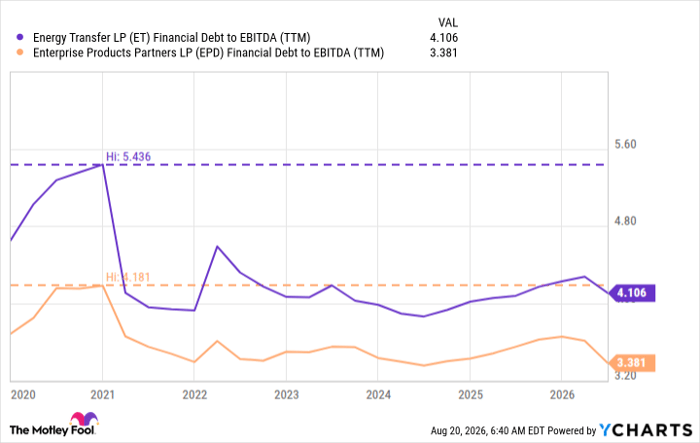
ET Financial Debt to EBITDA (TTM) data by YCharts
Energy Transfer's new goal is slow and steady growth
With the balance sheet in better shape, Energy Transfer's current target is for distribution growth of 3% to 5% a year. That's completely reasonable and is roughly in line with what investors have seen from Enterprise Products Partners, which offers a slightly lower 5.7% yield. Enterprise, however, has a long history of increasing its distribution annually, with a streak that runs 28 years. That's roughly as long as Enterprise has been publicly traded.
For conservative dividend investors, Enterprise is likely the better option. But, if you are trying to maximize the income you generate, Energy Transfer's added risks may be worth it for more aggressive investors. Indeed, both companies own large energy infrastructure portfolios and generate reliable cash flows from fees. Essentially, the volume that Energy Transfer and Enterprise move through their systems is more important than the price of the commodities being moved.
In fact, in some ways, Energy Transfer's distribution looks safer than Enterprise's. Energy Transfer's distributable cash flow covered its distribution by a robust 2.2x in the second quarter, while Enterprise's distribution was covered by a lower, but still strong, 1.9x. Both MLPs have material leeway to deal with adversity.
Complexity could be the decision maker
That said, Energy Transfer is a more complex business, noting that it also controls two other publicly traded MLPs. And it tends to be a bit more aggressive as a business. So, the higher yield relative to Enterprise reflects a higher risk profile. For conservative investors, the extra yield probably won't be worth the added risk. But if you can handle a little uncertainty, you may want to consider Energy Transfer. The distribution is likely to survive the next energy downturn, given the repositioning that occurred during the last energy downturn.
Should you buy stock in Energy Transfer right now?
Before you buy stock in Energy Transfer, consider this:
The Motley Fool Stock Advisor analyst team just identified what they believe are the 10 best stocks for investors to buy now… and Energy Transfer wasn’t one of them. The 10 stocks that made the cut could produce monster returns in the coming years.
Consider when Netflix made this list on December 17, 2004... if you invested $1,000 at the time of our recommendation, you’d have $429,223!* Or when Nvidia made this list on April 15, 2005... if you invested $1,000 at the time of our recommendation, you’d have $1,318,055!*
Now, it’s worth noting Stock Advisor’s total average return is 965% — a market-crushing outperformance compared to 212% for the S&P 500. Don't miss the latest top 10 list, available with Stock Advisor, and join an investing community built by individual investors for individual investors.
See the 10 stocks »
*Stock Advisor returns as of August 22, 2026.
Reuben Gregg Brewer has no position in any of the stocks mentioned. The Motley Fool has positions in and recommends Chevron. The Motley Fool recommends Enterprise Products Partners. The Motley Fool has a disclosure policy.
Recommended Articles


