


Billionaire David Tepper Piled Into a Debt-Laden Artificial Intelligence (AI) Neocloud Stock in Q2 While Also Increasing His Stake in Its Newest Rival
Key Points
CoreWeave's neocloud model provides Nvidia-based compute to AI developers.
Meta is reportedly exploring the idea of leasing some of its excess cloud capacity to frontier AI labs.
Pairing an investment in CoreWeave with one in Meta is a unique trade structure that provides exposure to a pure-play neocloud service and an emerging hyperscaler rival.
- 10 stocks we like better than CoreWeave ›
As the founder of Appaloosa Management, David Tepper built his reputation through a keen eye for distressed assets, including debt instruments trading at steep discounts, and deep-value stocks that most other investors overlooked amid temporary turmoil.
Tepper's willingness to embrace situations that others flee has helped him produce outsized returns over the long run. This makes his latest combination of bets between CoreWeave (NASDAQ: CRWV) and Meta Platforms (NASDAQ: META) particularly noteworthy for investors tracking the artificial intelligence (AI) infrastructure supercycle.
Missed Nvidia in 2009? This Rare Signal Is Flashing Again. In 2009, a "Double Down" signal flashed for a little-known chipmaker called Nvidia. For the first time in years, that same "Total Conviction" signal is flashing for a company 1/100th the size of Nvidia. Continue »
Image source: The Motley Fool.
The rise of neoclouds
Recent 13F filings show that Appaloosa initiated a position in CoreWeave stock during the second quarter, acquiring 1,078,248 shares. CoreWeave operates as a neocloud provider, delivering high-performance GPU capacity tailored to AI workloads. In an environment where hyperscalers are struggling to meet explosive AI-driven demand for training and inference deployments, neoclouds like CoreWeave bridge the gap by offering dedicated, scalable compute infrastructure optimized for Nvidia hardware and adjacent systems.
During the second quarter, CoreWeave's backlog grew by more than 246% year over year to $104 billion. Of note, this figure does not include new commitments of $25 billion signed shortly after the quarter ended. CoreWeave's customers include frontier AI labs, hyperscalers, and an expanding roster of enterprises. Revenue more than doubled year over year, reflecting the pace of rapid capacity deployment.
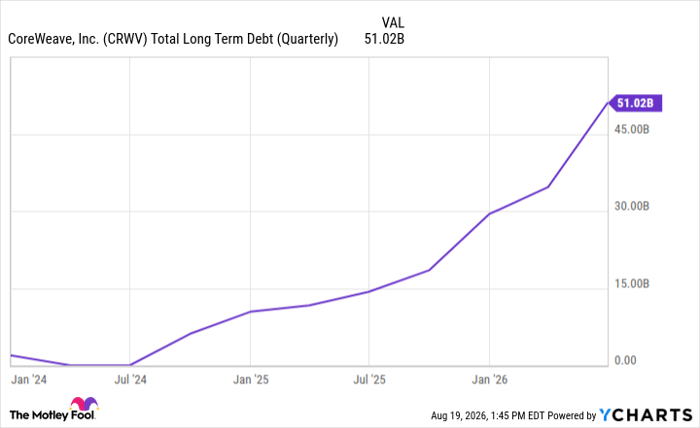
With that said, the company's balance sheet reveals a potential blemish that has left some on Wall Street uneasy. CoreWeave's total debt -- including operating leases -- stands north of $50 billion.
CRWV Total Long Term Debt (Quarterly) data by YCharts.
This capital from its debt sales is being used to finance the capital expenditures of its aggressive data center build-out. However, the company's leverage profile raises questions about possible refinancing needs in a higher-interest-rate environment. The combination of heavy borrowing and pressures to free cash flow has some investors concerned about the company's execution risks.
Why Tepper's Meta position looks interesting
During the second quarter, Appaloosa also increased its stake in Meta Platforms by 55%, adding 238,500 shares. This move looks particularly interesting because Meta is reportedly exploring the idea of leasing some of its excess AI compute capacity to third parties. This strategy could place the social media giant and hyperscaler in direct competition with neocloud operators such as CoreWeave.
While details remain sparse, that new revenue stream could help offset the costs that Meta is incurring to expand its data center footprint. What's even more interesting is contemplating the prospect of a well-capitalized CoreWeave customer -- Meta -- turning into one of CoreWeave's rivals.
The natural thought is that if hyperscalers start to fill more of the cloud capacity demand that they have previously outsourced to neoclouds, it could shrink the addressable market for those pure-play neocloud providers. Against this backdrop, Tepper's simultaneous commitments to both Meta and CoreWeave stand out against the potential friction.
How should investors view Tepper's positioning?
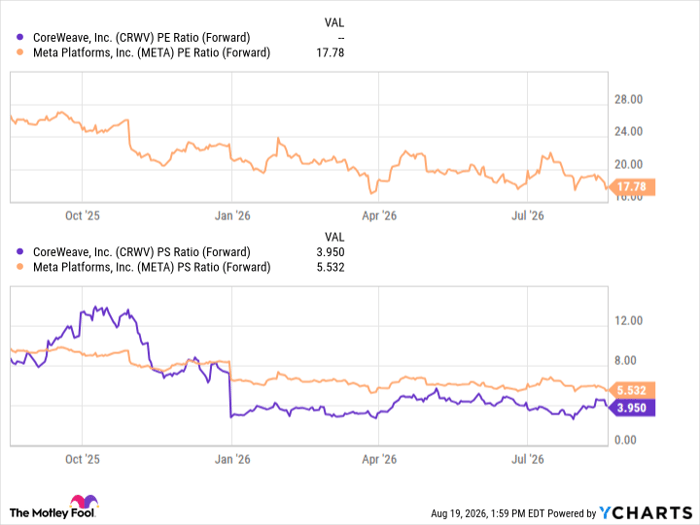
In my view, Tepper has built a unique hedge within the neocloud space by pairing his Meta and CoreWeave positions. Valuation analysis suggests that both companies can be viewed through a similar lens. Over the last several months, the forward price-to-sales (P/S) multiples of Meta and CoreWeave both compressed. Of note, Meta is also trading at a discount to its recent levels on a forward earnings basis.
CRWV PE Ratio (Forward) data by YCharts.
These trends could suggest that the market is already factoring much of CoreWeave's leverage risk into the share price while remaining skeptical over Meta's elevated capital outlays. I find downward pressure on both stocks interesting, as each company has consistently demonstrated robust growth throughout the AI boom.
Through his positions in CoreWeave and Meta, Tepper gains exposure to a market leader in the specialized neocloud landscape alongside a technology blue chip that is building a more three-dimensional AI ecosystem.
Whether this structure proves profitable will hinge on the companies' execution and the persistence of compute scarcity. If CoreWeave's remaining performance obligations (RPO) convert at a pace that allows it to retire debt at a meaningful pace, this position could bring asymmetric gains. At the same time, Meta's scale and diversification beyond advertising offer some balance should the valuations of pure-play neoclouds experience more pressure.
Tepper's track record of taking advantage of undervalued opportunities supports his strategy with this pairing, reflecting calculated opportunism rather than simple momentum chasing. In the long run, Appaloosa should be positioned to benefit regardless of how the competitive dynamics in the AI infrastructure space ultimately play out.
Should you buy stock in CoreWeave right now?
Before you buy stock in CoreWeave, consider this:
The Motley Fool Stock Advisor analyst team just identified what they believe are the 10 best stocks for investors to buy now… and CoreWeave wasn’t one of them. The 10 stocks that made the cut could produce monster returns in the coming years.
Consider when Netflix made this list on December 17, 2004... if you invested $1,000 at the time of our recommendation, you’d have $432,189!* Or when Nvidia made this list on April 15, 2005... if you invested $1,000 at the time of our recommendation, you’d have $1,330,956!*
Now, it’s worth noting Stock Advisor’s total average return is 967% — a market-crushing outperformance compared to 212% for the S&P 500. Don't miss the latest top 10 list, available with Stock Advisor, and join an investing community built by individual investors for individual investors.
See the 10 stocks »
*Stock Advisor returns as of August 21, 2026.
Adam Spatacco has positions in Nvidia. The Motley Fool has positions in and recommends Meta Platforms and Nvidia. The Motley Fool has a disclosure policy.
Recommended Articles


