


Cathie Wood's Ark Invest Held $1.16 Billion of Tesla Stock as of the End of the Second Quarter, Even as It Trails Every Other "Magnificent Seven" Stock in 2026. Is Her Conviction Still Justified?
Key Points
Ark's Tesla thesis increasingly depends on the success of its robotaxi business.
Ark forecasts that Tesla will reach $2,600 per share by 2029.
The robotaxi segment could eventually be responsible for nearly 90% of Tesla's value.
- These 10 stocks could mint the next wave of millionaires ›
Ark Investment Management's 13F filing for the second quarter showed that as of June 30, the investment firm held 2.76 million Tesla (NASDAQ: TSLA) shares worth approximately $1.16 billion. And though it reduced its position in the electric vehicle (EV) company slightly during Q2, Ark reportedly went right back to buying as Tesla shares fell, purchasing an estimated 450,000 shares worth roughly $170 million to $180 million between June 21 and Aug. 5. That's a pretty serious vote of confidence in a stock that's had a pretty bumpy year so far.
Through Aug. 19, Tesla was down roughly 23% year to date, leaving it in last place among the "Magnificent Seven." The gap isn't particularly close, either. Nvidia is up strongly for the year, while Amazon, Apple, and Alphabet are also sitting on double-digit percentage gains. Microsoft remains in positive territory, and even Meta Platforms -- the only other member of the group that is down in 2026 -- has lost less ground than Tesla. So why does Wood keep buying it?
Missed Nvidia in 2009? This Rare Signal Is Flashing Again. In 2009, a "Double Down" signal flashed for a little-known chipmaker called Nvidia. For the first time in years, that same "Total Conviction" signal is flashing for a company 1/100th the size of Nvidia. Continue »
She's not betting on cars
Here's the most important thing to understand about Ark's Tesla thesis: In Wood's view, it is not primarily an electric vehicle bet anymore. Ark's published valuation model gives Tesla a $2,600 per share price target for 2029, with a $2,000 bear case and $3,100 bull case. More importantly, Ark estimates that nearly 90% of Tesla's enterprise value and earnings could come from robotaxis by 2029. That's why its disappointing EV sales results haven't scared Wood away.
Tesla's EV deliveries actually improved substantially in Q2, rising 25% year over year to 480,126, the company's strongest second quarter ever. But profitability was another matter. Tesla reported $28.24 billion in revenue, but its adjusted earnings of $0.33 per share badly missed the $0.54 per share consensus estimate. Operating margin also fell to just 1.4% as the company continued spending heavily on AI, autonomy, and robotics.
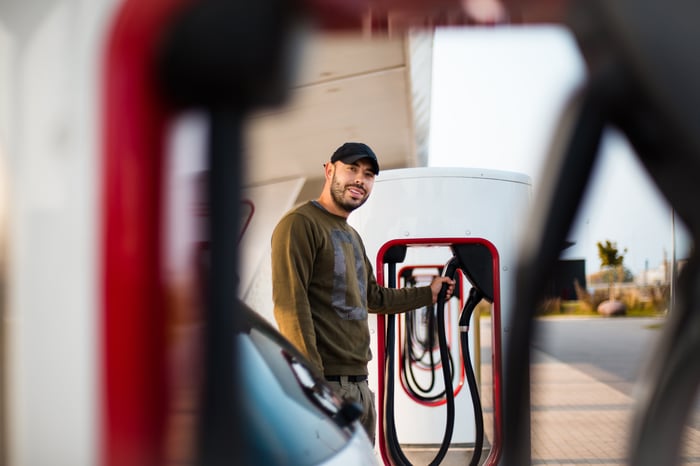
Image source: Getty Images.
There's finally something tangible
To Wood's credit, the robotaxi thesis isn't entirely theoretical anymore. Tesla launched its Robotaxi service in June 2025 and says it continued expanding and refining the service during the first half of 2026. The company also began production of its Cybercab model at Gigafactory Texas during Q2. Indeed, that is meaningful progress.
But there's an enormous difference between operating a growing autonomous ride-hailing service and building a business large enough to justify Ark's $2,600 price target on the stock. Ark's own model demonstrates just how dependent the valuation is on autonomy. Remove the robotaxi opportunity, and Ark previously estimated Tesla would be worth only about $350 per share in 2029.
Is Wood's conviction justified?
If Tesla can scale up the production of the Cybercab, expand its Robotaxi network across major cities, win over enough riders, and eventually generate high-margin recurring revenue from autonomous transportation, Wood's decision to keep buying the stock amid this year's declines could look brilliant in retrospect. But if the robotaxi business takes longer to scale, encounters regulatory roadblocks, or doesn't generate the economics Ark expects, her valuation forecast becomes much harder to defend.
Tesla's energy storage business is growing, its Optimus robot business could eventually become meaningful, and its vehicle delivery volume has recently improved. But none of those businesses currently justifies a $2,600 stock price. Robotaxis do. And that's ultimately what you have to understand about Wood's $1.16 billion Tesla bet. She's not buying the worst-performing Magnificent Seven stock because she thinks its EV sales are about to explode. She's betting that Tesla will eventually become something much bigger than a car company. And if history serves as a reliable indicator, she's probably right.
Don’t miss this second chance at a potentially lucrative opportunity
Ever feel like you missed the boat in buying the most successful stocks? Then you’ll want to hear this.
On rare occasions, our expert team of analysts issues a “Double Down” stock recommendation for companies that they think are about to pop. If you’re worried you’ve already missed your chance to invest, now is the best time to buy before it’s too late. And the numbers speak for themselves:
- Nvidia: if you invested $1,000 when we doubled down in 2009, you’d have $563,135!*
- Apple: if you invested $1,000 when we doubled down in 2008, you’d have $59,383!*
- Netflix: if you invested $1,000 when we doubled down in 2004, you’d have $432,189!*
Right now, we’re issuing “Double Down” alerts for three incredible companies, available when you join Stock Advisor, and there may not be another chance like this anytime soon.
See the 3 stocks »
*Stock Advisor returns as of August 21, 2026.
Jeff Siegel has no position in any of the stocks mentioned. The Motley Fool has positions in and recommends Alphabet, Amazon, Apple, Meta Platforms, Microsoft, Nvidia, and Tesla. The Motley Fool has a disclosure policy.
Recommended Articles


