


Hasbro Exec Rolled a "1" on Video Games -- and Lost His Job
Key Points
Hasbro reported terrific earnings last month -- then seemingly ushered Wizards of the Coast President John Hight to the exits after canceling "several" of his video games.
But Hight's Wizards of the Coast division was responsible for most of Hasbro's growth.
New expansions of the Dungeons & Dragons franchise may keep the growth going for Hasbro.
- 10 stocks we like better than Hasbro ›
If you're not an avid gamer, you may not have noticed, but it's been a busy couple of weeks in the world of gaming lately -- and for no one more so than for Hasbro (NASDAQ: HAS).
On July 21, Hasbro -- the entertainment titan behind everything from Monopoly and Nerf guns to Avengers action figures and Peppa Pig cartoons -- released a Q2 earnings report packed with large numbers. Total sales for the quarter grew 16% to $1.1 billion. Sales at the Wizards of the Coast (WotC) division, home to both roleplaying behemoth Dungeons & Dragons and dominant card game Magic: The Gathering (MTG), grew 27%.
Missed Nvidia in 2009? This Rare Signal Is Flashing Again. In 2009, a "Double Down" signal flashed for a little-known chipmaker called Nvidia. For the first time in years, that same "Total Conviction" signal is flashing for a company 1/100th the size of Nvidia. Continue »
In fact, MTG alone booked $500 million in quarterly revenue, driving the entire company's performance with its own 32% revenue growth rate.
One week later, Hasbro announced that the man responsible for much of this success, Wizards of the Coast President John Hight, will cease to be president effective Sept. 1. (He will, however, remain employed as an "advisor" to Hasbro through Sept. 2, 2027.)
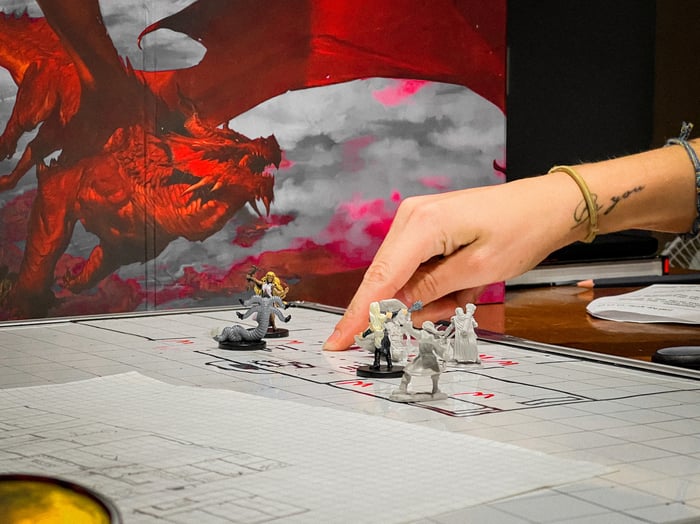
Image source: Getty Images.
Hight helped turn Hasbro profitable again
Hight's work for WotC helped Hasbro flip from a net loss of $6.10 per share a year ago to a net profit of $1.12 in Q2 2026. The profit might have been 35% bigger, but Hasbro had to take a $56 million impairment charge after canceling "several" unnamed video games that had been planned for release in 2028 and beyond.
Within the gaming blogosphere, the current working theory is that these cancellations lie behind Hight's departure.
The big worry is that Hight's leaving WotC may derail Hasbro's recent string of successes.
So long, and thanks for all the fiscal improvement
Consider the progress Hasbro made under Hight's tenure. According to data from S&P Global Market Intelligence, Hight took over WotC in July 2024 after a 12-year tenure at Blizzard Entertainment, where he ran the World of Warcraft franchise. He came aboard just as Hasbro was exiting an H1 that saw sales decline a precipitous 21%. Within a year of his arrival, Hasbro's sales were growing again, and 2025 sales grew nearly 14% over 2024, largely thanks to WotC.
Over the past 12 months, Hasbro approached $5 billion in sales, with $794 million in net profit, and more than $1.2 billion in positive free cash flow.
What's next for Hasbro
Can Hasbro keep this ball rolling in Hight's absence? Perhaps.
One of the other big developments in the gaming world these past couple of weeks, as you may be aware, was the latest running of the GenCon gaming convention in Indianapolis. Notable for the arrival of a tornado warning mid-convention, which at one point had the Indianapolis Convention Center actually raining inside, GenCon also featured a record-breaking crowd of 74,000 attendees, 800 game publishers and vendors... and a special presentation by WotC, which took over the Indiana Repertory Theater and renamed it for the weekend the "D&D Tower."
Within those walls, WotC unveiled a slew of new initiatives to keep the growth going, with or without Hight:
- A Dungeons & Dragons: World of Warcraft crossover campaign created with participation by Blizzard's new owner, Microsoft, due out in November.
- A separate amalgamation of D&D with Star Wars, which is now owned by Walt Disney. Details are still sparse on that one, other than its planned launch date in 2027.
- A revived "Dark Sun" D&D universe that is described as "brutal and mature" -- and presumably targeting the older segment of the roleplaying-games market.
- And additional campaigns in the iconic Dragonlance and World of Greyhawk D&D settings.
Hasbro is thus taking a two-pronged approach to future growth in the D&D franchise. On one hand, it's partnering with outside companies to create synergies between their fanbases and Hasbro's own. At the same time, Hasbro is mining the 50-plus years of intellectual property it has accumulated as successor to both TSR and WotC, refurbishing the old stories, and rolling them into new products it can market under its current D&D 5.5e gaming system.
Will it succeed? Analysts are forecasting less than a 9% earnings growth rate for Hasbro over the next five years. But with WotC already accounting for half the company's sales, and now growing those sales at 27%, I think the odds are in favor of Hasbro's exceeding expectations -- with or without its soon-to-be-departed exec.
At a current price-to-free cash flow ratio of just 11.4, paying a 3% dividend yield and carrying only modest debt, Hasbro stock looks like a "buy" to me.
Should you buy stock in Hasbro right now?
Before you buy stock in Hasbro, consider this:
The Motley Fool Stock Advisor analyst team just identified what they believe are the 10 best stocks for investors to buy now… and Hasbro wasn’t one of them. The 10 stocks that made the cut could produce monster returns in the coming years.
Consider when Netflix made this list on December 17, 2004... if you invested $1,000 at the time of our recommendation, you’d have $421,943!* Or when Nvidia made this list on April 15, 2005... if you invested $1,000 at the time of our recommendation, you’d have $1,382,819!*
Now, it’s worth noting Stock Advisor’s total average return is 983% — a market-crushing outperformance compared to 216% for the S&P 500. Don't miss the latest top 10 list, available with Stock Advisor, and join an investing community built by individual investors for individual investors.
See the 10 stocks »
*Stock Advisor returns as of August 15, 2026.
Rich Smith has no position in any of the stocks mentioned. The Motley Fool has positions in and recommends Microsoft and Walt Disney. The Motley Fool recommends Hasbro. The Motley Fool has a disclosure policy.
Recommended Articles


