


Greg Abel Just Plowed $4.2 Billion Into Warren Buffett's All-Time Favorite Stock
Key Points
Warren Buffett steered Berkshire Hathaway to market-crushing returns from 1965 to 2025.
In his final years as CEO, he plowed $77.8 billion into one stock that investors won't find in Berkshire's portfolio.
Berkshire's new CEO, Greg Abel, has immediately picked up where Buffett left off.
- 10 stocks we like better than Berkshire Hathaway ›
Warren Buffett served as chief executive officer of the Berkshire Hathaway (NYSE: BRKA)(NYSE: BRKB) holding company from 1965 to 2025. He turned it into a $1 trillion conglomerate with numerous wholly owned subsidiaries, a $350 billion stock portfolio, and over $300 billion in cash.
That's a tough act to follow for Buffett's chosen successor, Greg Abel, who took the reins at the beginning of 2026. But during the second quarter, ended June 30, he plowed $4.2 billion into Buffett's all-time favorite stock, which should be a very popular move with Berkshire's shareholders. Read on.
Missed Nvidia in 2009? This Rare Signal Is Flashing Again. In 2009, a "Double Down" signal flashed for a little-known chipmaker called Nvidia. For the first time in years, that same "Total Conviction" signal is flashing for a company 1/100th the size of Nvidia. Continue »

Image source: The Motley Fool.
Berkshire produced incredible returns during Buffett's tenure
Buffett acquired a controlling stake in Berkshire Hathaway in 1965, when it was a struggling textiles company. He quickly realized its core business wasn't viable, so he converted it into a holding vehicle for his various investments.
Berkshire has acquired stakes in many different companies since then, targeting those with steady growth, reliable profits, and strong management teams. But above all else, Buffett often favored companies that consistently returned money to shareholders through dividends and stock buybacks, because they compounded Berkshire's returns much faster.
Perhaps one of the best examples is Coca-Cola; Buffett acquired 400 million shares in the beverage giant for $1.3 billion between 1988 and 1994, and Berkshire still holds all of them today. The shares are now worth $34 billion and will pay Berkshire $848 million in dividends during 2026 alone. American Express is another dividend powerhouse Berkshire has owned for decades.
But then there's Apple. Buffett invested a whopping $38 billion in the iPhone maker between 2016 and 2023, and heading into 2024, the position was worth over $170 billion and accounted for half the value of the conglomerate's entire stock portfolio. Berkshire wound up selling around 75% of its Apple stake by the end of 2025 to cash in some of its gains and reduce concentration risk.
Occasionally, Buffett liked to acquire entire companies that Berkshire would manage privately. He bought numerous insurance companies, logistics companies, utilities, and even consumer brands, and they continue to provide a substantial amount of cash flow that funds Berkshire's other investments.
Berkshire stock produced a compound annual return of 19.7% during Buffett's 60-year tenure, crushing the S&P 500, which climbed by 10.5% per year over the same period. In dollar terms, an investment of $1,000 in Berkshire stock in 1965 would have grown to $48.5 million by the end of 2025, whereas the same investment in the S&P 500 would have been worth just $399,702.
Buffett plowed $77.8 billion into Berkshire stock between 2018 and 2024
The $38 billion Berkshire invested in Apple is more money than Buffett ever parked in any other company. However, between 2018 and 2024, he plowed $77.8 billion into another stock you won't see in Berkshire's portfolio -- Berkshire itself!
Toward the end of Buffett's tenure, Berkshire became so large that he struggled to find new investments that could contribute enough growth to actually move the needle. Therefore, he opted to return some of the conglomerate's idle cash to shareholders through stock buybacks instead.
Buffett authorized Berkshire to purchase its own shares on the open market, which shrank the available float and subsequently gave investors a larger slice of the company. Buybacks give shareholders full control over when they realize their gains for tax purposes, whereas alternatives like dividend payments are taxed almost right away.
Greg Abel is picking up where Buffett left off
After authorizing $77.8 billion worth of buybacks between 2018 and 2024, Buffett didn't authorize any during his final year as CEO in 2025. In my opinion, it's probably because he wanted to leave his successor, Abel, with as much cash as possible to take Berkshire into its new era.
Abel is already putting that money to work, investing over $20 billion in Google parent Alphabet since taking over as CEO. But he also restarted the buyback machine almost immediately; during the first quarter of 2026, Abel authorized $235 million worth of buybacks, and in the second quarter, he upped the ante to $4.2 billion.
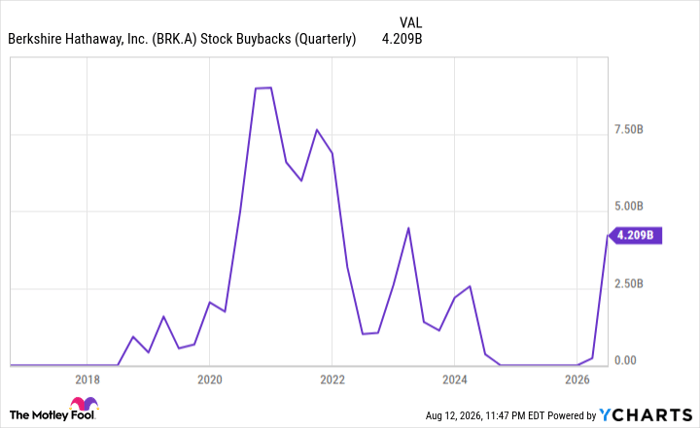
BRK.A Stock Buybacks (Quarterly) data by YCharts
Berkshire can continue repurchasing its own stock at management's discretion as long as the balance of its cash and cash equivalents remains above $30 billion. Since the conglomerate is sitting on a whopping $365 billion in dry powder now, I think Abel will continue returning money to shareholders for the foreseeable future.
Should you buy stock in Berkshire Hathaway right now?
Before you buy stock in Berkshire Hathaway, consider this:
The Motley Fool Stock Advisor analyst team just identified what they believe are the 10 best stocks for investors to buy now… and Berkshire Hathaway wasn’t one of them. The 10 stocks that made the cut could produce monster returns in the coming years.
Consider when Netflix made this list on December 17, 2004... if you invested $1,000 at the time of our recommendation, you’d have $421,511!* Or when Nvidia made this list on April 15, 2005... if you invested $1,000 at the time of our recommendation, you’d have $1,381,960!*
Now, it’s worth noting Stock Advisor’s total average return is 981% — a market-crushing outperformance compared to 216% for the S&P 500. Don't miss the latest top 10 list, available with Stock Advisor, and join an investing community built by individual investors for individual investors.
See the 10 stocks »
*Stock Advisor returns as of August 15, 2026.
American Express is an advertising partner of Motley Fool Money. Anthony Di Pizio has no position in any of the stocks mentioned. The Motley Fool has positions in and recommends Alphabet, American Express, Apple, and Berkshire Hathaway. The Motley Fool has a disclosure policy.
Recommended Articles


