


Not Nvidia. Not AMD. This Chip Stock Will Be the Biggest Winner of the Historic AI Semiconductor Boom
Key Points
TSMC fabricates the chips designed by AMD, Nvidia, and many other companies, which explains why its revenue growth has been impressive this year.
TSMC's solid pricing power should ensure healthy earnings growth, paving the way for a big jump in its stock price.
- 10 stocks we like better than Taiwan Semiconductor Manufacturing ›
The artificial intelligence (AI)-fueled semiconductor boom isn't showing any signs of slowing, as major hyperscalers and pure-play AI companies continue to invest aggressively in infrastructure to meet the tremendous demand for AI services and to fulfill their massive contractual backlogs.
Market research firm Omdia estimates that the global semiconductor industry's revenue could jump by an impressive 94% in 2026. The firm notes that computing and data storage chips will generate just under $1 trillion in revenue this year. Importantly, semiconductor specialist Advanced Micro Devices (NASDAQ: AMD) predicts that the market for high-performance and AI computing chips could reach $2 trillion by 2030.
Missed Nvidia in 2009? This Rare Signal Is Flashing Again. In 2009, a "Double Down" signal flashed for a little-known chipmaker called Nvidia. For the first time in years, that same "Total Conviction" signal is flashing for a company 1/100th the size of Nvidia. Continue »
This is great news for semiconductor stocks such as AMD and Nvidia (NASDAQ: NVDA), which have been enjoying phenomenal growth amid booming demand for AI chips. However, I think that there is a better way to play the AI-driven semiconductor boom by investing in a company that plays an instrumental role in powering AMD and Nvidia's solid growth -- Taiwan Semiconductor Manufacturing (NYSE: TSM).
Let's see why.
Image source: Getty Images.
TSMC is the most important player in the AI chip ecosystem
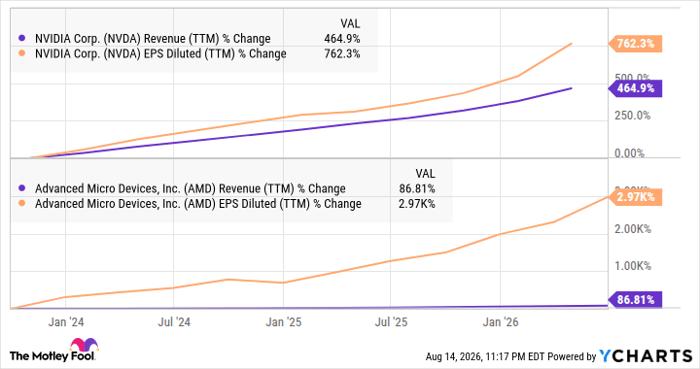
AMD and Nvidia design data center chips such as central processing units (CPUs) and graphics processing units (GPUs). These are deployed in AI data centers and edge applications, such as personal computers and vehicles. Both companies have been experiencing phenomenal growth in revenue and earnings.
Data by YCharts
AMD recently released its second-quarter results, posting a 50% year-over-year increase in revenue to $11.5 billion. Its non-GAAP earnings increased at a much stronger pace of 246% year over year to $1.66 per share. AMD attributed its impressive performance to robust demand for its server CPUs and GPUs, resulting in a 107% year-over-year increase in data center revenue in Q2.
The good news for AMD stock investors is that its solid growth trajectory is here to stay. The company anticipates a 41% year-over-year revenue increase in the current quarter. However, it could exceed that estimate due to the launch of its Helios rack-scale server platform and the introduction of newer, faster AI compute chips.
Nvidia, meanwhile, is poised to release its fiscal 2027 second-quarter results later this month. It expects $91 billion in revenue for fiscal Q2, pointing to a year-over-year increase of 95%. Nvidia can sustain such terrific growth over the long run, given its dominant position in the AI chip ecosystem.
So, it won't be surprising to see these two AI stocks delivering healthy gains to investors over the long run. However, for investors seeking a more comprehensive play in the AI semiconductor space, TSMC appears to be a better bet than AMD or Nvidia. That's because TSMC's foundry business model makes it one of the best ways to capitalize on the AI chip boom.
Fabless chip designers, including AMD and Nvidia, use TSMC's fabrication facilities to manufacture their chips. However, TSMC's scope isn't limited to just these two fabless chipmakers. TSMC also makes chips for Apple, Qualcomm, Broadcom, Amazon, Microsoft, Alphabet, and others. This diversified clientele exposes TSMC not only to growth in AI data center chips but also to the growing demand for AI-capable PCs and smartphones.
Not surprisingly, TSMC's growth rate is getting better. The company's revenue in the first seven months of the year increased by 37% year over year, well above the 31.6% growth it delivered in 2025. The Taiwan-based foundry giant recently released its July revenue report, reporting a 45% year-over-year increase.
This indicates the company is on track to beat its updated 2026 revenue growth guidance of 40%. More importantly, TSMC sees strong AI chip demand persisting over the long run, which explains why the company remains focused on aggressively expanding the output of its advanced chipmaking nodes used by the likes of AMD and Nvidia.
For instance, the output of TSMC's popular 3-nanometer (nm) process node is poised to increase by 20% by the end of 2026, as compared to the first half of the year. Moreover, the demand for the company's 2nm process node is significantly higher than for the 3nm node, which isn't surprising, given the improved performance and reduced power consumption it offers over the 3nm platform.
As a result, TSMC seems well-positioned to maintain its dominant market share of 73% in the foundry market. TSMC is the undisputed leader in this space, with second-placed Samsung holding just 7% of the foundry market, according to Counterpoint Research. This outstanding market share helps TSMC exercise solid pricing power, which explains why the company is reportedly planning to implement a 25% price increase next year for customers looking to purchase additional AI chips.
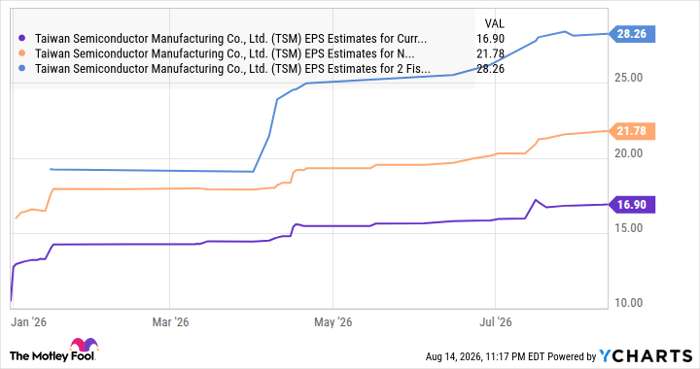
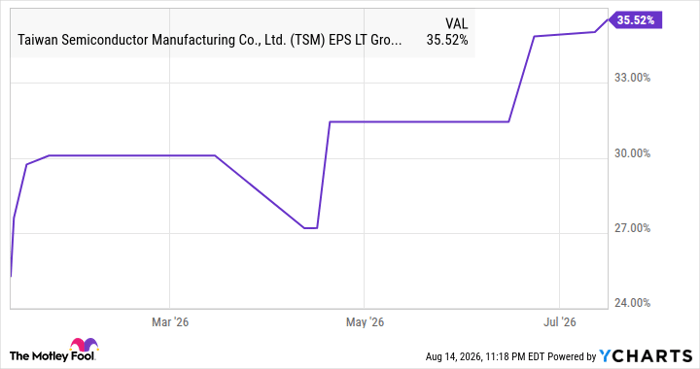
That will be on top of the standard 5%-10% price increase that TSMC plans for its advanced chipmaking services. Not surprisingly, analysts have been becoming more bullish about TSMC's long-term earnings growth prospects in recent months.
Data by YCharts
Stronger earnings growth will send this chip stock soaring
TSMC stock has jumped 76% over the past year. However, it can still be bought at an attractive 25 times forward earnings. For comparison, the iShares Semiconductor ETF, which invests in semiconductor companies, has a price-to-earnings ratio of 67. So, investors are getting a solid deal on TSMC right now, especially given that its bottom-line growth rate is on track to pick up.
Data by YCharts
Even if TSMC trades at an attractive 30 times earnings at the end of 2028 and its earnings per share reach $28.26, the stock could jump to $848. That's nearly double TSMC's stock price right now. Another point worth noting is that TSMC's forward earnings multiple is almost in line with Nvidia's, and the foundry giant is significantly cheaper than AMD, which has a forward earnings multiple of 63.
It won't be surprising to see TSMC commanding a higher multiple in the future, which could set this stock up for bigger gains in the long run as its earnings growth accelerates.
Should you buy stock in Taiwan Semiconductor Manufacturing right now?
Before you buy stock in Taiwan Semiconductor Manufacturing, consider this:
The Motley Fool Stock Advisor analyst team just identified what they believe are the 10 best stocks for investors to buy now… and Taiwan Semiconductor Manufacturing wasn’t one of them. The 10 stocks that made the cut could produce monster returns in the coming years.
Consider when Netflix made this list on December 17, 2004... if you invested $1,000 at the time of our recommendation, you’d have $421,511!* Or when Nvidia made this list on April 15, 2005... if you invested $1,000 at the time of our recommendation, you’d have $1,381,960!*
Now, it’s worth noting Stock Advisor’s total average return is 981% — a market-crushing outperformance compared to 216% for the S&P 500. Don't miss the latest top 10 list, available with Stock Advisor, and join an investing community built by individual investors for individual investors.
See the 10 stocks »
*Stock Advisor returns as of August 15, 2026.
Harsh Chauhan has no position in any of the stocks mentioned. The Motley Fool has positions in and recommends Advanced Micro Devices, Alphabet, Amazon, Apple, Broadcom, Microsoft, Nvidia, Qualcomm, Taiwan Semiconductor Manufacturing, and iShares Trust-iShares Semiconductor ETF. The Motley Fool has a disclosure policy.
Recommended Articles


