


Apple’s AI push puts its privacy premium to the test
Apple has always benefited from a superior market valuation, based on hardware quality, a strong ecosystem, and unwavering customer loyalty. However, in the age of AI, the company faces a more complex challenge in terms of how to maintain its reputation when it comes to the respect for privacy, while its technology becomes more personalized, more integrated into the user’s digital lives and sometimes relies on processes that go beyond the device itself.
The Financial Times summed up Apple’s dilemma in its headline:
“The Apple trust premium in the age of AI.”
This framing is significant since Apple is now appealing to its customers to extend the same trust they have in its devices to a much more information-hungry assistant.
On September 14, Apple launched its newest approximation of “Apple Intelligence”, which includes a beta version of Siri AI in English. The company described the new version as an “entirely new” Siri capable of understanding personal context, having onscreen awareness, and taking more actions across apps.
What Apple is asking users to hand over
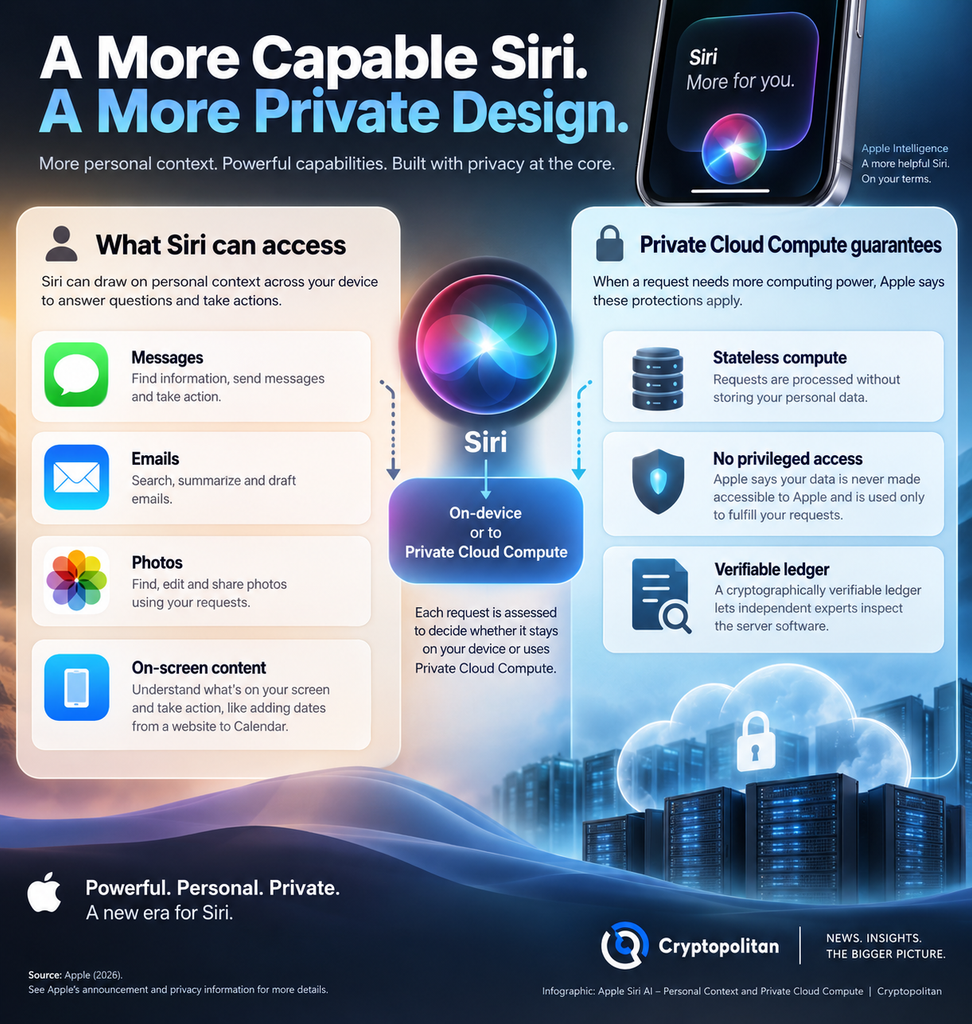
The updated Siri has the ability to make use of personal information throughout a user’s devices as well as what comes up on the screen in order to respond to inquiries and perform actions.
According to Apple’s privacy page, every request is evaluated to determine whether it can be executed using on-device data or it must use Private Cloud Compute (PCC). Apple’s privacy strategy starts with a strong assurance on how requests are dealt with after reaching the company’s servers:
With Private Cloud Compute, your data is never made accessible to Apple — it’s used exclusively to fulfill your requests.
This assurance is crucial for the trust proposition. Apple states that the server software can be examined by independent experts, while private user information and interactions are not employed for training the foundational models unless the users agree.
Such preferences are important since, as per the Improve Siri & Apple Intelligence program, the audio, transcripts, and other relevant information can be kept for up to two years and matched to randomly generated identifiers on the device. Part of the information can be analyzed by humans, but the audio analysis is done just by Apple’s staff members.
In other words, trust is based not only on the Apple architecture but also on default options and user preferences.
The trust story now runs on other companies’ hardware
In June, Apple said in a security update that it was working with Google and NVIDIA to run demanding Apple Intelligence workloads on Google Cloud using NVIDIA GPUs, extending PCC to third-party data centers for the first time. Apple also said its next generation of Apple Foundation Models was built with Google using technology behind Gemini.
According to Apple, PCC safeguards monitor those workloads and binaries remain available for examination by independent parties. Moreover, Apple engages third-party SOC 3 audits of the PCC provisioning system, but its own documentation specifies the following:
The examinations were not conducted to evaluate the performance or integrity of Apple’s artificial intelligence services.
To put it another way, the test measures what kind of controls and provisions the PCC has in place rather than whether Siri’s AI is accurate and trustworthy. This separation determines how the SOC 3 report can be utilized as proof of the quality of Apple’s AI technology.
Why trust is the scarce asset now
The chance for progress can be easily seen and experienced since the use of AI is growing faster than the trust in the technology. A survey carried out in June by Pew Research Center surveyed 5, 119 adults in the US and disclosed that 49% of them had used chatbots at least once, while only 33% confessed to such use back in 2024.
The same survey revealed that 63% of respondents consider the process of developing AI technologies too fast, 71% of them think that AI will make personal information more vulnerable, and 59% lack confidence in local companies’ ability to handle the technology appropriately.
Considering the size of Apple, privacy may transform into a competitive characteristic instead of an additional marketing feature. If customers appreciate proven protective measures, competitors and cloud suppliers will be obliged to combine model features with confidential inference, external audits, and auditable infrastructure.
Apple’s trust proposition is also facing scrutiny in other matters besides AI. Cryptopolitan has reported on the UK’s mediation for access to Apple’s encrypted cloud data. It was reported by Reuters on September 17 that the first directive was dropped after negotiations with the US, but a second directive dated July is applicable to Apple customers based in the UK.
The crypto bridge: verify instead of trust
Crypto was developed based on the same concept: decrease dependence on institutional trust via cryptographically verifiable claims, which is currently being presented in some official research. A working paper by the Bank for International Settlements (BIS), released on September 2, advocated for anchoring the cryptographic fingerprints of public statistics to the XRP ledger, thus offering users a possibility to confirm their origin and integrity.
In addition, the BIS Bulletin published in July evaluated the trade-off between decentralization, security, and scalability and concluded that some responses to blockchain fragmentation could bring back trust and governance dependence.
Apple falls somewhere in between those two extremes. While it continues to ask its users to trust the company, it is now increasingly attempting to make that trust verifiable through the publication of software, encryption, and independent auditing of its systems and processes.
Whether or not this combination actually serves to solidify its premium status may prove to be a critical test for privacy in the face of AI technology.
What should users understand about Apple’s AI privacy model?
The key distinction is between data Apple says it collects, data it processes on-device, and data processed in Private Cloud Compute. Apple’s model is designed to limit direct access to personal information while allowing more demanding AI workloads to use cloud computing.
| Data/privacy point | What Apple says | Why it matters |
|---|---|---|
| Retention | Certain AI-related information may be retained for up to two years | Users should distinguish between processing and longer-term retention |
| Identifier | Some requests use a rotating device-generated identifier rather than an Apple Account | Reduces direct account linkage |
| AI improvement | Users can opt into settings allowing certain interactions to improve services and train models | Privacy depends partly on user settings |
| Private Cloud Compute | More demanding AI processing can occur in Apple’s privacy-focused cloud environment | Cloud AI does not necessarily mean Apple can access the underlying request |
| SOC 3 | Apple publishes independent SOC 3 reports covering specified Private Cloud Compute controls | Provides external assurance, but not a blanket AI-security certification |
| Audit frequency | Apple publishes quarterly SOC 3 reporting for the relevant infrastructure | Gives users and researchers recurring external checks |
Apple’s model shifts the question from simply “Does Apple collect my data?” to “Which data is processed where, for how long, under what identifier, and subject to what external verification?” That distinction becomes increasingly important as AI systems gain access to more personal information and perform more actions on a user’s behalf.
If you're reading this, you’re already ahead. Stay there with our newsletter.
Recommended Articles


