


ASUS and Poesis test autonomous AI agents that research, manage risk and trade
ASUS and Poesis partnered for a week-long experiment in which autonomous AI agents conducted market research, managed risk, and performed real trades. According to the announcement from the two companies, the agents worked on the ASUS ExpertCenter Pro ET900N G3 laptop with the use of NVIDIA tech.
The significance of the experiment lies not only in the fact that another trading bot was developed. The essence of the experiment is that it allows us to glimpse into a new market where AI no longer only offers advice.
Now, we are witnessing agents who can collect data, develop strategies, and conduct trading on an ongoing basis. The 24/7 nature of crypto and its programmable infrastructure makes it the most clear-cut field for the implementation of this change.
An agent that trades, not just advises
ASUS is advocating for running agents locally. The firm points out that AI that runs continuously is not well-suited to a cloud billing arrangement. This is because agents keep generating calls in the background instead of just responding to occasional requests from a human user.
In a blog article, ASUS describes this as “The Token Trap,” where continuous agent activity can lead to unpredictable API bills and run into usage caps imposed by cloud providers.
ASUS uses its Ascent GX10 as an example of the costs: an upfront investment of about $4,000 plus approximately $384 annual electricity costs, compared to the $6,000 to $8,000 in annual API fees for the comparable cloud-based workload.
Even though the GX10 was not the device used in the Poesis test and the testing was conducted using the ExpertCenter Pro ET900N G3, the comparison clearly highlights the premises of ASUS regarding local agent deployment.
However, there is one important caution. The Poesis testing is only a short proof-of-concept test rather than a long-term performance testing, and it was not specifically designed for trading cryptocurrencies.
From predictive models to acting agents
A paper, published in March 2026, describes the evolution of financial AI from rule-based algorithmic trading to machine learning prediction, and now, to agentic finance. Its four-layer model describes the stages of data perception, reasoning, strategy generation, and execution with control. Possible applications include trading, portfolio management, risk monitoring, and decentralized finance.
However, the adoption of financial AI is already underway. According to the Global AI in Financial Services Report compiled by Cambridge Judge Business School based on information from 628 companies located in 151 countries, as many as 52% of companies surveyed have already been experimenting with agentic AI or using it in their operations.
Crypto’s rails are already opening to agents
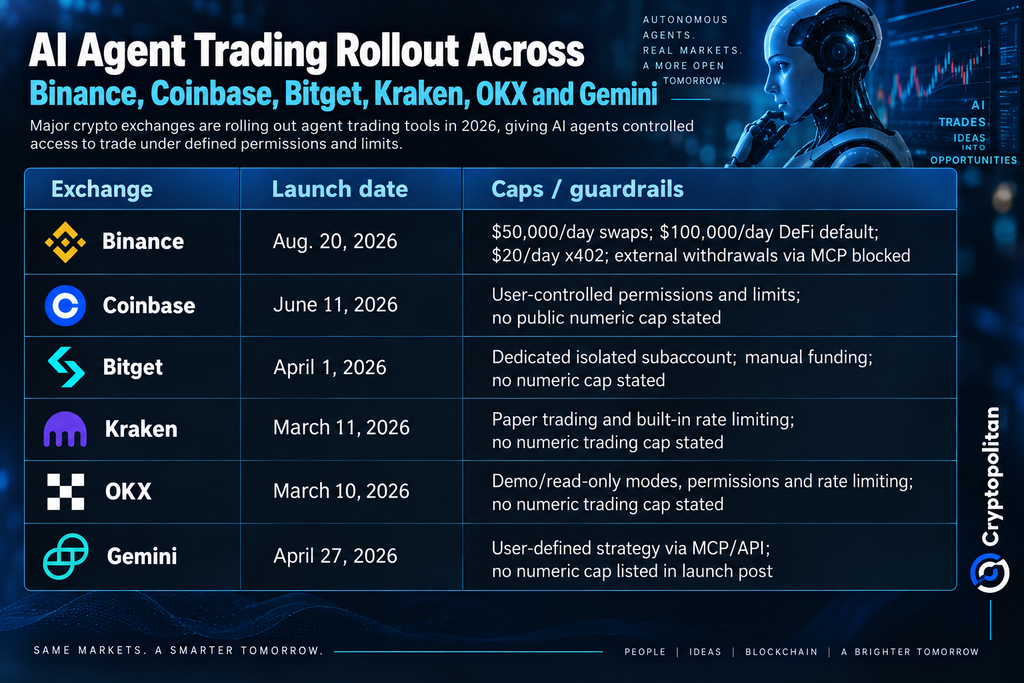
Crypto exchanges have spent 2026 building infrastructure that autonomous traders can use. Binance launched Agent OS on August 20, connecting AI tools to dedicated Agentic subaccounts.
Withdrawals through the integration are blocked, while wallet limits include $50,000 daily for swaps, $100,000 by default for DeFi transactions and $20 for x402 payments.
As Cryptopolitan reported, the wider rollout includes Kraken and OKX in March, Bitget in April, Gemini in April, and Coinbase in June. The common theme is permissioned autonomy: agents can act, but exchanges are putting account separation, permissions, limits, or controlled environments around them.
Where the risks concentrate
The potential upside is broader market coverage, faster execution and deeper electronic trading, part of a wider transformation in capital markets examined by S&P Global.
But autonomous agents could also magnify shared weaknesses. CFA Institute’s Algorithmic Market Hypothesis warns that similar models reacting to similar signals can create crowded, reflexive markets and an “algorithmic monoculture.” The Financial Markets Standards Board likewise stresses that market-facing AI still operates under human supervision and that accountability must remain clear.
Crypto also faces a capacity question. Avalanche Treasury Company CEO Bart Smith told The Block that if agentic activity reaches financial markets at scale, more settlement could move onto blockchains and “there’s not enough block space.”
His comment is a projection, but it captures the infrastructure challenge: if AI agents become a larger class of market participant, markets will need to handle not only more intelligence, but far more machine-driven activity.
The smartest crypto minds already read our newsletter. Want in? Join them.
Recommended Articles


