


Anthropic, OpenAI, and Google have discussed forming a joint AI standards organization
Anthropic, OpenAI, and Google have talked about forming a collaborative industry standards body, according to a report by The Information. This would give the largest frontier laboratories an opportunity to lay down the safety standards against which their own models will be evaluated.
For companies evaluating whether to utilize frontier models for sensitive tasks or not, the introduction of common standards would increase their certainty about adoption. But this same framework might empower the largest players. The OECD has previously warned that high fixed expenses, lack of computing resources, and concentrated infrastructure already make it difficult for companies to enter the AI market. Compliance costs might add yet another hurdle that smaller laboratories have to face.
The proposals already on the table
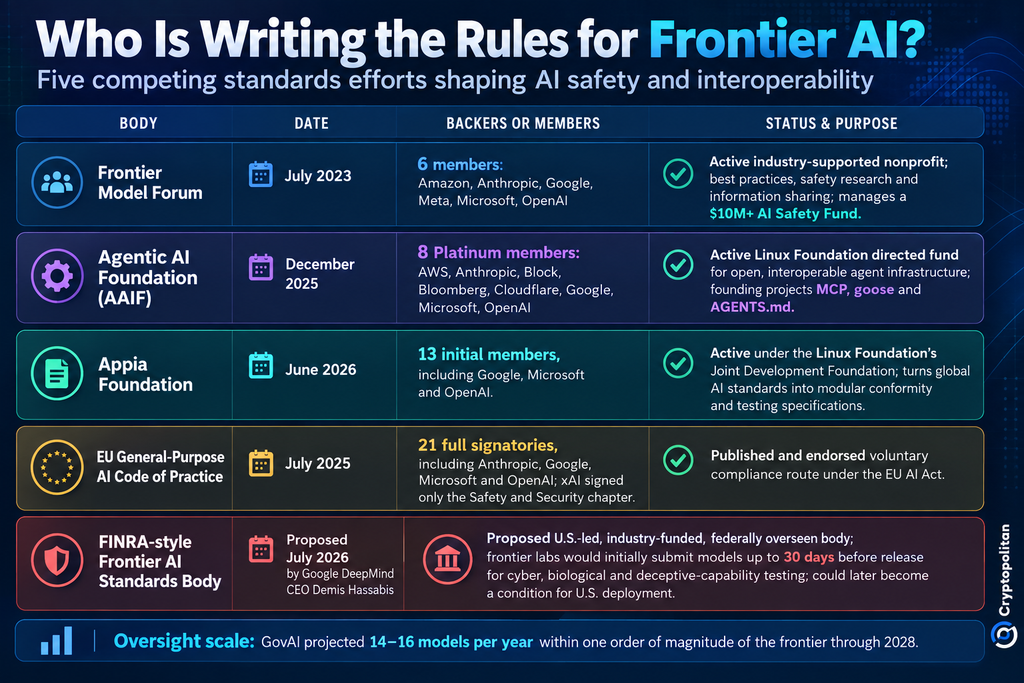
On July 14, Demis Hassabis, the head of Google DeepMind, suggested an initiative for a U.S.-based Frontier AI Standards Body, inspired by the Financial Industry Regulatory Authority (FINRA).
In his proposal, frontier labs would voluntarily submit their advanced technologies for assessment, with an evaluation period of 30 days before their release. The evaluators would assess the safety of the technologies to make sure they do not present any risks, such as cybersecurity, biological threats, or manipulation.
The Council on Foreign Relations (CFR) reported that the White House was already mulling the idea introduced by Hassabis. As per his proposition, it would only be mandatory to pass the evaluation process at a later stage, in order to deploy frontier technologies in the U.S.
In his September article titled “We Must Pace the Frontier,” Dario Amodei, CEO of Anthropic, views the problem from a different angle. Safety efforts need to be given some additional time to catch up with AI capabilities, according to him. The way out for Amodei is to allow independent evaluators like METR to visit frontier laboratories for extended periods of time, which will pave the way for collaboration between major AI businesses from democratic states regarding safety standards.
Why this is not the first attempt
It is important to note that industry-led safety organizations have been around for some time. In fact, in 2023, the Frontier Model Forum came together with six major AI companies as part of the effort to set up an independent safety research program through the AI Safety Fund of over USD 10 million.
The Agentic AI Foundation was created in December 2025 as a part of the Linux Foundation and aims to develop open standards and infrastructure for AI agents. The projects that made the foundation include the Model Context Protocol of Anthropic, the goose of Block, and AGENTS.md of OpenAI.
OpenAI cooperated in the creation of the Appia Foundation, which was established in June 2026 with 13 members. The foundation aims to turn general principles of AI governance into specifications, tests, and proofs of compliance, which would be used across the AI supply chain.
The urge for coordination is also observed beyond industry organizations. As reported by Cryptopolitan, the head of global affairs of OpenAI, Chris Lehane, insisted that the US and China should support the global framework of AI safety, comparing this initiative to international nuclear cooperation.
The moat problem nobody has solved
The key problem is independence. According to the CFR’s analysis, a regulator financed by the sector may encounter conflicts that resemble those seen in the case of the issuer-pays credit-rating system before the financial crisis of 2008, raising a series of unanswered questions with respect to the regulator’s access to frontier models, the expertise of evaluators, national security measures, and the reliability of current methods of testing.
Capacity is another challenge. A projection provided by GovAI is that 14-16 models in the years from 2025 to 2028 could belong to the same order of magnitude as the biggest training run to date, which means that continuous review capacity is required instead of periodical assessments.
Competition is also important. The standards established mainly by the biggest laboratories can become fixed costs, which is easier for the incumbents to sustain compared to startups. If some voluntary framework is turned into a mandatory requirement, it is necessary to introduce some mechanisms that will prevent the safety compliance from functioning as an entry barrier into the market.
Whatever is created has to correlate with Europe. The General-Purpose AI Code of Practice of the European Union, which was introduced in July 2025 to serve as a voluntary way to prove compliance with the AI Act, has already included Anthropic, Google, Microsoft, and OpenAI as signatories. Therefore, any new U.S. or industry-led standards body would have to enter a crowded landscape of governance rather than create one itself.
If you're reading this, you’re already ahead. Stay there with our newsletter.
Recommended Articles


