


What Is XRP? How Will the Clarity Act Impact XRP's Regulatory Status and Future Value?
TradingKey - On September 7, U.S. Senator Cynthia Lummis posted on social media platform X, stating, "If the Clarity Act fails to pass in this Congress, the next real opportunity to reintroduce legislation will not come until 2030." For Ripple (XRP), what does whether the Clarity Act passes actually mean?
What Is XRP?
XRP is the native cryptocurrency of the XRP Ledger (XRPL) blockchain. Promoted and utilized by the fintech company Ripple Labs, its core objective is to provide cross-border payment solutions for global banks and financial institutions.
Compared with traditional cross-border payments, XRP offers numerous advantages, such as eliminating the need for pre-funded capital pools, ultra-fast settlement speed, and extremely low costs, as detailed below:
XRP | Traditional Cross-Border Payments | |
Settlement Time | 3–5 seconds | 1–5 business days, longer over weekends or holidays |
Operating Hours | 24/7/365 | Restricted by bank business hours and national holidays |
Transaction Fees | Extremely low: On-chain fees are negligible, less than 1 cent | High: Approx. $15–$50 per transaction + 1–3% FX spread and intermediary fees |
Pre-Funding Requirements | No pre-funding required: Real-time liquidity conversion via ODL | Extremely high: Requires pre-depositing large amounts of capital in overseas banks |
Transparency and Tracking | Blockchain is open and transparent, with real-time end-to-end confirmation in seconds | Black-box process, progress is difficult to track |
How Will the Passage of the Clarity Act Impact XRP?
The lawsuit between Ripple and the U.S. SEC concluded in a settlement in 2025, with the court establishing that sales of XRP to retail investors on public exchanges do not constitute securities, and both the SEC and CFTC issuing joint guidance treating it as a digital commodity. However, these administrative guidelines and regulatory attitudes could change with political turnover.
If the Clarity Act passes, it will formally codify XRP's status as a digital commodity into federal code, explicitly placing it under the exclusive regulation of the Commodity Futures Trading Commission (CFTC) and providing permanent legal certainty. Specifically, once compliance concerns are completely eliminated, legal barriers for traditional banks, pension funds, and major asset management institutions to connect to the XRPL network will no longer exist, representing a major potential positive driver for the price of XRP.
Conversely, if the bill is delayed or rejected, it means XRP will maintain the status quo, relying on the protection of court precedents from the 2025 Ripple-SEC lawsuit settlement. This could cause wait-and-see sentiment to resurface, leading some traditional institutions with strict compliance requirements to delay adoption, while prolonging approval timelines for XRP's more complex institutional-grade derivatives or dedicated trust products, driving institutional capital to generally prefer Bitcoin (BTC) and Ethereum (ETH). In summary, whether the bill passes is a critical turning point that will determine whether XRP can move from judicial precedent protection to full mainstream financial integration, ultimately deciding XRP's long-term value.
Clarity Act Latest Developments and XRP Price Analysis
The Clarity Act has gone through several key stages: In 2024, its predecessor, the Financial Innovation and Technology for the 21st Century Act, passed the House of Representatives with bipartisan support but stalled in the Senate; in July 2025, the House passed the Clarity Act by a overwhelming vote of 294 to 134; in May 2026, the Senate Banking Committee passed the bill by a vote of 15 to 9; the Senate is currently scheduled to hold a procedural vote on the bill on September 15, but prediction markets such as Polymarket and Kalshi show only about a 16% chance of passage within the year.
In July 2025, XRP surged to $3.6 before continuing to fall, dropping below $1 in mid-to-late August this year, and is currently fluctuating around $1.4. If the Clarity Act fails to make new progress in mid-September or is delayed, XRP will inevitably suffer a pullback, retesting the $1 mark or even falling below it. If the bill passes, XRP's rebound will continue, potentially even initiating a bull market.
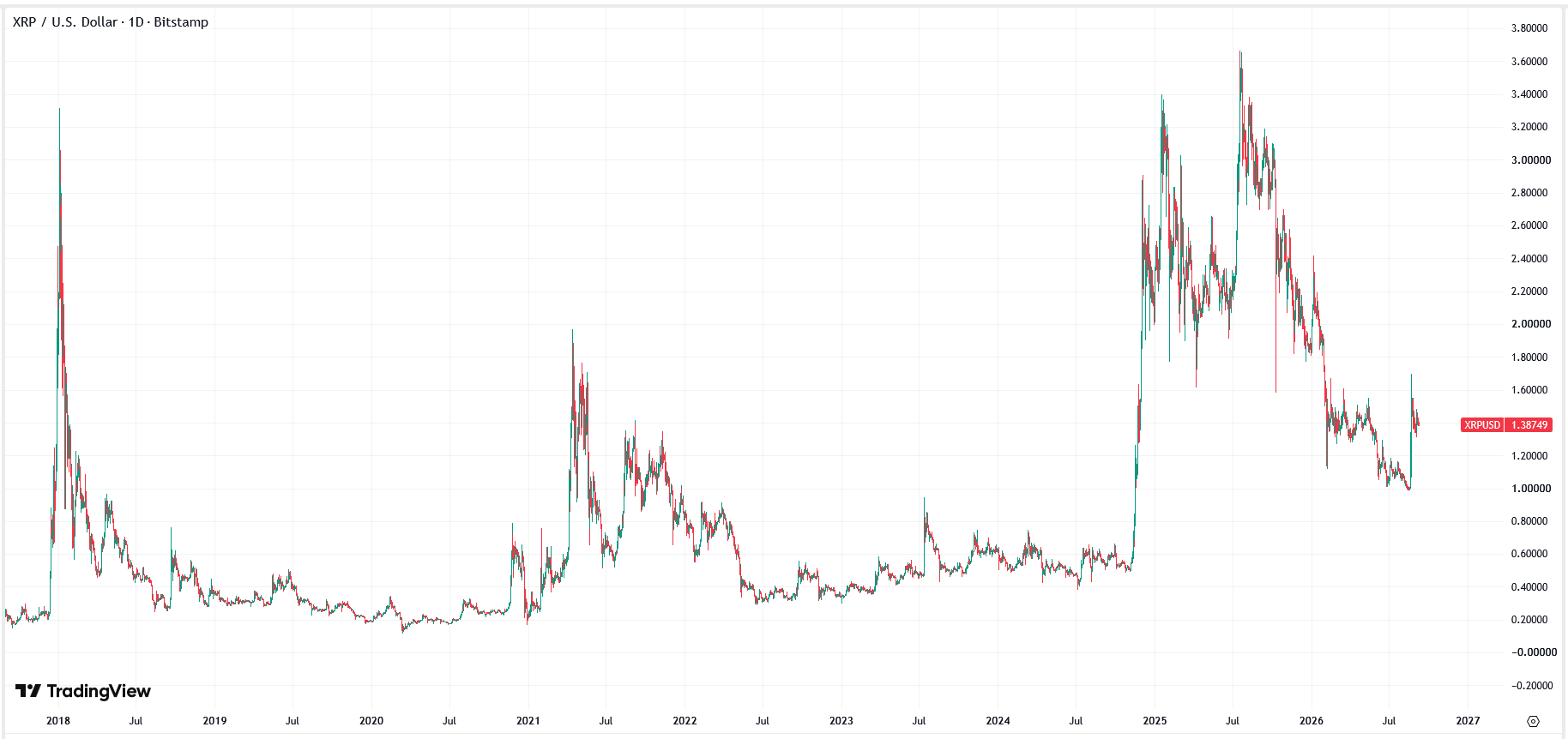 XRP price chart, Source: TradingView
Conclusion
XRP is the native token of the XRPL blockchain, designed primarily for efficient cross-border payments. If the Clarity Act passes, it will officially establish its status as a digital commodity under CFTC regulation, eliminating institutional compliance hurdles and unlocking massive institutional capital; if it is delayed or fails to pass, it will rely on judicial precedent for protection, which could delay institutional adoption and exert downward pressure on its price toward $1.
Recommended Articles


