


Patagonia emerges as AI data centers chase power and land
Given that established data center locations are becoming limited in terms of energy and land availability, Argentina’s Patagonia is now looking more strategic than distant. As noted in Reuters’ investigation on September 7, developers are considering Neuquén and Chubut for large data centers that can use cold climate, hydroelectric power, and wind along with solar and Vaca Muerta gas.
The critical issue now is whether AI computations will prefer to move to regions with an abundance of energy rather than remain concentrated in established emporiums. If Patagonia can convert proposals to functioning assets, there is a chance that Argentina will be able to take advantage of a boom in infrastructure that is increasingly being affected by the availability of electricity and geography.
Why the map is being redrawn
The effect of this pressure on well-established markets is becoming evident. According to CBRE’s Global Data Center Trends 2026, vacancy in Northern Virginia has reached only 0.3%, with the company predicting that availability of power, grid restrictions, and local resistance to construction will change the selection of new sites in major hubs across North America and Europe.
Simultaneously, the Global Data Centre Outlook report by PwC forecasts that total capital expenditure for global AI infrastructure will reach $31.6 trillion by 2050, with annual spending on data centers rising from $800 billion in 2026 to $1.8 trillion in the middle of the century. Considering the emphasis put by PwC, Patagonia is particularly relevant, as it will be power availability that will have the greatest impact on investment location decisions.
McKinsey provides another valuable perspective, distinguishing between supply-advantaged markets and demand-driven markets that have advanced digital ecosystems. Patagonia falls into the first category. The task of Patagonia is not to supplant Northern Virginia, London, or Singapore, rather it should attract those customers with workloads that consume large amount of electricity, who are able and willing to move their data further away from final users if the energy, connectivity, and finance conditions are met.
What Patagonia is actually selling
In Neuquén, Pampa Energía is working on a project at the site of its Loma de la Lata thermal power plant, which will be able to deliver around 500 MW of electricity. Investors are considering constructing a pilot power plant with a capacity of 20–40 MW first, although construction of further electrical infrastructure for the full 500 MW power plant will cost nearly $900 million.
FlexDomes is looking for investors for a $1.4 billion project in Neuquén, which would begin with 120 MW. Further down south is Green Capital, which is looking to build a project in Chubut that starts with 300 MW and can go up to 3,000 MW over time. The company is leasing 501 square miles of land south of Trelew for wind and solar power generation to limit dependence on the national grid.
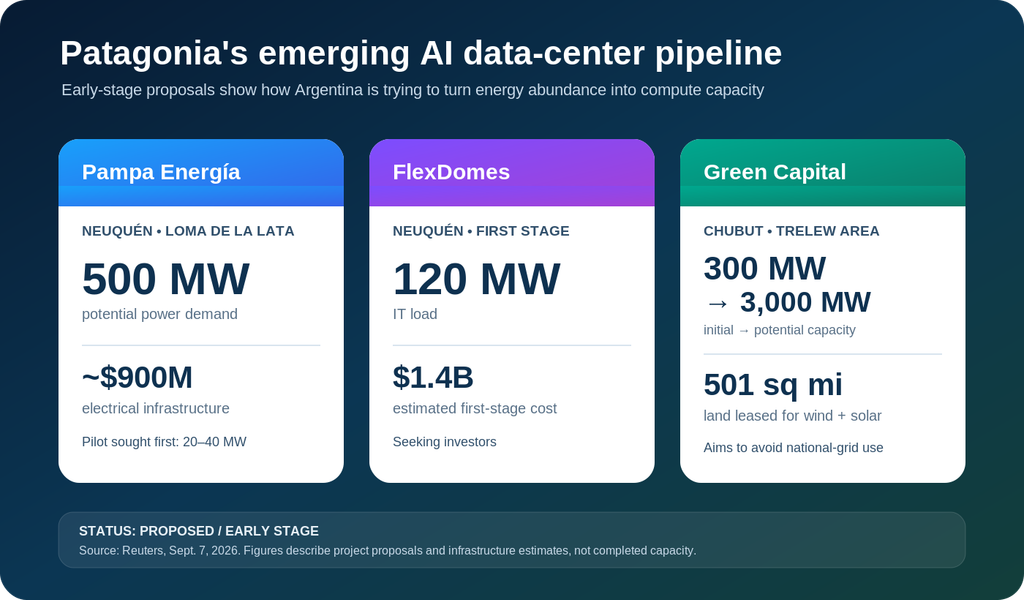
Those figures sound good in theory, but they do represent plans rather than realized capacity. Their real value will come from availability of financing, fiber, transmission, and commitment from customers.
Milei’s incentives and the Stargate anchor
Policies are playing a vital role in Patagonia`s energy pitch. Argentina’s RIGI framework provides incentives and legal stability for big projects while Decree 105/2026 has extended the enrollment window another year from July 8, 2026. The decree includes artificial intelligence in the list of technology activities that are covered by this regime.
Currently, the most important project under discussion is Stargate Argentina. OpenAI and Sur Energy signed a letter of intent in October 2025 to begin working on what would become the first Stargate project in Latin America. The authorities in Argentina estimate that the installation will be capable of producing 500 MW of electricity at an investment of $25 billion. Cryptopolitan covered the news about the proposal when it first appeared.
At that time, it was regarded as the only landmark investment project in the country related to AI technology. The landscape looks somewhat different today as the number of important projects in the data-center sphere sponsored by Pampa Energía, FlexDomes, and Green Capital is increasing, adding to Patagonia’s potential data-center pipeline.
“The Stargate Argentina project represents a historic opportunity for the country,” Sur Energy partner Emiliano Kargieman said, arguing that Argentina could combine renewable-energy potential with AI infrastructure at global scale.
OpenAI CEO Sam Altman said the effort could help Argentina build toward becoming “an AI hub for all of Latin America.”
The gap between announcements and steel
Execution continues to be the hardest part. The Inter-American Development Bank highlights reliable, affordable energy, strong connectivity and a stable regulatory environment as principal components for bringing investments in data centers to Latin America.
Although Patagonia is brimming with energy and has a favorable regulatory environment, its success largely hinges on its connectivity and financing. The decision about whether to go ahead with these projects could set a precedent outside of Argentina: if any part of the pipeline succeeds, it will prove that energy-rich areas, even outside the traditional data center locations, can be an attractive option for big data processing.
If it turns out that the projects fail, it will also teach us an important lesson: cheap energy does not equate to a successful compute hub.
Don’t just read crypto news. Understand it. Subscribe to our newsletter. It's free.
Recommended Articles


