


Nvidia slid 7.7% after hours while AMD and Broadcom rose — the AI trade changed hands, it didn't break

Three numbers from Wednesday's session do most of the work.
173.73 — Nvidia's regular-session close, up 2.87%, ending a two-day slide of roughly 10%.
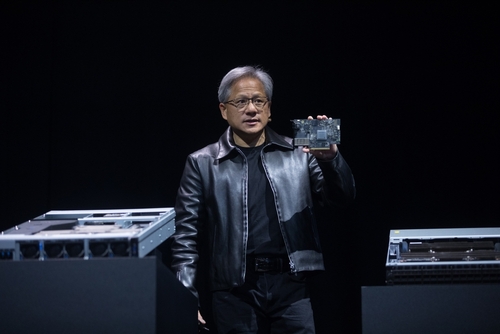
160.40 — where the stock traded after the bell, down 7.7%, after the New York Times and Wall Street Journal reported the board was preparing to decide on chief executive Jensen Huang's future and had retained an outside firm to search for a successor. The after-hours low was 159.44, a decline of 8.1%.
5.7% — the gain in the Philadelphia Semiconductor Index that same session, with all 30 components higher. Micron rose 11.9%. CoreWeave rose 24.7%.
Read those together and the headline writes itself: a single stock was repriced, an entire industry was not.
What actually repriced on Wednesday
The demand number went up
CoreWeave reported third-quarter revenue of $3.66 billion, up 168% year over year, with a smaller-than-expected loss and a raised full-year outlook. That is the demand side of the AI trade printing its best quarter, three days before Nvidia reports.
The tape agreed. SanDisk added 14%, Arm 12%, Micron 11.9%, and the SOX closed green on every component. Nvidia itself closed up 2.87% in the regular session — the selling only began after the governance story crossed the wire.
If investors were marking down AI capital spending, Wednesday's session could not have looked like that.
The signature did not
Nvidia's problem this week is not demand. It is who signs the purchase orders.
The company issued a statement of confidence in its chief executive on 8 November. Three days later, the board was reported to be preparing for a possible transition, with the chief financial officer floated as an interim option. Neither the company nor the executive has confirmed the reports; Nvidia declined to comment.
That gap — between a public endorsement and a reported succession search — is what a governance discount looks like. It is not a discount on earnings. It is a discount on the continuity of the decision chain that converts AI demand into Nvidia's revenue.
Analysts moved quickly and in different directions, which is itself informative. Bernstein cut Nvidia to market perform with a $200 target. Baird moved to neutral. Morningstar kept a $310 fair value. A 55% spread between the low and high anchor prices is not a consensus; it is a market admitting it does not know what the governance risk is worth.
Why AMD and Broadcom are the tell
AMD and Broadcom each rose more than 3% after hours, in the same tape where Nvidia fell 8%.
That is the cleanest available test of the rotation thesis. If the board story were a proxy for an AI-wide de-rating, the beneficiaries of that de-rating would be cash, not Nvidia's competitors. Competitors bid means money stayed inside the semiconductor complex and moved along the risk curve — out of the single name with an unresolved governance question, into the names without one.
The index-level reaction confirms the distinction. Nasdaq 100 futures fell about 1% while S&P 500 futures fell 0.4% — Nvidia's weight is large enough to drag the index, but the drag is concentrated, not broad.
There is a second, slower force doing damage in the background: rates. The 10-year Treasury yield is back at 5.00%, the dollar index hit a fresh yearly high of 102.85, and the market prices an 87% chance of a 25-basis-point hike on 9 December. At that discount rate, a high-multiple name has no room for an unquantified risk. The governance story did not create the vulnerability; it pulled the trigger.
204.54 is the level that falsifies this
Technically, Nvidia is below every major average: the 20-day at 206.18, the 60-day at 217.77, and the 200-day at 204.54. Wednesday's close sat 15% below the 200-day. From the 6 October high of 243.37 to the 10 November low of 165.89, the drawdown is 31.8%.
The 14-day RSI closed at 28.74 — oversold, but oversold inside a downtrend is a description, not a signal.
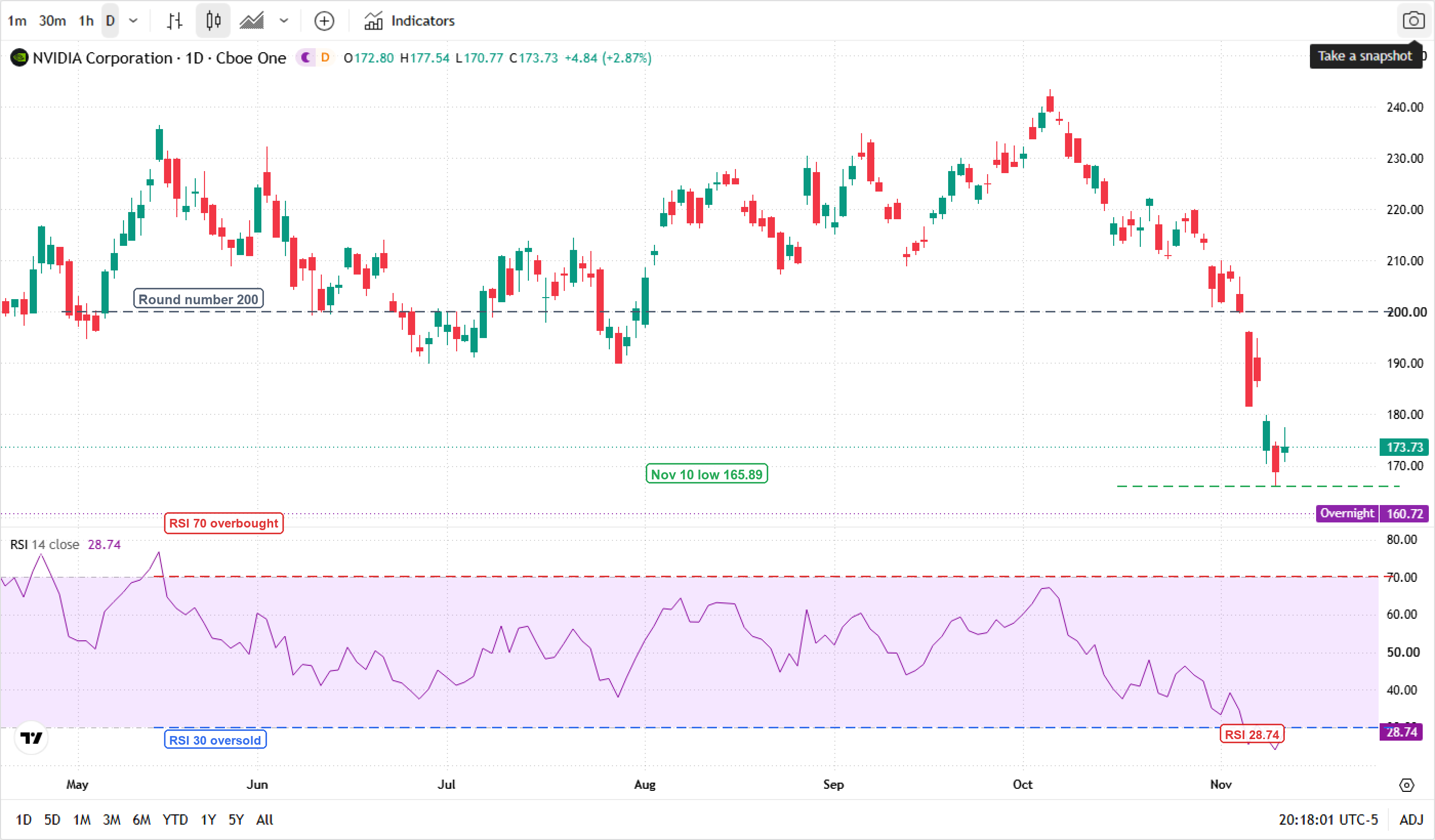
* Chart source: TradingView (NVDA daily)
So here is the falsification condition, stated plainly. This is a rotation, not an AI de-rating — and that interpretation is wrong if AMD and Broadcom give back their Wednesday gains while Nvidia stays pinned below 165.89. In that case the money did not change hands inside the industry; it left, and the whole complex is repricing.
The second condition is the rebound test. A close back above 204.54 would say the governance discount has been absorbed; every bounce that stalls below that line is short covering, not a repair.
Two dates settle it. Nvidia reports third-quarter results on 17 November — the first full print after the board story, where the call matters more than the numbers. And the December FOMC on 9 December decides whether 5% yields are a ceiling or a waypoint.
Read more
* The content presented above, whether from a third party or not, is considered as general advice only. This article should not be construed as containing investment advice, investment recommendations, an offer of or solicitation for any transactions in financial instruments.


