


Nvidia fell 4.3% on a day the Nasdaq rose 2.7% — this is a governance discount, not an AI warning

On November 9 the Philadelphia Semiconductor Index rose 6.85%. The Nasdaq rose 2.74%. Advanced Micro Devices added 13.3%, Broadcom added roughly 8%, and Apple closed at a record $350.69.
Nvidia closed at $178.67, down 4.27%.
That combination is the whole story. When a sector rips 7% and its largest member falls 4%, the market is not repricing the sector. It is repricing one company. And the reason it is repricing one company has nothing to do with chips.
The 2.5x volume is the tell
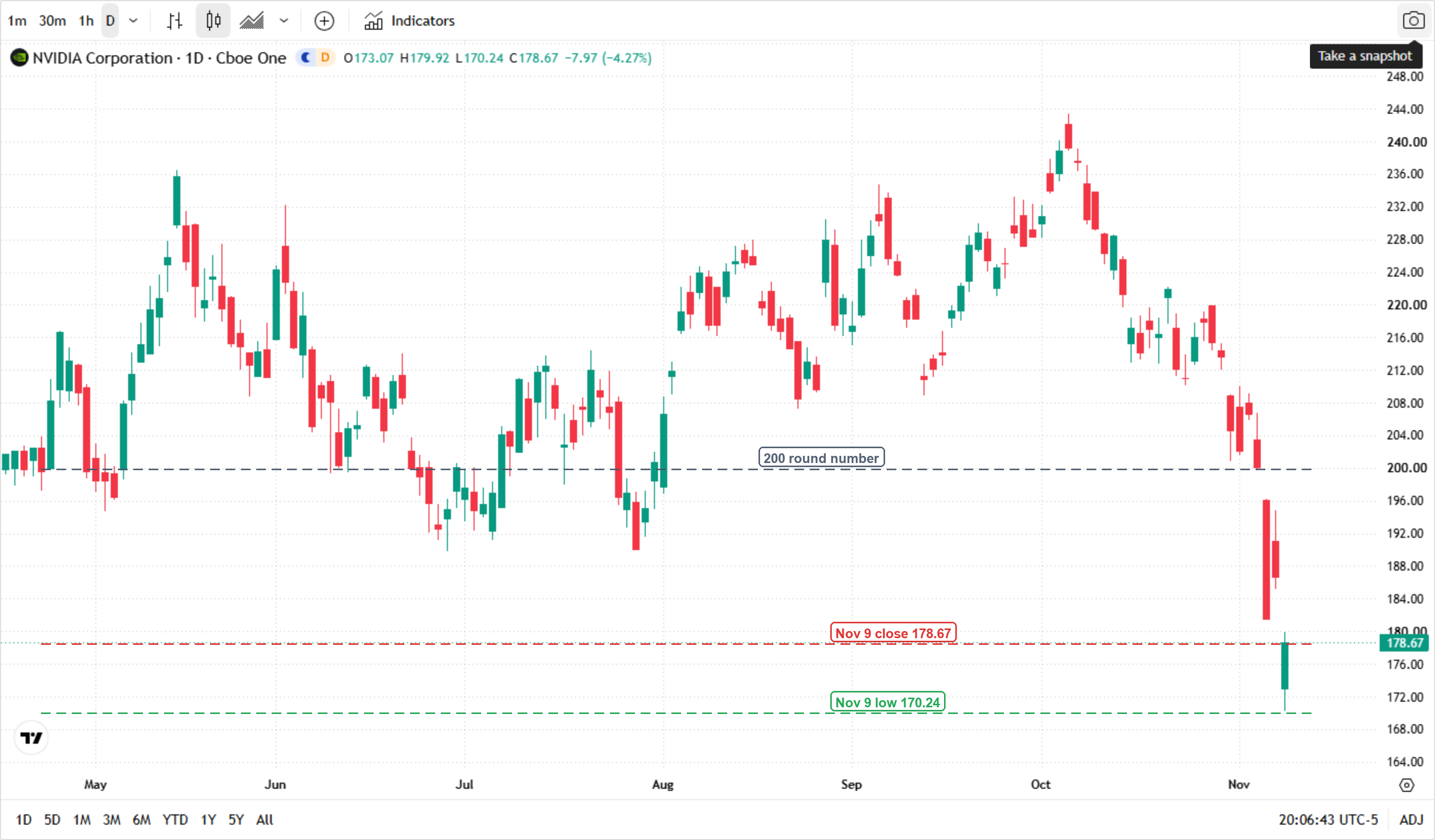
Look at the tape before you look at the headline. Monday's session opened at $173.07, printed a high of $179.92, sold down to $170.24 — an 8.8% drawdown from Friday's close — and recovered to $178.67 by the bell. Roughly 456.8 million shares traded, against 179.7 million the prior session.
That is not drift. That is a forced repricing on information, followed by dip-buying into the close.
Three analysts, one phrase
The information: over the weekend the board opened an independent review, run by a committee of independent directors with outside counsel, after Jensen Huang issued a public statement about his personal life. The company said it has no reason to believe anything material was compromised. Analysts at Citi, Bernstein and Wedbush all landed on the same phrase within hours of each other: key-man risk.
Here is the arithmetic that matters. Nvidia peaked at $239.24 on October 6. Monday's close is 25.3% below that. The stock has given back more than a trillion dollars of market value in five weeks — and it has now dropped behind Apple, roughly $4.5 trillion versus $4.98 trillion.
* Chart source: TradingView (NVDA, daily)
What a governance discount actually prices
A governance discount is not a view on revenue. It is the price the market pays for uncertainty about who is making the decisions, and it shows up in the multiple, not the model.
Three things get repriced at once:
First, the succession premium. Nvidia's valuation has been built on one person's roadmap cadence. There is no publicly designated successor. When a board opens an independent review, the market has to attach a probability to "the roadmap is delivered by someone else" — and it has no way to price that probability precisely, so it discounts the whole multiple.
Second, the regulatory tail. An independent review invites questions from committees that do not normally write about semiconductors. That is a slow-burn cost: legal fees, management attention, and the risk that the November 17 earnings call spends its first ten minutes on governance instead of gross margins.
Third, the index mechanics. Nvidia is a top-two weight in the Nasdaq 100 and the S&P 500. When the largest components de-rate on non-fundamental news, passive flows amplify the move — which is exactly why the stock fell while the index it dominates rose.
What did not change over the weekend
Notice what is not in that list: AI demand. Nothing about data-center orders, HBM supply or capex guidance changed over the weekend. That is the argument for the other side of the trade — the dips were bought into the close, and the recovery from $170.24 to $178.67 happened on the same day as the news.
170.24 and 200: the only two levels that matter now
The November 17 test
The chart has become unusually clean because the news created two reference points.
| Level | What it is | What it decides |
|---|---|---|
| $200.00 | The round number the stock broke on October 30 and could not reclaim | A daily close above it ends the governance-driven downtrend and puts $239.24 back in play |
| $178.67 | Monday's close | The pivot: above it, dip-buyers are in control; below it, the sellers are |
| $170.24 | Monday's low, -28.8% from the October 6 peak | Losing it opens $165.17, the March low and the 52-week floor |
The catalyst is on the calendar: November 17, Q3 earnings. That is five sessions away, and it is the first time management can put numbers in front of the governance story. Guidance on data-center revenue and gross margin will either re-anchor the multiple or confirm that the discount is structural.
One more thing is worth flagging. Monday's rally was not an AI rally — it was a peace-trade rally. Brent crude fell 5.93% to $92.49 and the S&P 500 had its best day in seven months. Nvidia's move was therefore doubly abnormal: it fell on a day when its own sector rose, during a session driven by something that had nothing to do with semiconductors.
The clean way to frame the next two weeks: if Nvidia reclaims $200 before November 17, the market has decided the governance issue is a one-off. If it loses $170.24 first, the market has decided the discount stays until management shows up with numbers.
Read more
Before making any trading decisions, it is important to equip yourself with sufficient fundamental knowledge, have a comprehensive understanding of market trends, be aware of risks and hidden costs, carefully consider investment targets, level of experience, risk appetite, and seek professional advice if necessary.
Furthermore, the content of this article is solely the author's personal opinion and does not necessarily constitute investment advice. The content of this article is for reference purposes only, and readers should not use this article as a basis for any investment decisions.
Investors should not rely on this information as a substitute for independent judgment or make decisions solely based on this information. It does not constitute any trading activity and does not guarantee any profits in trading.
If you have any inquiries regarding the data, information, or content related to Mitrade in this article, please contact us via email: insights@mitrade.com. The Mitrade team will carefully review the content to continue improving the quality of the article.


