


Micron's $4.5 billion Taiwan fab won't make a chip until 2028 — the market sold it as a 2026 problem


Mitrade Insights — Micron closed 17.46% lower at $656.39 on Nov 5, its worst day in years, after Bloomberg reported that construction at its roughly $4.5 billion Fab 11E in Taoyuan, Taiwan, had “all but halted” over a labor dispute. The plant was not scheduled to produce wafers until 2028. That is the detail the sell button skipped: the market sold a 2028 capacity problem as if it were a 2026 demand signal.
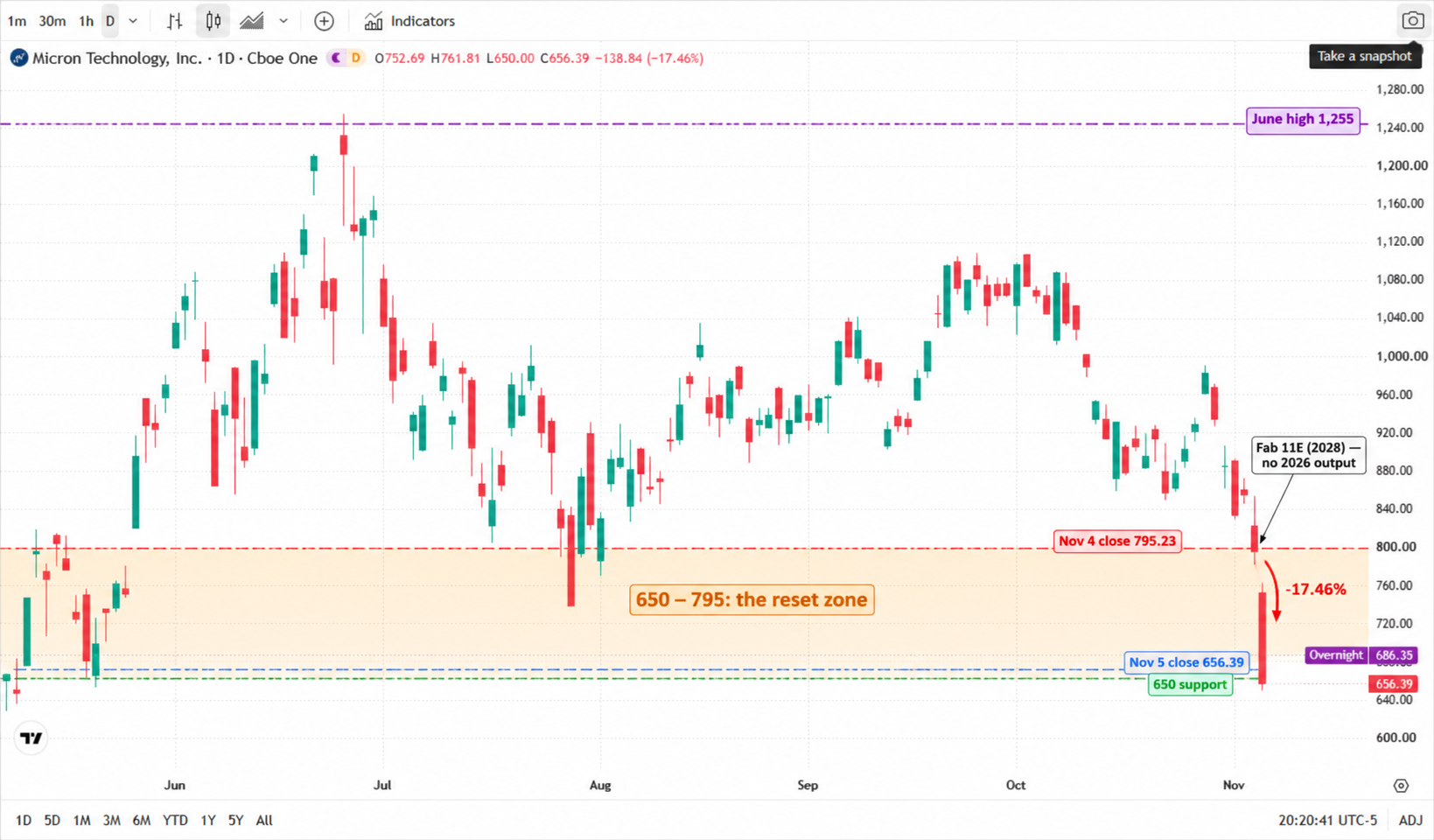
* Chart source: TradingView (NASDAQ:MU, daily).
The fab that wasn't supposed to matter yet
Fab 11E is a $4.5 billion DRAM and HBM plant in Taoyuan, built for ASML tools and originally targeted for 2028. According to the Bloomberg report, construction has been largely suspended because a Taoyuan union representing fewer than 3,000 workers is demanding 15% of Micron's global operating profit in cash, and management fears the October deal with the larger Taichung union could be overturned.
Micron said its Taiwan operations “continue as normal” and declined to confirm the suspension. Reuters said it could not independently verify the report. Neither statement changes the timeline: the fab was not going to contribute a single wafer in 2026.
A labor dispute, not a demand signal
The market did not trade the labor dispute. It traded the possibility that the dispute is a proxy for something larger — a slowdown in AI memory demand. The tape gave plenty of cover for that interpretation: SanDisk fell 22%, Western Digital 17%, Seagate 16%, SK Hynix 9.5%, Samsung 7.5%. The Philadelphia Semiconductor Index dropped 12.25%, its worst session since March 2020.
But the near-term memory data runs the other way. Micron's fiscal Q4 revenue was $54.23 billion, up 31% quarter over quarter. Data-center revenue was $18.0 billion, more than 11 times the year-earlier level. The company said the vast majority of calendar 2027 HBM bit supply is already sold at “significantly higher” prices, and more than 75% of FY2027 output is committed. A paused 2028 fab does not change any of that.
What $656 is actually pricing
At $656.39, Micron trades at roughly 4.1 times the FY2027 EPS consensus of $160.05. That is not a multiple the market pays for a demand collapse; it is a multiple the market pays when it believes the earnings are at a cycle peak and will mean-revert.
| Memory / semiconductor | Nov 5 move |
|---|---|
| Micron (MU) | −17.46% |
| SanDisk (SNDK) | −22% |
| Western Digital (WDC) | −17% |
| Seagate (STX) | −16% |
| SK Hynix | −9.5% |
| Samsung Electronics | −7.5% |
| Philadelphia Semiconductor Index | −12.25% |
That is the real debate. Micron's FY2026 revenue was $133.19 billion, with $86.76 billion of non-GAAP net income and FY EPS of $75.52. The FQ1 2027 guide is $61.5 billion of revenue and $38.15 of adjusted EPS. If those numbers are the peak, 4.1 times earnings is not cheap — it is the market's way of saying the next two years will be lower.
Four times forward earnings, at a cycle peak
The strongest bear argument is not the Taiwan fab. It is Qualcomm. Qualcomm fell 9.5% despite an earnings beat because handset revenue dropped 26% year over year to $5.14 billion. That is an actual end-demand crack, not a construction delay. If handsets are weakening while memory prices are still rising, the memory cycle is being asked to carry the entire AI capex story on its own.
The second bear argument is financing. AI data-center projects are increasingly funded with debt and vendor guarantees; credit spreads for neoclouds have widened, and Nvidia's own commitments have climbed. A higher cost of capital compresses the multiple the market is willing to pay for peak memory earnings, even if the earnings themselves are intact.
$650 is the line between a cycle and a crack
The chart is unusually clean for a 17% day. Micron closed at $795.23 on Nov 4 and gapped down to $656.39 on Nov 5, with an intraday low of $650.00. The $650 line is now the dividing line between two stories.
While MU holds $650, the tape is treating the Taiwan report as a valuation event: the 2028 fab is delayed, but 2026 and 2027 earnings are still supported by sold-out HBM and committed output. A reclaim of $795.23 would confirm that reading and put the June high of $1,255 back in play.
A clean close below $650 would say the market is no longer trading the fab at all. It would be pricing a 2026 demand crack — the Qualcomm handset signal spreading to memory — and the next reference is the May low near $627, then $600.
What would prove the bear case
The bear case needs one of three things: a downward revision to FY2027 EPS consensus, a confirmed cancellation or delay of 2027 HBM orders, or a second consecutive quarter of falling DRAM contract prices. None of those has happened. The next referee is Micron's FQ1 2027 report, tentatively scheduled for Dec 23.
Until then, the market is left with a 2028 fab, a 2026 selloff, and a $650 line that decides which one it is trading.
Read more
* The content presented above, whether from a third party or not, is considered as general advice only. This article should not be construed as containing investment advice, investment recommendations, an offer of or solicitation for any transactions in financial instruments.


