


Gold hit a one-year low while central banks bought 321 tonnes — the sellers were never the ones you think


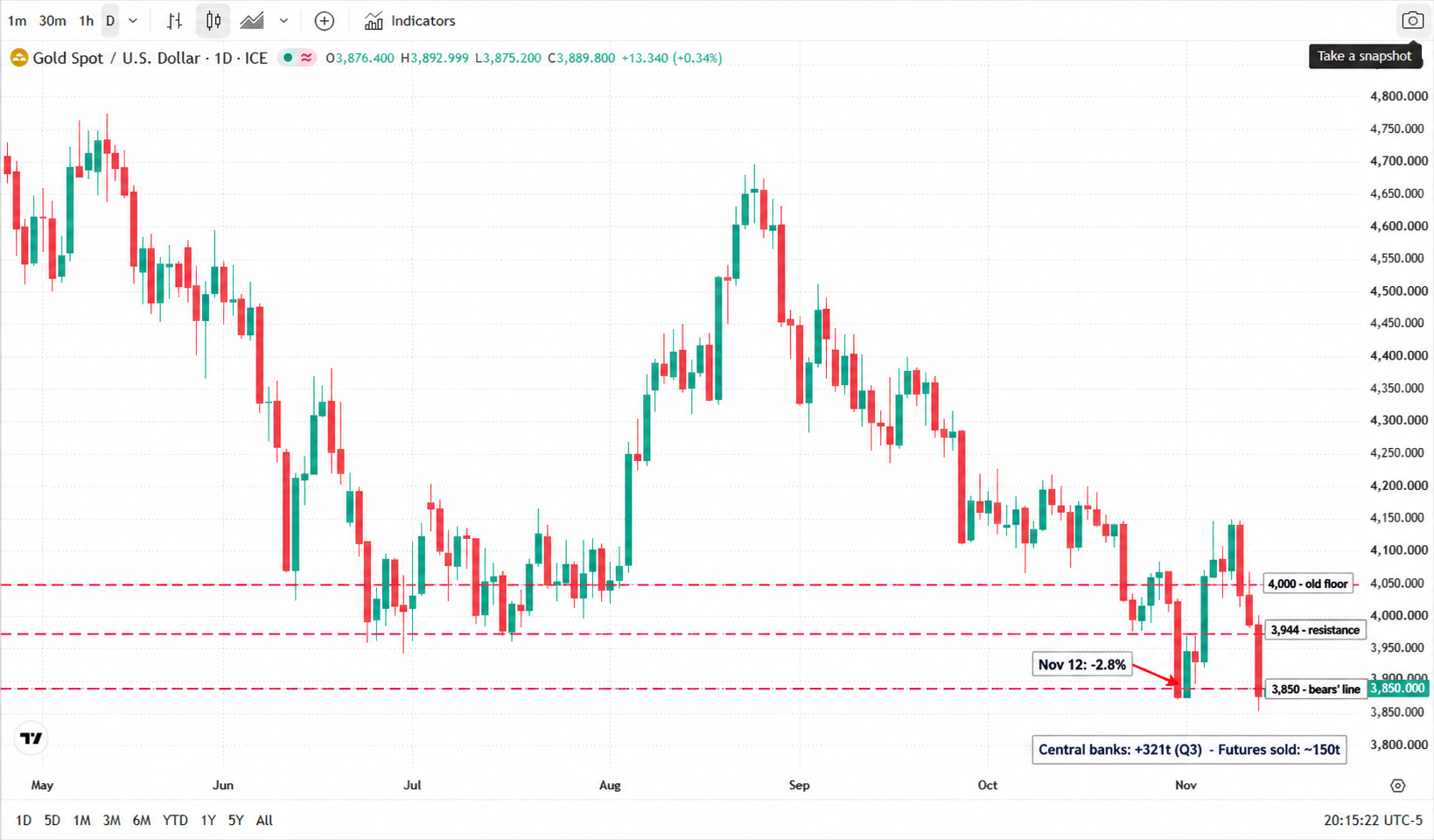
Spot gold closed at $3,876 on Thursday, down 2.8% — its lowest close in more than a year — after touching $3,852 intraday. By Friday's session it was steady around $3,890.
The explanation you will read everywhere is the dollar. The dollar index is at 103.21, a 19-month high. The 10-year Treasury is at 5.10%. December hike odds are near 89%. Higher real yields and a stronger dollar are the textbook bear case for a metal that pays no coupon, and on the surface the fall looks like a clean macro trade.
Then you look at who was on the other side of it, and the story stops being clean.
* Chart source: TradingView (Gold Spot / U.S. Dollar, XAUUSD, 1D, ICE)
The 95% that was not hedge funds
Goldman Sachs' desk estimates roughly $19.5 billion of gold futures were sold between September 22 and early November — about 150 tonnes — and that around 95% of that selling came from "other" and non-reportable categories, not from managed money.
That distinction is the whole story. Managed money is the price-sensitive crowd: it chases momentum, it uses stops, and it will sell into a break. "Other" and non-reportable is where sovereign and corporate treasury activity sits. Those accounts are not trading a chart. When they liquidate, they are converting a liquid reserve asset into dollars for reasons that have nothing to do with gold's 50-day average.
That is also why the move felt one-directional. The CFTC managed-money net long has fallen for nine consecutive weeks to roughly 105,000 ~ 111,000 contracts — about 324 tonnes — the lowest in 21 weeks. But 324 tonnes of managed money did not fall out of a market where the price dropped 30% from its January peak. Something much larger and much less price-sensitive was doing the selling.
Central banks added 321 tonnes and did not stop for the drawdown
The buying side has not moved. Central banks bought 321 tonnes in the third quarter, up 42% year on year, taking the year-to-date total to roughly 675 tonnes — an average of about 85 tonnes a month. The PBoC added 25.8 tonnes in October, its 24th consecutive month of purchases.
Note the timing. Those purchases happened while the price was already falling. A buyer who is allocating reserves is not waiting for a 3,850 print; they are averaging into a strategic position and reporting it a month later. That is the definition of a price-insensitive bid, and it is still there.
The ETF money never left the building
ETF holdings peaked at a record 4,256 tonnes and have come down only at the margin — roughly 6 tonnes a week in late October, with about $662 million of US ETF outflows in that stretch. Against a 4,256-tonne base, that is a trim, not an exit.
There is a second, quieter buyer. Chinese gold ETFs took in roughly RMB 4.25 billion in the fourth quarter through November 10 — buying into weakness, in the same weeks the Western futures market was selling.
The two books that have to balance
The bear case is real and it is mechanical. Every week the 10-year sits near 5%, the opportunity cost of holding gold rises, and every week the dollar makes a new high, the metal gets more expensive for everyone outside the US. The put skew in gold options is at the 85th percentile, which tells you positioning still expects more downside, and Goldman's desk has flagged $3,850 as the next level before a central-bank-supported base.
The bull case is that the selling is a liquidity event, not a valuation event. Sovereign accounts liquidating reserves for dollar funding are, by construction, finite sellers — they sell what they need and stop. Central banks buying 85 tonnes a month are, by construction, price-insensitive buyers. When the first group finishes and the second group is still bidding, the price has to clear higher. Goldman's own 2027 target remains $5,400 even with the near-term call of $3,850.
The two books balance at one number: $3,850. Above it, the central-bank bid is absorbing the liquidation. Below it, the liquidation is outpacing the bid and the 2027 thesis needs a new argument.
The three dates that settle it
13 November — US producer prices. A hot print pushes December hike odds from 89% toward 100% and makes $3,850 the next test.
9 December — the FOMC decision. This is the single largest input into real yields, and therefore into the opportunity cost that has been driving the whole move.
Early January — the next World Gold Council quarterly data. Q4 central-bank purchases will show whether the 85-tonnes-a-month pace held through the drawdown. If it did, the "price-insensitive buyer" argument survives the year.
Read more
* The content presented above, whether from a third party or not, is considered as general advice only. This article should not be construed as containing investment advice, investment recommendations, an offer of or solicitation for any transactions in financial instruments.


