


Could SoundHound AI Be Your Ticket to Becoming a Millionaire by 2035?
Risk-tolerant investors hunting for growth often gravitate toward technology stocks -- and for good reason. These companies are driving some of the world's top social, economic, and cultural changes, after all. That's why so many of these tickers experience great gains (and a select few see outright massive ones). Indeed, the right tech stock can make you a millionaire with just a relatively small investment.
Is SoundHound AI (NASDAQ: SOUN) such a millionaire-making name? Maybe. The stock's 300% price spike since late October certainly suggests at least some investors see big things in its foreseeable future.
Where to invest $1,000 right now? Our analyst team just revealed what they believe are the 10 best stocks to buy right now. See the 10 stocks »
Before you take the same plunge in anticipation of becoming a millionaire within the next 10 years, however, there are a few things you'll want to consider.
SoundHound's (very) cool interactive voice technology
SoundHound is an artificial intelligence (AI) technology company. Its specialty is voice-based solutions, like turning a spoken drive-thru order into a written prep list for the fast-food restaurant staff, or hands-free activation (or deactivation) of an automobile's features. By leveraging the full potential of modern large language model (or LLM) AI, it can even support assistance-minded conversations with users of its tech.
And customers are paying for access to its solutions. Restaurant management software provider Toast has integrated SoundHound's voice ordering technology into its offerings, while hamburger chain White Castle has directly secured access to it as a means of streamlining its drive-thrus. Carmaker Stellantis -- parent to Jeep, Dodge, Chrysler, Fiat, and others -- has utilized SoundHound's in-car solutions in some of its more driver-interactive vehicles. Streaming music platform Pandora (owned by SiriusXM) can now be managed by subscribers' voices thanks to SoundHound AI. All told, this company monetized its technology to the tune of $25 million during the quarter ending in September, up 89% year over year.
There's more growth on the horizon, too. Market research outfit Straits Research believes the global speech recognition industry is poised to grow at an annualized pace of 17% through 2032, jibing with outlooks from Technavio as well as Polaris Market Research.
This business being its sole focus, SoundHound AI is seemingly well-positioned to capture at least its fair share of this growth. This possibility is the top reason at least a small handful of investors are piling in, perhaps in anticipation of riding the stock's coattails to reach the millionaire mark in the relatively near future.
If you're thinking of doing the same, though, know that there's a fairly low likelihood of this stock actually making you a millionaire by 2035 no matter how much capital you commit to it today. In fact, there's arguably more risk than reward.
Overvalued for any time frame
There's no denying this company has significantly raised the bar on the voice-based artificial intelligence front. It's successfully monetizing its technology, too. Indeed, as Wedbush Securities analyst Daniel Ives recently noted, "SoundHound represents an underappreciated pure-play AI company" that's likely to report accelerated growth and new market prospects over the course of 2025.
There are legitimate concerns about its longer-term growth prospects, however. Chief among them is the fact that, while impressive, there's nothing particularly unique about its technology.
Take OpenAI's ChatGPT and Alphabet Google's Gemini as examples. Both are capable of offering text-based AI-generated conversations, and Google has already developed a serviceable speech-to-text tool for some of its offerings. Microsoft's AI assistant, Copilot, can also be voice-based. Tweaking any of these solutions into a tool that's akin to SoundHound AI's wouldn't be a great leap. It's just that these companies have thus far opted not to. Microsoft, Google, and ChatGPT owner OpenAI all certainly enjoy access to deeper developmental pockets though. If and when any of them attempt to step onto SoundHound's turf, they could easily topple the smaller outfit.
This fragility makes the second concern surrounding this stock all the more troubling. That's the stock's valuation. SoundHound AI shares are incredibly expensive. Never even mind the company's current lack of profits.
It's obviously difficult to value any company operating in the red. You own a stock based on where the organization is going rather than where it is, but the future isn't always clear. Investors simply believe SoundHound will be fiscally viable at some point in time even with no real clarity as to when that might be. And maybe it will eventually swing to a profit.
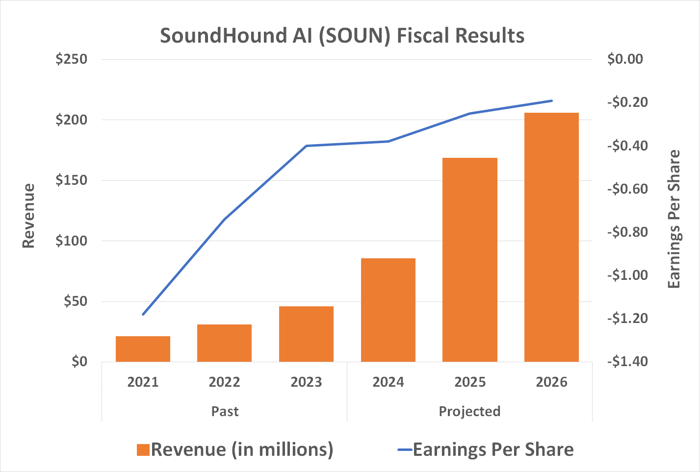
Data source: StockAnalysis.com. Chart by author.
Even by the most forgiving valuation standards, though, at roughly 100 times its trailing-12-month revenue, this stock's still wildly expensive. For the sake of comparison, the S&P 500's current price-to-sales ratio is in the ballpark of 3.1.
Said in more practical terms, SoundHound AI's top line could grow more than 30-fold from here and shares would still be priced in line with its peers where it stands right now.
The stock's really not any more promising in the near term, either. Analysts' current consensus price target of $14.36 is 40% below SoundHound shares' present price. Sure, target prices can and do rise over time. It could be a long time before the analyst community's consensus catches up with the stock's current level, however, if it ever does. The company continues to issue new stock to raise funds in the meantime, diluting existing shareholders. It's not clear when this practice is set to slow down.
Not enough reward to justify the risk, but...
Never say never. SoundHound could make you a millionaire by 2035. It might acquire or develop a new marketable tech with a wider defensive moat than its voice-based AI currently has, for instance.
From an odds-making perspective though, that's a very low-likelihood prospect. There are just too many short-term headwinds already blowing, and too many long-term headwinds waiting in the wings.
Don't sweat it too much if you're looking for millionaire-making stocks, however. They're out there. It's just that SoundHound AI isn't one of them. Check out these tickers if you can stomach the risk required of promising millionaire-making prospects.
Don’t miss this second chance at a potentially lucrative opportunity
Ever feel like you missed the boat in buying the most successful stocks? Then you’ll want to hear this.
On rare occasions, our expert team of analysts issues a “Double Down” stock recommendation for companies that they think are about to pop. If you’re worried you’ve already missed your chance to invest, now is the best time to buy before it’s too late. And the numbers speak for themselves:
- Nvidia: if you invested $1,000 when we doubled down in 2009, you’d have $362,841!*
- Apple: if you invested $1,000 when we doubled down in 2008, you’d have $49,054!*
- Netflix: if you invested $1,000 when we doubled down in 2004, you’d have $498,381!*
Right now, we’re issuing “Double Down” alerts for three incredible companies, and there may not be another chance like this anytime soon.
See 3 “Double Down” stocks »
*Stock Advisor returns as of December 23, 2024
Suzanne Frey, an executive at Alphabet, is a member of The Motley Fool’s board of directors. James Brumley has positions in Alphabet. The Motley Fool has positions in and recommends Alphabet, Microsoft, and Toast. The Motley Fool recommends Stellantis and recommends the following options: long January 2026 $395 calls on Microsoft and short January 2026 $405 calls on Microsoft. The Motley Fool has a disclosure policy.
Recommended Articles


