


Palo Alto Surges 9% on Earnings, $4.5 Billion Applied Compute Deal as Stock Eyes $400 Mark
TradingKey - Sustained growth in cybersecurity demand drove Palo Alto Networks (PANW) to deliver quarterly results that beat market expectations.
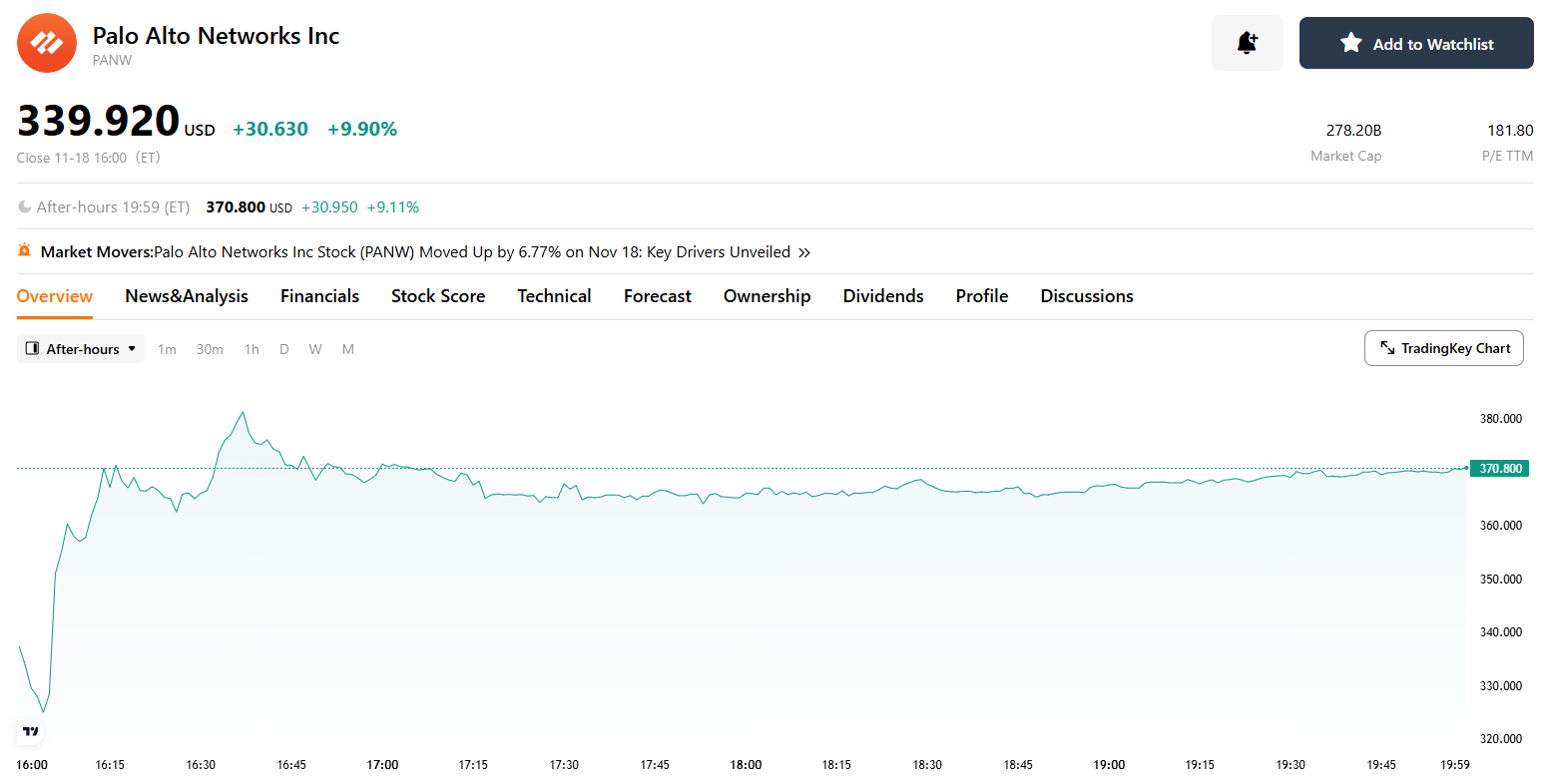
In after-hours U.S. trading on Wednesday, the company's shares jumped over 9%, driving several cybersecurity peers higher as well. An across-the-board earnings beat, an upgraded full-year outlook, and the $4.5 billion acquisition of AI startup Applied Compute collectively bolstered market sentiment.
Source: TradingKey
During the reporting period, Palo Alto Networks' revenue grew 39% year over year to $3.44 billion, topping analysts' estimates of $3.31 billion; adjusted earnings per share came in at $1.05, also beating the market consensus of $0.97. Next-Generation Security annualized recurring revenue increased 66% to $9.73 billion, and remaining performance obligations rose to $21 billion, reflecting continued strong enterprise customer demand for integrated security platforms.
Earnings and cash flow performance were equally solid. The company's adjusted net income for the quarter was $881 million, cash flow from operations reached $1.9 billion, and the adjusted free cash flow margin was 56.2%. Management stated that artificial intelligence is expanding the attack surface faced by enterprises while driving customers to reduce vendor count by consolidating network, cloud, identity, and security operations tools onto a few comprehensive platforms, a trend providing sustained momentum for the company's platformization strategy.
Based on its first-quarter performance and subsequent orders, Palo Alto Networks raised its fiscal 2027 revenue guidance to between $14.52 billion and $14.57 billion, representing projected year-over-year growth of 26% to 27%, with adjusted earnings per share expected to be $4.26 to $4.30. The company also expects second-quarter revenue to reach $3.53 billion to $3.55 billion, with Next-Generation Security annualized recurring revenue poised to top $10.2 billion.
$4.5 Billion Acquisition of Applied Compute
Alongside raising its guidance, Palo Alto announced a $4.5 billion acquisition plan to acquire AI startup Applied Compute in an all-stock transaction, with the deal expected to close in the third quarter of fiscal 2027. Applied Compute primarily provides a post-training and inference platform for open-weight AI models, helping enterprises leverage their own data to adjust, train, and deploy models.
Unlike traditional closed-source models, open-weight models allow users to download and modify model parameters, enabling enterprises to adjust model performance and operational behavior according to their needs, but also introducing additional security risks. For example, models could be maliciously tampered with, training data and sensitive enterprise information could be leaked, or they could be exploited by bad actors. As more enterprises begin deploying self-trained or fine-tuned AI models, controlling security risks while preserving flexibility is becoming a critical challenge for enterprise AI adoption.
Applied Compute's technology portfolio directly addresses this demand. By integrating its model post-training and inference capabilities, Palo Alto aims to help enterprises train, adjust, and run AI models more securely across public cloud and self-deployed environments.
Company CEO Nikesh Arora stated that the transaction represents a further extension of the company's business boundaries beyond traditional cybersecurity, aiming to secure a more prominent position in enterprise AI infrastructure.
Palo Alto Stock Price Technical Analysis
Source: TradingKey
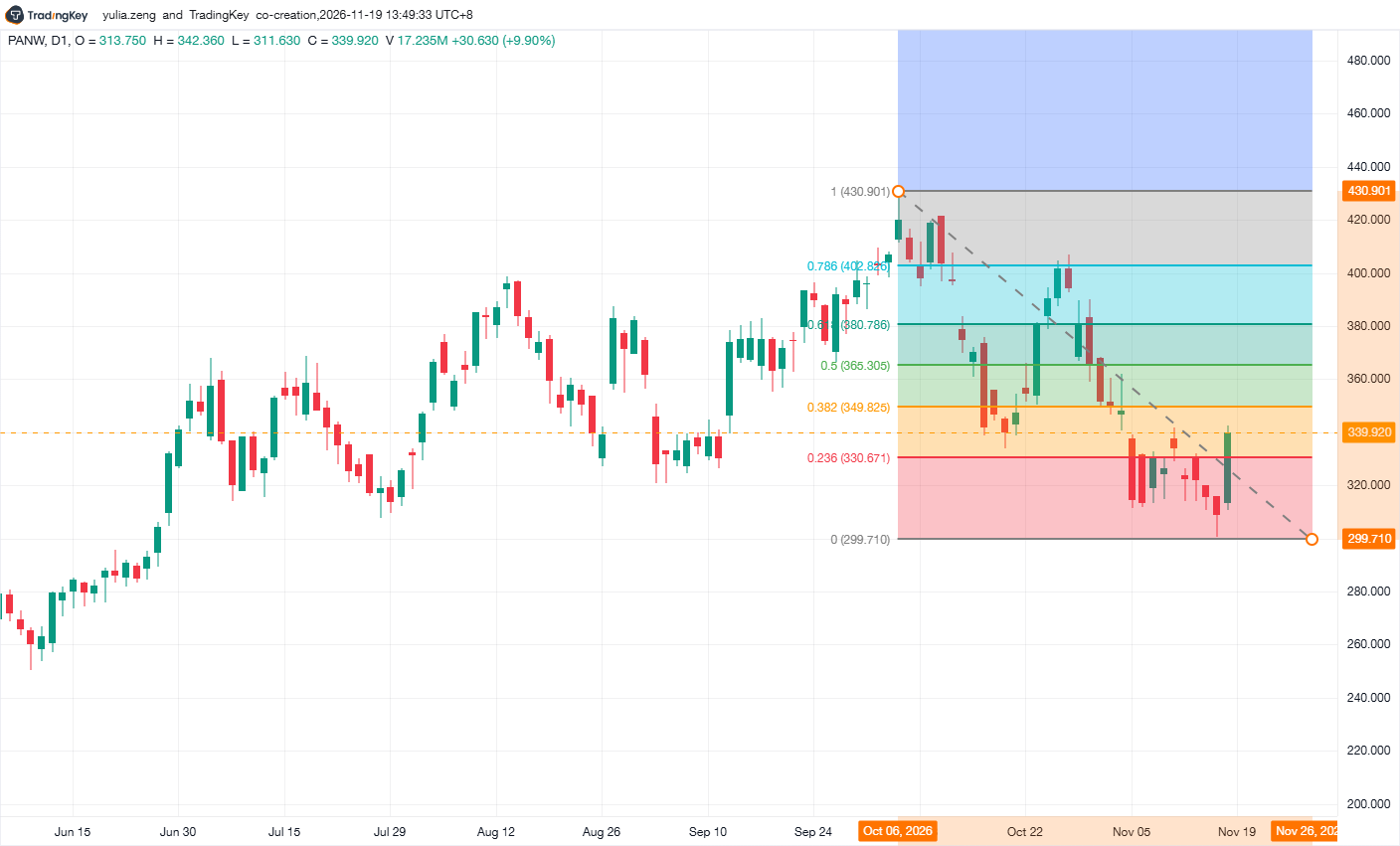
From a technical perspective, Palo Alto shares closed at $339.92 ahead of earnings, up 9.9% on the day, and rose further to around $370.80 in after-hours trading, breaking above the 20-day moving average of $347.45 and reclaiming the 60-day moving average of $363.98. If this breakout is confirmed at the close of the next trading session, it would indicate that the downtrend in place since October is being repaired.
Currently, the area around $368 corresponds to both the 50% Fibonacci retracement level and the 60-day moving average, serving as the key battleground between bulls and bears in the near term. Once the stock stabilizes above this area, the next resistance level is near $382, followed by the $400 to $404 range. An advance from the after-hours price to $400 represents a potential upside of approximately 8.4%. If the stock breaks above $404 on heavier volume, it could retest its previous high of $432.
The RSI has rebounded rapidly from low levels to 47.75 and moved above its signal line at 39.63, indicating a noticeable weakening of bearish momentum, although the indicator has yet to cross the 50 bull-bear threshold. Therefore, whether the stock can hold above $364 to $369 will determine whether this rally marks a trend reversal or merely a short-term, earnings-driven gap rebound.
On the downside, initial support levels to monitor are $364 and $347. If the stock pulls back and breaks below $347, the breakout signal would weaken significantly, potentially prompting another test of $332; if $332 also fails to hold, a retest of the previous low at $301 cannot be ruled out.
Recommended Articles


