


Salesforce Suffers Its Worst Day Since 2024 as AI Fears Hit Software, With $189.50 Next
TradingKey - Salesforce (NYSE: CRM) fell 9.41% to $194.62 on Tuesday, November 17, from $214.83, and overnight trading is nearly unchanged at $195.00. It was the stock's worst day since May 2024, according to Kiplinger, and its lowest close since mid-August, with the shares down about 19% over the past month.
There was no company news behind the drop. Salesforce led a broad software selloff as investors worried about which software companies AI tools could displace, with Anthropic's IPO set to start trading on Thursday, November 19.
The Software Selloff Spread Across the Market
Other software stocks fell with it, as ServiceNow and Intuit each dropped more than 6%, and every sector of the S&P 500 finished lower, according to Reuters. The Dow dropped about 860 points, or 1.64%, with Salesforce among its biggest decliners, and the S&P 500 and Nasdaq posted their first four-day losing streak since September.
The worry is about how software is sold. Salesforce charges many customers per user, so if AI agents can do work that people now do with its tools, companies might need fewer licenses. That fear has grown as AI developers, including Anthropic and OpenAI, push tools that handle more complex business tasks. Anthropic prices its IPO on Wednesday, November 18, which has put that debate in front of investors this week.
Salesforce's Own Numbers Tell a Different Story
Weak results did not cause the selloff. In its fiscal second quarter, which ended July 31, revenue rose 11% to $11.3 billion, including $456 million from Informatica, a data management company Salesforce bought. Subscription and support revenue grew 12% to $10.8 billion. Non-GAAP EPS, which excludes items such as stock-based pay and acquisition costs, rose 103% to $5.90, and free cash flow, the cash left after running the business and paying for new equipment, rose 81% to $1.1 billion.
Salesforce's own AI products are growing fast. Annual recurring revenue, or ARR, the yearly value of subscriptions, for Agentforce and Data 360 reached nearly $3.9 billion, up more than 210%, and Agentforce ARR alone topped $1.5 billion, up more than 240%. Current remaining performance obligation, or cRPO, contracted revenue Salesforce expects to book over the next 12 months, rose 14% to $33.5 billion. CEO Marc Benioff called it "one of our best quarters ever, outperforming across every key metric."
So the stock fell even though nothing in the business has visibly weakened. Investors are not reacting to current results. They are pricing the risk that AI changes the way companies pay for software over the next few years.
Guidance and Buybacks Support the Stock
Salesforce raised its fiscal 2027 revenue guidance by $200 million to $46.1 billion to $46.4 billion, up 11% to 12%, including slightly more than 3 points from Informatica. It expects non-GAAP EPS of $16.67 to $16.71 and a non-GAAP operating margin of 34.3%. For the third quarter, it guided revenue to $11.42 billion to $11.50 billion, including slightly more than 4 points from Informatica, so growth without the acquisition is closer to 7% to 8%, by my calculation. It expects cRPO growth of about 14%.
The company is also buying back stock aggressively. It is carrying out a $25 billion accelerated share repurchase, where it buys a large block of shares upfront, with 103 million shares delivered initially. In August, it said final settlement was expected in October 2026. At $194.62, Salesforce trades at about 11.7 times the midpoint of its full-year non-GAAP EPS guidance, a low multiple for a profitable software company growing revenue at double digits.
The next test comes on Wednesday, December 2, when Salesforce reports fiscal third-quarter results after the close. Investors will watch Agentforce ARR, cRPO growth and any comments on moving from per-user pricing toward usage-based pricing as AI agents spread.
Salesforce Technical Analysis: Daily Close Below $189.50 Could Open $174.41
That shift in sentiment shows clearly on the daily chart. The stock has broken out of the triangle pattern, two converging trendlines, that held it since July. The drop also took out $213.72 support and both moving averages, which track the average price over recent sessions, at $217.98 and $225.27. Sellers are clearly in control, with lower highs under a falling trendline from the September peak, a line drawn across those lower highs. An earnings marker on the chart points to more volatility ahead of the December 2 report.
RSI, a momentum gauge that runs from 0 to 100, has dropped to about 26, in oversold territory, below the 30 level where selling is often seen as stretched. The MACD, another momentum indicator, keeps sliding, so selling may be stretched, but there is no sign of a reversal yet.
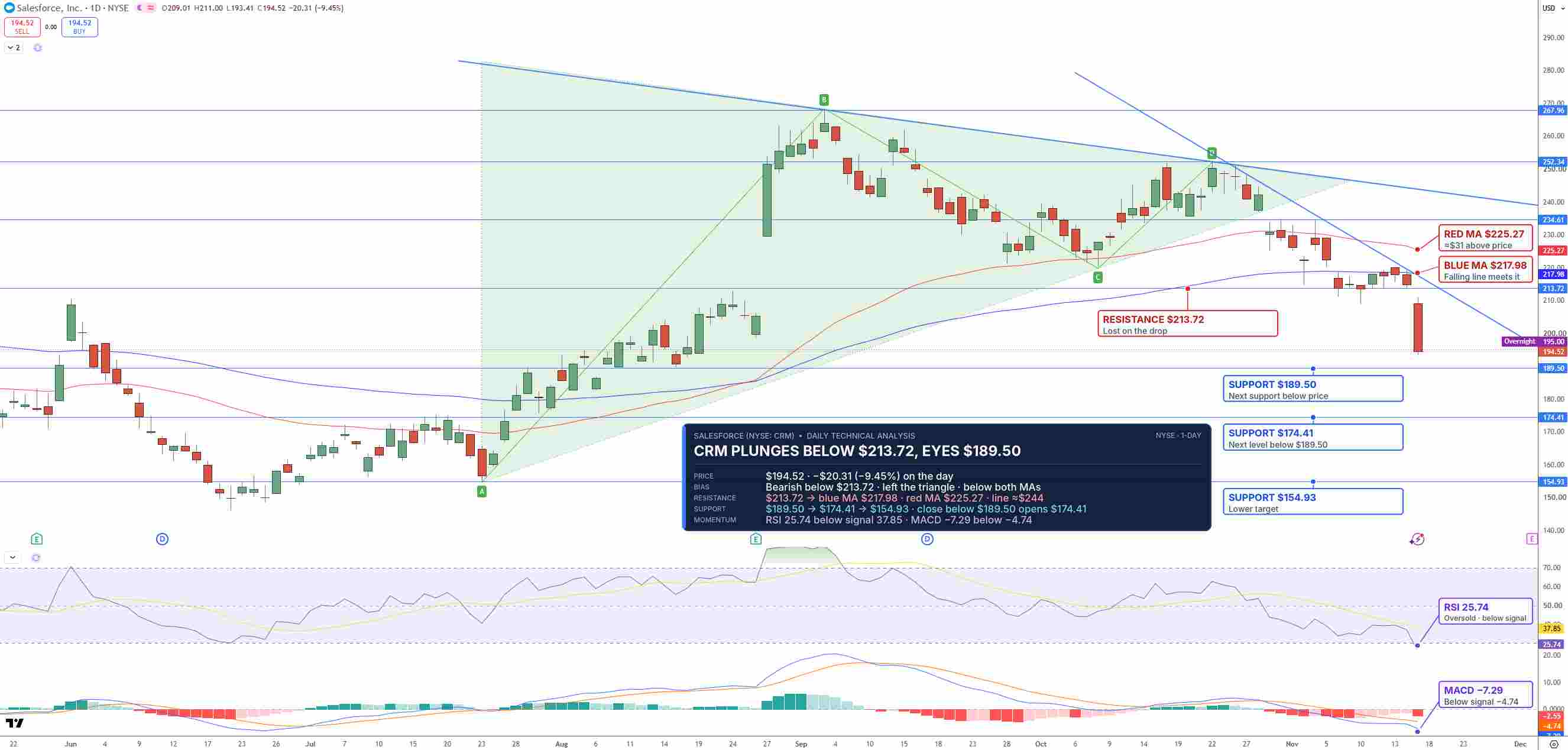
CRM Price Chart - Source: Tradingview
On the downside, $189.50 is the next key support. A daily close below it could send the stock toward $174.41, followed by $154.93. For buyers, reclaiming $213.72 would be the first sign of relief.
I'm bearish while Salesforce stays below $213.72, though oversold conditions could spark a short bounce.
Key Levels
- Last close: $194.62, down 9.41% on Tuesday, November 17 (overnight: $195.00)
- Support: $189.50, $174.41, $154.93
- Resistance: $213.72, $217.98, $225.27
- RSI: 25.74
- Bullish trigger: Daily close above $213.72
- Bearish trigger: Daily close below $189.50
FAQs
Why did Salesforce stock fall 9%?
Salesforce fell 9.41% on November 17 without any company news, as investors sold software stocks on fears that AI agents could reduce demand for per-user software licenses, with Anthropic's IPO due to start trading on November 19.
What is the Salesforce stock forecast now?
The bias is bearish while CRM stays below $213.72. A daily close below $189.50 could send the stock toward $174.41 and $154.93, while reclaiming $213.72 would be the first sign of relief, and oversold conditions could spark a short bounce.
Bottom Line
Salesforce's results and AI growth have not weakened, but the market is pricing a long-term threat to how software is sold. The level that matters is $189.50. In my view, a daily close below it would extend the selloff toward $174.41, while a move back above $213.72 would show the fear has gone too far.
Recommended Articles


