


SpaceX Now Trades Like an AI Stock. Here’s What That Means for Your Portfolio
Key Points
SpaceX's AI segment generated $7.6 billion in third-quarter revenue, more than Starlink.
AI also accounted for about 84% of SpaceX's capital spending in the quarter.
Investors who bought SpaceX for its space business or for Starlink need to understand where the company’s revenue comes from.
- Motley Fool Issues Rare "Total Conviction" Buy Alert ›
When many investors think of SpaceX (NASDAQ:SPCX), they think of reusable rockets and Starlink satellite internet. And to be fair, both of those are impressive businesses. But SpaceX's third-quarter results show the company's main revenue driver isn't either of these.
SpaceX's Super Intelligence segment (formerly xAI), which includes the Grok AI models, the cloud computing business, and the Cursor coding company, produced $7.6 billion in revenue in the third quarter. That's more than half of the company's total, and for comparison, Starlink produced $5.2 billion.
Missed AI’s "Act 1"? Act 2 Could Be 15x Bigger. Most investors think they missed the AI boat because they didn't buy Nvidia in 2005. But according to our analysts, we’re only at the end of "Act 1"—the R&D phase. "Act 2" is the global rollout. Continue »
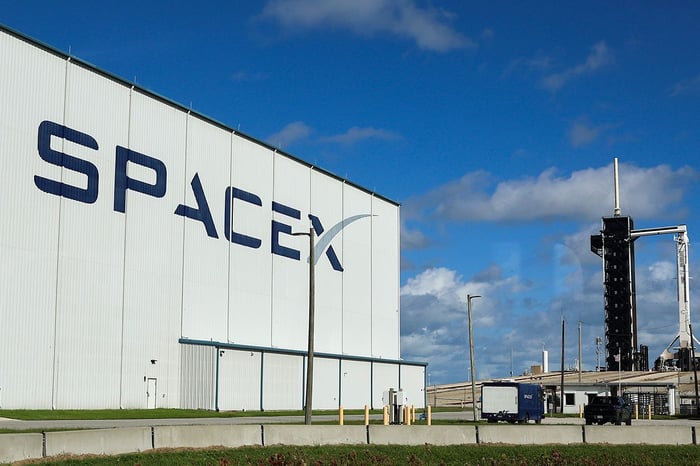
Image source: Getty Images.
How SpaceX's business has evolved
Until recently, AI was a rather small part of SpaceX's business, and that's even true after the company merged with xAI earlier this year. In the third quarter, the AI business's revenue grew by 830% year-over-year and nearly tripled sequentially. It isn't just acquisition-driven either. The Cursor acquisition contributed $608 million, which is certainly significant, but this also means that more than 90% of AI revenue came from non-acquisition streams.
As you might expect, SpaceX is investing heavily in its AI business. The company's total capital expenditures totaled $19.6 billion in the third quarter, with 84% allocated to building its AI compute capacity.
Why is SpaceX becoming an AI-focused business?
The short answer is that SpaceX is investing heavily in AI because management believes the returns will be worth the cost. On its second-quarter earnings call, the company said that new computing capacity was paying for itself in less than a year and that it expects to have 2 GW of capacity running by the end of 2026 (1.7 GW at the end of the third quarter). And the AI segment is already highly profitable on an adjusted EBITDA basis.
What does it mean for investors?
The key point for SpaceX investors (and those considering becoming investors) is that the stock is likely to behave more like an AI infrastructure company than a rocket launch or satellite internet business. If AI spending slows or AI stocks fall out of favor with investors, SpaceX could take a hit.
From a portfolio management standpoint, it's important to consider how much AI exposure you have through chipmakers, hyperscalers, AI infrastructure companies, and other AI plays, since SpaceX adds to that exposure.
To be clear, I'm not saying that the focus on AI makes SpaceX a bad investment. Far from it. But it's important for investors to know exactly what every stock in their portfolio is. SpaceX is now an AI company with a fast-growing satellite company and a rocket company attached.
Should you buy stock in Space Exploration Technologies right now?
Before you buy stock in Space Exploration Technologies, consider this:
The Motley Fool Stock Advisor analyst team just identified what they believe are the 10 best stocks for investors to buy now… and Space Exploration Technologies wasn’t one of them. The 10 stocks that made the cut could produce monster returns in the coming years.
Consider when Netflix made this list on December 17, 2004... if you invested $1,000 at the time of our recommendation, you’d have $355,124!* Or when Nvidia made this list on April 15, 2005... if you invested $1,000 at the time of our recommendation, you’d have $1,296,254!*
Now, it’s worth noting Stock Advisor’s total average return is 901% — a market-crushing outperformance compared to 210% for the S&P 500. Don't miss the latest top 10 list, available with Stock Advisor, and join an investing community built by individual investors for individual investors.
See the 10 stocks »
*Stock Advisor returns as of October 26, 2026.
Matt Frankel, CFP® has no position in any of the stocks mentioned. The Motley Fool has no position in any of the stocks mentioned. The Motley Fool has a disclosure policy.
Recommended Articles


