


Intel and TSMC Are Vying for Chip Fabrication Supremacy. 1 Offers Superior Value.
Key Points
Taiwan Semiconductor is delivering solid results.
But the market loves Intel's turnaround story more.
TSMC's stock is far cheaper than Intel's.
- 10 stocks we like better than Taiwan Semiconductor Manufacturing ›
Taiwan Semiconductor Manufacturing (TSMC) (NYSE: TSM) and Intel (NASDAQ: INTC) are two major names in the chip fabrication world. However, Taiwan Semiconductor has a monster lead that cannot be overstated. Intel used to be a major player, but because it let its technology slip, clients gradually moved their business to other foundries, namely TSMC.
However, with recent investments from Nvidia and the U.S. government, Intel's chip foundry business looks to be back in action. There is a major market shift that could happen over the next few years, but which stock is best positioned to capitalize on it? Let's take a look.
Missed AI’s "Act 1"? Act 2 Could Be 15x Bigger. Most investors think they missed the AI boat because they didn't buy Nvidia in 2005. But according to our analysts, we’re only at the end of "Act 1"—the R&D phase. "Act 2" is the global rollout. Continue »
Image source: Getty Images.
Intel is seeing strong growth
Intel splits its business into two parts: Intel Foundry and Intel Products. Intel products include the devices that it makes, like CPUs, and it is split into two divisions: Client Computing and the Physical AI Group, and Data Center and AI. This is not what's coming against TSMC, but it is doing pretty good growth figures, with revenue rising 28% year over year to $15.1 billion. Still, it's good to know in the context of Intel as a whole, as an investment in Intel also acquires these segments, not just its foundry business.
Intel's foundry business has steadily improved and generated revenue of $5.8 billion, up 31% year over year. So, it's a lot smaller of a business unit than its products. However, if Intel's foundry business can continue acquiring clients, this could be the start of a major growth trend.
However, it's much smaller in size than TSMC. TSMC is only a foundry company, so it should only be compared to that division from Intel. In Q3, its revenue totaled $46.7 billion, up 41% year over year. We're still waiting on Intel's Q3 results, so if we rewind the clock to Q2, TSMC grew at a 34% year over year pace to $40.2 billion.
So, if Q2 results are used, TSMC and Intel are about on the same level in terms of growth, although TSMC has a notable size advantage.
But there is one glaring difference that investors cannot miss: profitability. Right now, Intel is fighting to get its foundry business back to profitability. In Q2, its operating margin was a pretty sad 36% loss. On the flip side, TSMC's operating profit margin was 59%.
So, Intel's Foundry business is currently a major loss leader for the company, while TSMC has achieved an incredible level. I think this is something notable to keep in mind, as it helps put the valuation of the two in context.
Intel looks incredibly expensive right now
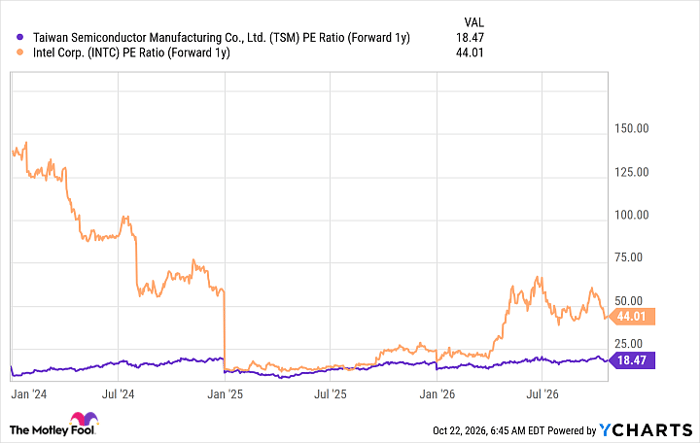
The most commonly used metric investors use to value stock is the price-to-earnings (P/E) ratio. While it works in some situations, it's terrible for Intel because its foundry business is deeply unprofitable right now. However, if we shift the focus from now to next year, Intel's profitability is expected to improve, which brings its P/E ratio into a more comparable range.
TSM PE Ratio (Forward 1y) data by YCharts
If 2027's earnings estimates are used, Intel trades at 44 times future earnings while TSMC is only at 18. That's a huge price mismatch, and points to TSMC providing superior value versus Intel. The reality is that Intel's stock has done very well in 2026. However, its turnaround is far from complete, even if the market has already declared it a winner.
While I'm rooting for an Intel turnaround, I don't need to invest in its stock. Instead, picking Taiwan Semiconductor makes far more sense, as it is reasonably priced and is already where Intel is trying to go.
Should you buy stock in Taiwan Semiconductor Manufacturing right now?
Before you buy stock in Taiwan Semiconductor Manufacturing, consider this:
The Motley Fool Stock Advisor analyst team just identified what they believe are the 10 best stocks for investors to buy now… and Taiwan Semiconductor Manufacturing wasn’t one of them. The 10 stocks that made the cut could produce monster returns in the coming years.
Consider when Netflix made this list on December 17, 2004... if you invested $1,000 at the time of our recommendation, you’d have $355,124!* Or when Nvidia made this list on April 15, 2005... if you invested $1,000 at the time of our recommendation, you’d have $1,296,254!*
Now, it’s worth noting Stock Advisor’s total average return is 901% — a market-crushing outperformance compared to 210% for the S&P 500. Don't miss the latest top 10 list, available with Stock Advisor, and join an investing community built by individual investors for individual investors.
See the 10 stocks »
*Stock Advisor returns as of October 26, 2026.
Keithen Drury has positions in Nvidia and Taiwan Semiconductor Manufacturing. The Motley Fool has positions in and recommends Intel, Nvidia, and Taiwan Semiconductor Manufacturing. The Motley Fool has a disclosure policy.
Recommended Articles


