


Is It Too Late to Invest in the Stock Market? History Offers a Crystal Clear Answer.
Key Points
The stock market is still riding a multiyear bull market.
However, there are concerns about the macro environment, valuations, and the future of artificial intelligence.
This could leave investors questioning whether to invest in the broader market right now.
- 10 stocks we like better than S&P 500 Index ›
With the broader benchmark S&P 500 (SNPINDEX: ^GSPC) index regularly hitting all-time highs over the past several years, it's easy to wonder if it's too late to invest in the stock market.
After all, the market is being fueled by what some call a once-in-a-lifetime artificial intelligence (AI) supercycle, and many market strategists, analysts, and pundits think it is due for a pullback.
Missed Nvidia in 2009? This Rare Signal Is Flashing Again. In 2009, a "Double Down" signal flashed for a little-known chipmaker called Nvidia. For the first time in years, that same "Total Conviction" signal is flashing for a company 1/100th the size of Nvidia. Continue »
Can you still invest in the stock market? History offers a crystal clear answer.

Image source: Getty Images.
The doomers could be right in the near term
People and investors of all kinds should understand that those calling for a market pullback or a significant sell-off may very well be right.
After all, the jury is still out on AI's true capabilities, and some of the world's largest companies are betting hundreds of billions that AI will disrupt every facet of society. But if this turns out not to be true, or if all the spending does not yield adequate returns, there could certainly be a strong sell-off.
The thing about market corrections, in which the market falls at least 10% from a recent high, is that they are more common than one might think. A report from Charles Schwab last year found that there have been 27 market corrections since 1974, suggesting there is likely to be one every other year.
Now, only six of these corrections turned into a full-blown bear market in which the market falls at least 20% from a recent peak, but that still means investors should expect a bear market at least once a decade.
Corrections and bear markets are actually considered healthy over the long term. They help remove froth from the market and are essential to holding bad actors accountable.
Good news for long-term investors
The Schwab study also found that bear markets, on average, last 409 days, or about 13 months, and can have an average market loss of 36%. Yes, that's a painful drawdown, and yes, it will not be fun when it's happening.
The good news is that long-term investors who rode out these bear markets have generated attractive returns. Just look at the S&P 500's performance since the turn of the century.
In these 26 years, there have been four bear markets: the dot-com bubble, the Great Recession, the COVID-19 pandemic, and, in 2022, when the Federal Reserve embarked on an aggressive interest rate-hiking campaign.
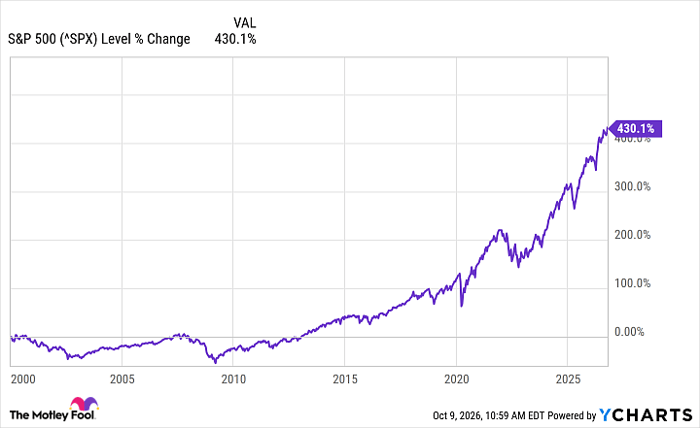
^SPX data by YCharts.
Even when you consider the intense inflation over the past two decades, those with significant stock holdings have done well. Looking back even further, since the S&P 500's inception in 1957, the index's average annual return has been about 10%. Over the past 40 years, it's been even better at 11.5%.
In fact, the broader market has performed so well that it serves as a benchmark for most professional money managers, those considered some of the top stock pickers in the world with decades of experience.
Even for the high fees that institutional funds like hedge funds charge, consistently beating the market is by no means a given.
So, is it too late to invest in the stock market? History is crystal clear that it is not too late. But the key for investors is to invest on a long-term horizon, meaning you plan to hold your stocks or index funds for at least five years. This will help smooth out market volatility.
A 2020 Schroders study found that investors who bought the S&P 500 and only held it for a month lost money 40% of the time in inflation-adjusted terms. However, the longer you hold, the better your odds get.
Over a five-year horizon, that number falls to 20%. Over a 10-year horizon, the number is closer to 10%, and over 20 years, there is almost no chance of losing money in inflation-adjusted terms.
A good strategy, especially now when there is tremendous uncertainty, is to practice dollar-cost averaging in which you invest a set amount of money every month, which helps smooth out your cost basis over time.
Should you buy stock in S&P 500 Index right now?
Before you buy stock in S&P 500 Index, consider this:
The Motley Fool Stock Advisor analyst team just identified what they believe are the 10 best stocks for investors to buy now… and S&P 500 Index wasn’t one of them. The 10 stocks that made the cut could produce monster returns in the coming years.
Consider when Netflix made this list on December 17, 2004... if you invested $1,000 at the time of our recommendation, you’d have $380,795!* Or when Nvidia made this list on April 15, 2005... if you invested $1,000 at the time of our recommendation, you’d have $1,390,634!*
Now, it’s worth noting Stock Advisor’s total average return is 946% — a market-crushing outperformance compared to 215% for the S&P 500. Don't miss the latest top 10 list, available with Stock Advisor, and join an investing community built by individual investors for individual investors.
See the 10 stocks »
*Stock Advisor returns as of October 14, 2026.
Charles Schwab is an advertising partner of Motley Fool Money. Bram Berkowitz has no position in any of the stocks mentioned. The Motley Fool recommends Charles Schwab and recommends the following options: short September 2026 $95 calls on Charles Schwab. The Motley Fool has a disclosure policy.
Recommended Articles


